Facts
On December 31, 2012, at approximately 8:00 PM, a head-on collision occurred between two motorcycles near Gayatri Hospital, involving the respondent and the injured party, Ramesh Kumar Markandey (P.W.3)
Source reference: para. 2, 10The State alleged the respondent was driving in a rash and negligent manner while under the influence of alcohol
Source reference: para. 2, 10Following an investigation, the respondent was charged under Sections 279 and 338 of the IPC, and Sections 3/181 and 146/196 of the Motor Vehicles Act
Source reference: para. 1On May 23, 2014, the Judicial Magistrate First Class (JMFC), Raipur, acquitted the respondent of all charges
Source reference: para. 1, 5The State preferred this acquittal appeal, contending that the trial court's findings were perverse and ignored the testimony of the injured witness
Source reference: para. 6Issues
1. Whether the trial court committed a manifest error or reached a perverse finding in acquitting the respondent despite the testimony of the injured witness
Source reference: para. 62. Whether the prosecution established the identity of the accused and the elements of rash and negligent driving beyond a reasonable doubt
Source reference: para. 11, 123. What is the scope of interference by an appellate court in an appeal against acquittal under Section 378 of the Cr.P.C.
Source reference: para. 9Law Applied
The court primarily applied Section 378(1) of the Cr.P.C. regarding appeals against acquittal
Source reference: para. 1It relied on the principle established in Jafarudheen and others v. State of Kerala (2022), which held that an appellate court must be "relatively slow" in reversing an acquittal because the presumption of innocence is strengthened by the trial court's judgment, and interference is only warranted upon thorough scrutiny of accepted legal parameters
Source reference: para. 9Substantively, the court considered Sections 279 and 338 of the IPC regarding rash and negligent driving and causing grievous hurt, alongside Sections 3, 146, 181, and 196 of the Motor Vehicles Act
Source reference: para. 1Reasoning
The Court observed that the prosecution’s case rested almost entirely on the testimony of the injured witness, P.W.3
Source reference: para. 10However, the Court found P.W.3’s claim that the respondent was intoxicated unreliable, as this detail was absent from his initial police statement and examination-in-chief
Source reference: para. 11Furthermore, P.W.2 (the complainant) admitted in cross-examination that he did not witness the accident and could not identify the accused
Source reference: para. 10Other witnesses (P.W.4, 5, and 7) provided hearsay testimony based solely on instructions from the injured party
Source reference: para. 10The Court noted a lack of conclusive evidence to determine which party's fault caused the head-on collision in the middle of the road, especially given that P.W.3 was also being prosecuted for the same accident
Source reference: para. 7, 11Applying the Jafarudheen standard, the Court determined that the trial court’s view was a "possible one" and that the prosecution failed to bridge the gap between "may be true" and "must be true"
Source reference: para. 9, 12, 13Holding
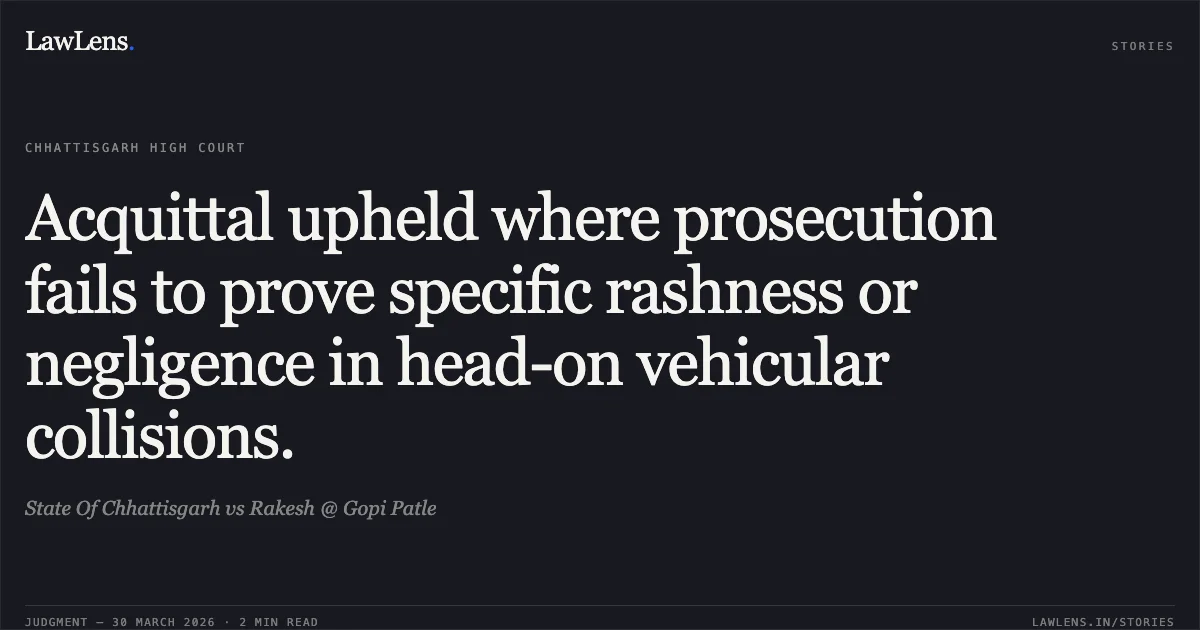
The High Court dismissed the acquittal appeal and upheld the judgment of the JMFC, Raipur
The Court held that the prosecution failed to prove beyond a reasonable doubt that the respondent caused the accident through rash and negligent driving
Source reference: para. 12It concluded that the trial court's appreciation of evidence was just and proper, and in the absence of perversity or illegality, the double presumption of innocence in favor of the accused could not be disturbed
Source reference: para. 13Acts & Sections Cited
7 provisions across 2 statutes referred to in this judgment. Each provision opens on LawLens.
Indian Penal Code, 18603
Motor Vehicles Act, 19884
Original Court PDF
State Of ChhattisgarhvsRakesh @ Gopi Patle
Click to open original judgment
Original judgment, available to read, download and summarize on LawLens.in


![Subsequent exoneration does not retrospectively invalidate a finalized promotion select list.. UNNIKRISHNAN M vs M/o Environment And Forests. CAT - ['Ernakulam']. LawLens](/stories/thumbnails/subsequent-exoneration-does-not-retrospectively-invalidate-a-finalized-promotion-select-li-ce80a0e84f2f4887857271e8b4341c42.webp)