Facts
The State of Madhya Pradesh filed an appeal against the judgment dated May 26, 2015, passed by the Special Judge, SC/ST (Prevention of Atrocities) Act, Anuppur, which acquitted the respondent, Shrikant Shukla, of charges under Sections 450, 376(2)(g), and 506(Part-2) of the IPC and Section 3(2)(5) of the SC/ST Act.
Source reference: para. 1The prosecution's case was that the main accused, Bhagwandeen (who died prior to the filing of the charge sheet), forcefully entered the victim's house and committed sexual assault.
Source reference: para. 2However, the victim’s initial written complaint (Ex.P/1) and the FIR (Ex.P/2) named two other individuals, Anil Brahman and Pooran Singh Gond, as the perpetrators.
Source reference: paras. 3-4During the trial, the victim (PW-1) admitted she had not seen the respondent, Shrikant Shukla, at the scene of the crime.
Source reference: para. 4Issues
1. Whether the trial court’s finding of acquittal was perverse or illegal given the testimony provided by the victim.
Source reference: para. 22. Whether the prosecution established the respondent’s guilt beyond a reasonable doubt in light of contradictory statements and admissions by the victim.
Source reference: paras. 5-6Law Applied
The court emphasized that the prosecution must prove the guilt of the accused beyond all reasonable doubt.
Source reference: para. 6Relying on State of Gujarat v. Jayrajbhai Punjabhai Varu (2016), the court held that if two views are possible, the one favorable to the accused must be adopted.
Source reference: para. 6It further cited Nikhil Chandra Mondal v. State of W.B. (2023), stating that suspicion, no matter how strong, cannot replace proof.
Source reference: para. 6Finally, the court applied the principles summarized in Mallappa & others v. State of Karnataka (2024), which restrict appellate interference in acquittals unless the trial court's view is legally implausible, perverse, or suffers from an error of law or fact.
Source reference: para. 7Reasoning
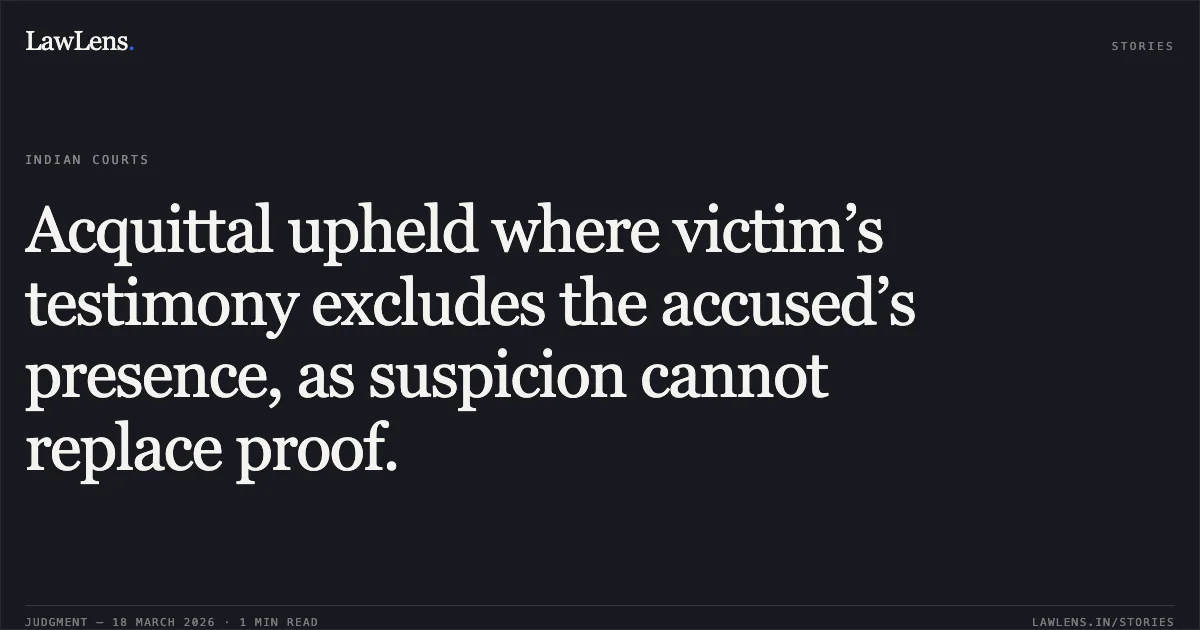
The High Court found no evidence to implicate the respondent.
Source reference: para. 4It noted that the victim (PW-1) admitted in her examination-in-chief and cross-examination that she had not seen Shrikant Shukla and that he was not present at the place of the incident.
Source reference: paras. 4-5The victim also admitted that her initial reports (Ex.P/1 and Ex.P/2) named different individuals and that she had been pressurized to falsely implicate the deceased co-accused, Bhagwandeen.
Source reference: para. 5The court observed that even if the victim’s doubtful statements were accepted, the allegations of sexual assault were directed at Bhagwandeen, not the respondent.
Source reference: para. 5The bench concluded that the trial court had correctly appraised the evidence, as a conviction cannot be recorded on the basis of surmises and conjectures in the absence of an "iota of evidence".
Source reference: para. 5Holding
The High Court dismissed the appeal and upheld the acquittal of the respondent.
The court held that the acquittal was based on sound legal reasoning and cogent grounds, and that the prosecution failed to demonstrate any perversity or illegality in the trial court’s judgment.
Source reference: para. 8Consequently, the charges under Sections 450, 376(2)(g), 506(Part-2) of the IPC and the SC/ST Act were not sustained.
Source reference: para. 8Acts & Sections Cited
4 provisions across 2 statutes referred to in this judgment. Each provision opens on LawLens.
Indian Penal Code, 18603
Scheduled Castes and the Scheduled Tribes (Prevention of Atrocities) Act, 19891
Original Court PDF
The State Of Madhya PradeshvsShrikant Shukla
Click to open original judgment
Original judgment, available to read, download and summarize on LawLens.in


![Subsequent exoneration does not retrospectively invalidate a finalized promotion select list.. UNNIKRISHNAN M vs M/o Environment And Forests. CAT - ['Ernakulam']. LawLens](/stories/thumbnails/subsequent-exoneration-does-not-retrospectively-invalidate-a-finalized-promotion-select-li-ce80a0e84f2f4887857271e8b4341c42.webp)