01Facts
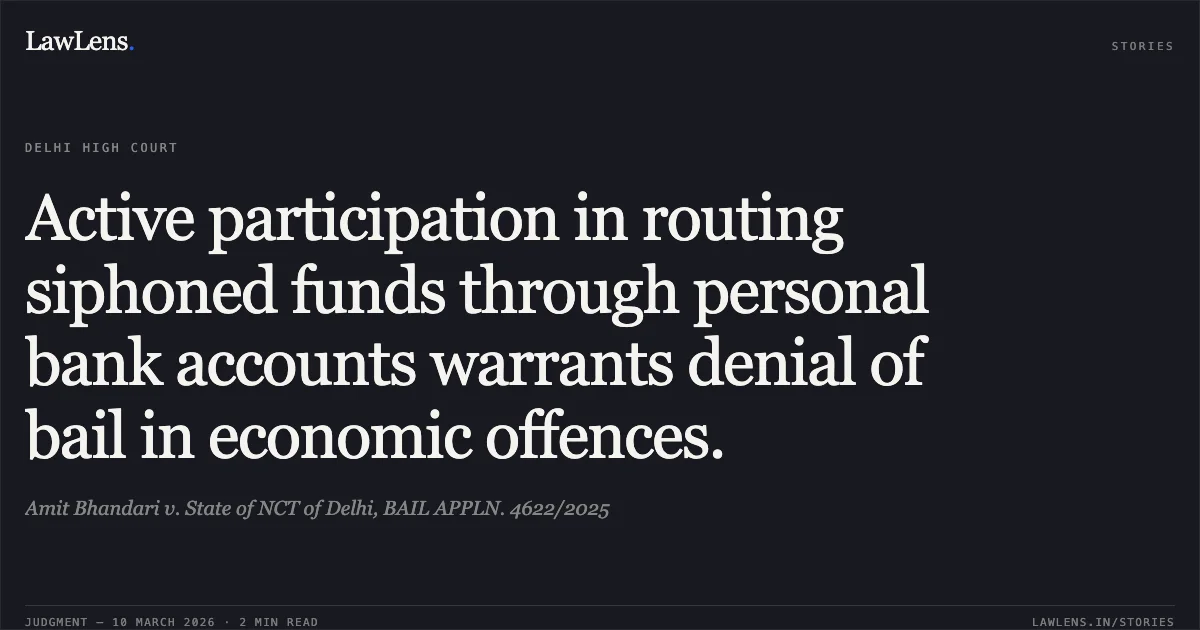
The applicant, Amit Bhandari, sought regular bail in connection with FIR No. 129/2024 involving allegations of financial fraud against M/s KNAB Finance Advisors Pvt. Ltd.
pp. 1-2The co-accused, Vinay Negi (Assistant Manager of the company), allegedly manipulated the Loan Management System to divert company funds totaling ₹3,23,00,000/- into various accounts.
¶ 2Investigation revealed that ₹68,05,000/- was transferred directly to the applicant’s AU Small Finance Bank account, which the applicant then routed back to the co-accused’s Bank of Baroda account after deducting a commission/loan amount.
¶ 3The co-accused claimed in a disclosure statement that the applicant was paid ₹17-19 lakhs for his involvement, leading to the applicant's arrest on May 16, 2025.
¶ 4The applicant contended he was a "passive conduit" acting under the instructions of his cousin (the co-accused) without knowledge of the illegal activities.
¶ 5-602Issues
i.Whether the applicant is entitled to regular bail under Section 483 read with Section 528 of the Bharatiya Nagarik Suraksha Sanhita (BNSS), 2023, considering his role as a relative of the main accused and the nature of the financial transactions.
p. 1 / para 1ii.Whether the gravity of economic offences and the applicant’s conscious involvement in routing siphoned funds outweigh the completion of the investigation and filing of the chargesheet.
pp. 4-5 / para 10-1103Law Applied
The Court applied the provisions of Section 483 and Section 528 of the BNSS regarding bail and inherent powers.
p. 1Substantively, it considered Sections 316(5), 318(4), 336(3), and 340(2) of the Bharatiya Nyaya Sanhita (BNS) alongside Sections 65 and 66 of the IT Act.
p. 1The Court relied on established precedents regarding economic offences, including *State of Gujarat v. Mohanlal Jitamalji Porwal*, *Y.S. Jagan Mohan Reddy v. C.B.I.*, and *Tarun Kumar v. Assistant Director, ED*, which mandate that bail in economic offences must be viewed with extreme caution due to their impact on the national economy and community at large.
p. 5 / para 11Provisions in the judgment · 6 · Linked ones open on LawLens
Bharatiya Nyaya Sanhita, 2023 Section 316Section 318Section 336Section 340
Bharatiya Nagarik Suraksha Sanhita, 2023 Section 483Section 528
04Reasoning
The Court rejected the applicant's "passive conduit" defense, noting that as a literate person with accounting knowledge, he consciously dealt with a substantial sum of ₹68,05,000/- and retained a portion of it.
¶ 10The Court observed that the close familial relationship between the applicant and the mastermind, combined with the repeated and calculated nature of the transfers, indicated pre-meditated intent for personal gain.
¶ 10-11The Court emphasized that economic offences are a "class apart" and require a different approach to bail compared to traditional crimes, as they affect the country's economic dynamics.
¶ 11Despite the chargesheet being filed and the investigation being complete, the Court found the magnitude of the transactions and the risk of influencing witnesses or hampering the trial sufficient to deny bail.
¶ 8, 1205Holding
The Court answered the issues in the negative, holding that no grounds were made out for the release of the applicant on bail at this stage.
¶ 13The Court dismissed the bail application, maintaining that the gravity of the economic offence and the applicant's conscious involvement necessitated continued custody.
¶ 10, 13The Court clarified that these observations are for the purpose of the bail application only and have no bearing on the merits of the trial.
¶ 14Original Court PDF
Amit Bhandari v. State of NCT of Delhi, BAIL APPLN. 4622/2025
Click to open original judgment
Original judgment, available to read, download and summarize on LawLens.in