Facts
The appellant-husband and respondent-wife married on 29 August 1999 and had three children, who attained majority during the proceedings.
Source reference: paras. 4, 22The husband, a Kannada film actor popularly known as “Duniya Vijay,” previously filed a divorce petition in 2013 alleging cruelty and desertion; the parties later entered into a settlement dated 19 November 2014, withdrew their respective proceedings, and resumed cohabitation.
Source reference: paras. 5–9Under a Mutual Consent Agreement dated 2 May 2016, the parties acknowledged that their married life was unhappy, and the wife agreed that she had no objection to the husband contracting another marriage; the husband undertook various financial obligations, including clearing the matrimonial-home loan, transferring the house to the wife, and making monetary payments.
Source reference: paras. 11–12, 55–61The Family Court dismissed the husband’s petition for divorce under Sections 13(1)(i-a) and 13(1)(i-b) of the Hindu Marriage Act, 1955, holding that cruelty and desertion were not proved.
Source reference: paras. 40–43The husband appealed under Section 19(1) of the Family Courts Act. Mediation before the High Court failed.
Source reference: para. 44Issues
Whether the wife had deserted the husband within the meaning of Section 13(1)(i-b) of the Hindu Marriage Act, 1955?
Source reference: paras. 47–53Whether the wife had treated the husband with cruelty within the meaning of Section 13(1)(i-a) of the Hindu Marriage Act, 1955?
Source reference: paras. 47–49, 78–79Law Applied
The Court applied Sections 13(1)(i-a) and 13(1)(i-b) of the Hindu Marriage Act, 1955, under which divorce may be granted for cruelty or desertion for a continuous period of at least two years.
Source reference: para. 49Desertion requires proof of both the factum of separation and the intention permanently to end cohabitation (animus deserendi), together with absence of consent and absence of reasonable cause; the burden rests on the petitioner throughout the statutory period, as explained in Bipinchandra Jaisinghbai Shah v. Prabhavati and Lachman Utamchand Kirpalani v. Meena.
Source reference: paras. 51–53Under Section 23(1) of the Hindu Marriage Act, relief cannot be granted where the petitioner seeks to take advantage of his or her own wrong.
Source reference: paras. 74–76Mental cruelty means conduct causing such mental pain and suffering that the parties cannot reasonably be expected to live together, assessed contextually with regard to the parties’ social status, circumstances, and the impact of the conduct; the Court relied on V. Bhagat v. D. Bhagat and Samar Ghosh v. Jaya Ghosh.
Source reference: paras. 78–79Unfounded defamatory allegations, repeated false complaints, and public statements damaging a spouse’s reputation may constitute mental cruelty, particularly where they adversely affect the spouse’s professional and social standing, as recognised in K. Srinivas Rao v. D.A. Deepa, Narendra v. K. Meena, and Joydeep Majumdar v. Bharti Jaiswal Majumdar.
Source reference: paras. 88–89, 97The Court also relied on Section 23 and Rakesh Raman v. Kavita in holding that, in an appropriate case, an irretrievably broken and acrimonious marriage may amount to cruelty.
Source reference: paras. 109–112Reasoning
The Court found that the husband had established separation from the wife after May 2016 through the Mutual Consent Agreement, the surrounding conduct of the parties, and the evidence of PW-2.
Source reference: paras. 54–62However, the desertion claim failed because the husband’s own intimate relationship with Keerthi Gowda, including publicly presenting her as his wife during the subsistence of the marriage, showed that he was not consistently willing to resume marital cohabitation and obligations.
Source reference: paras. 64–77Consequently, granting divorce on desertion would allow him to take advantage of his own wrong, contrary to Section 23(1).
Source reference: paras. 64–77The cruelty claim, however, succeeded. The wife repeatedly made public allegations that the husband had several wives, including allegations not substantiated by evidence, and supported or participated in proceedings and complaints that exposed him to public censure and reputational harm.
Source reference: paras. 80–99Given the husband’s public profile as a film actor, the Court held that the repeated media statements had a particularly serious impact on his professional and social standing.
Source reference: paras. 80–99The Court also relied on the evidence concerning the wife’s conduct towards the husband’s parents, including the parents’ Wills recording their wish that she not attend their funerals, as corroborative of the severe matrimonial discord and the intolerable environment created within the family.
Source reference: paras. 100–106Considering the prolonged separation, repeated failed reconciliation efforts, extensive litigation, mutual allegations, and complete disintegration of marital unity, the Court held that the marriage had irretrievably broken down and that continuation of the legal relationship itself constituted cruelty.
Source reference: paras. 107–112Although the wife had not specifically sought permanent alimony and had not appeared at the appeal hearing, the Court awarded it to secure her financial stability and that of the parties’ three children, taking into account the duration of the marriage, the husband’s earning capacity, the transfer of the matrimonial house, and his prior financial commitments.
Source reference: paras. 119–126Holding
The appeal was allowed.
The Court held that the husband failed to prove desertion under Section 13(1)(i-b), principally because his own conduct disentitled him from relying on the wife’s alleged desertion.
Source reference: para. 77Nevertheless, the wife’s repeated unsubstantiated public allegations, conduct affecting the husband’s reputation, treatment of his parents, and the cumulative breakdown of the marriage amounted to mental cruelty under Section 13(1)(i-a).
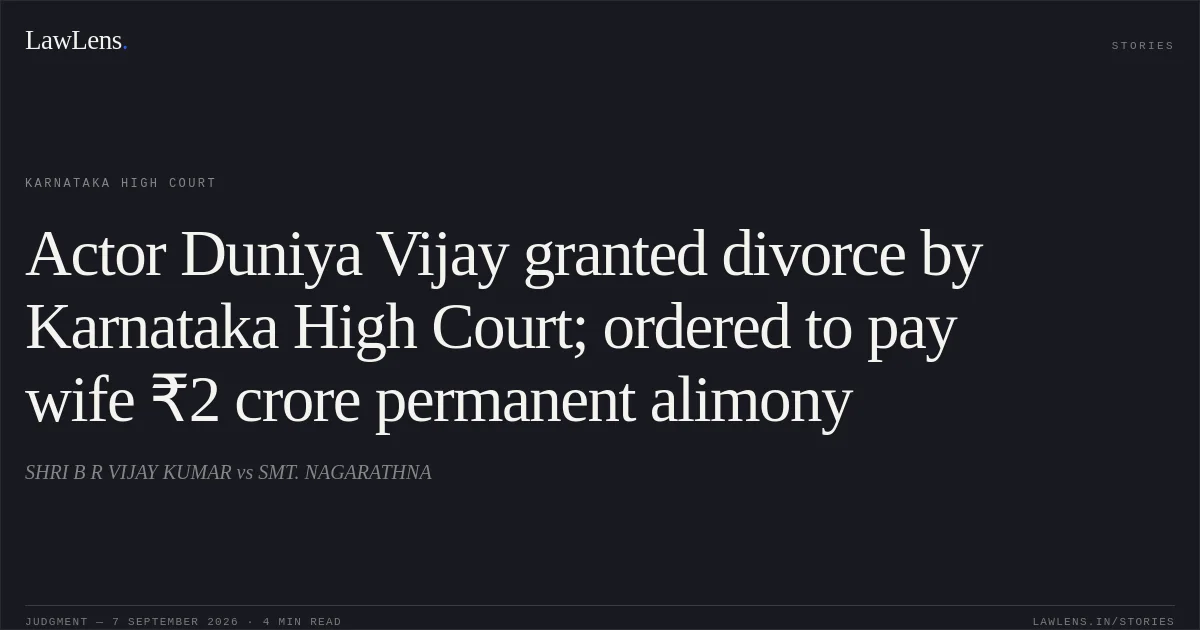
Source reference: paras. 94–112The marriage solemnized on 29 August 1999 was dissolved by a decree of divorce on the ground of cruelty.
Source reference: para. 127(i)–(ii)The husband was directed to pay Rs. 2 crore as permanent alimony to the wife within three months from receipt of the order; failing payment, the amount would carry interest at 6% per annum from the date of the decree until payment.
Source reference: para. 127(iii)Acts & Sections Cited
7 provisions across 3 statutes referred to in this judgment. Each provision opens on LawLens.
Family Courts Act, 19841
Hindu Marriage Act, 19555
Code of Criminal Procedure, 19731
Original Court PDF
SHRI B R VIJAY KUMARvsSMT. NAGARATHNA
Click to open original judgment
Original judgment, available to read, download and summarize on LawLens.in