Facts
The petitioner (Gajendra) and Respondent No. 8 participated in the recruitment for Gram Rojgar Sahayak under the MGNREGS. Initially, Respondent No. 8 ranked higher due to marks from a computer diploma
Source reference: p. 1Upon the petitioner's objection, the University reported the diploma was forged, leading to the withdrawal of 50 marks and the petitioner’s appointment on 22.01.2013
Source reference: p. 2Respondent No. 8 appealed to the Additional Collector, Morena, who allowed the appeal on 08.01.2014, setting aside the petitioner's appointment
Source reference: p. 2The petitioner challenged this order, alleging the Additional Collector lacked jurisdiction and erroneously allowed Respondent No. 8 to rely on a different diploma (from CMJ University) not part of the original application
Source reference: p. 3Issues
1. Whether the Additional Collector had the jurisdiction to adjudicate the appeal under Clause 17 of the MGNREGS Scheme, which designates the "District Programme Coordinator (Collector)" as the appellate authority
Source reference: p. 72. Whether the appellate authority's direction to verify a new computer diploma amounted to an impermissible improvement of candidature after the recruitment process
Source reference: p. 4, 9Law Applied
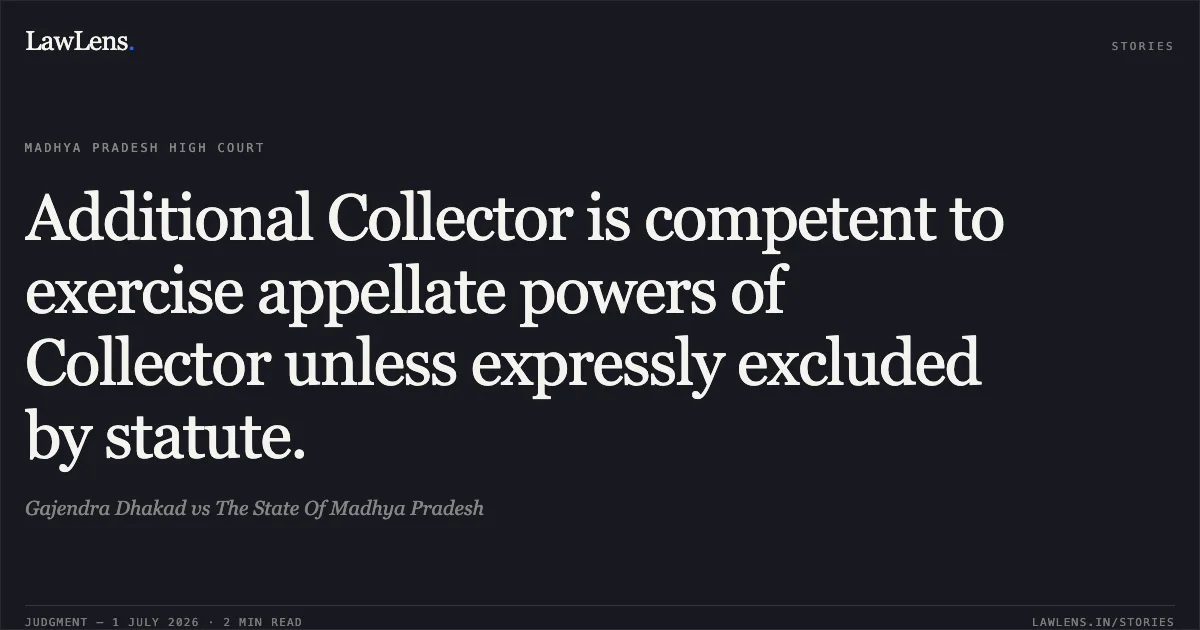
The Court applied Section 17 of the M.P. Land Revenue Code, 1959, and Section 17 of the M.P. General Clauses Act, which establish that an Additional Collector is a statutory authority competent to exercise the Collector's powers assigned via work distribution
Source reference: p. 6, 8It relied on Mirza Rashid Beg v. Inayatulla Khan & Others (1986) and Kaushal Prasad Kashyap v. State of M.P. (1999), which hold that an Additional Collector’s orders cannot be questioned solely because the power was specifically vested in the "Collector" unless the statute expressly excludes such exercise
Source reference: p. 8-9Reasoning
Regarding jurisdiction, the Court found that the MGNREGS Scheme does not expressly prohibit Additional Collectors from hearing appeals; thus, under the M.P. Land Revenue Code framework, the Additional Collector acted as a competent statutory authority
Source reference: p. 8-9The Court noted the petitioner failed to raise this jurisdictional objection during the appellate proceedings
Source reference: p. 8On merits, the Court observed that the Additional Collector had physically examined the original records and found that the allegedly forged diploma was not actually part of Respondent No. 8’s self-attested application
Source reference: p. 9The Court reasoned that the impugned order did not grant an appointment but merely directed a verification of the genuine diploma present in the record to ensure merit-based selection
Source reference: p. 9-10As the High Court’s jurisdiction under Article 226 is supervisory and not appellate, it declined to re-appreciate these factual findings
Source reference: p. 10Holding
The Court answered the first issue in the affirmative, holding that the Additional Collector had the jurisdiction to decide the appeal
the appellate order was a valid exercise of power to ensure document authenticity
Source reference: p. 10The Writ Petition was dismissed, the order dated 08.01.2014 was affirmed, and the petitioner’s challenge to his removal was rejected. No order as to costs
Source reference: p. 11Acts & Sections Cited
1 provisions across 1 statute referred to in this judgment. Each provision opens on LawLens.
MP Land Revenue Code 19591
Original Court PDF
Gajendra DhakadvsThe State Of Madhya Pradesh
Click to open original judgment
Original judgment, available to read, download and summarize on LawLens.in


