Facts
The petitioners challenged notices issued under Section 148 of the Income Tax Act, 1961, for Assessment Year (AY) 2017-18, dated 15.04.2024 and 06.04.2024, alleging they were time-barred.
Source reference: para. 1In the lead case, a show-cause notice under Section 148A(b) was issued on 21.03.2024.
Source reference: para. 3The petitioner requested adjournments on 28.03.2024 and 08.04.2024, eventually filing a reply on 13.04.2024.
Source reference: paras. 3-4On 15.04.2024, the Assessing Officer (AO) rejected the objections under Section 148A(d) and simultaneously issued the impugned Section 148 notice.
Source reference: para. 4The petitioner argued that the six-year limitation period under the first proviso to Section 149(1) expired on 31.03.2024, rendering the subsequent notice void.
Source reference: para. 5Issues
Whether the notice dated 15.04.2024 issued under Section 148 of the Act for AY 2017-18 is barred by limitation or protected by the statutory exclusion of time.
Source reference: para. 14Law Applied
The court applied Section 149 of the Income Tax Act, 1961 (as substituted by the Finance Act, 2021).
Source reference: no citationThe First Proviso to Section 149(1) stipulates that no notice under Section 148 can be issued if it would have been time-barred under the pre-2021 limitation rules (six years for the relevant category).
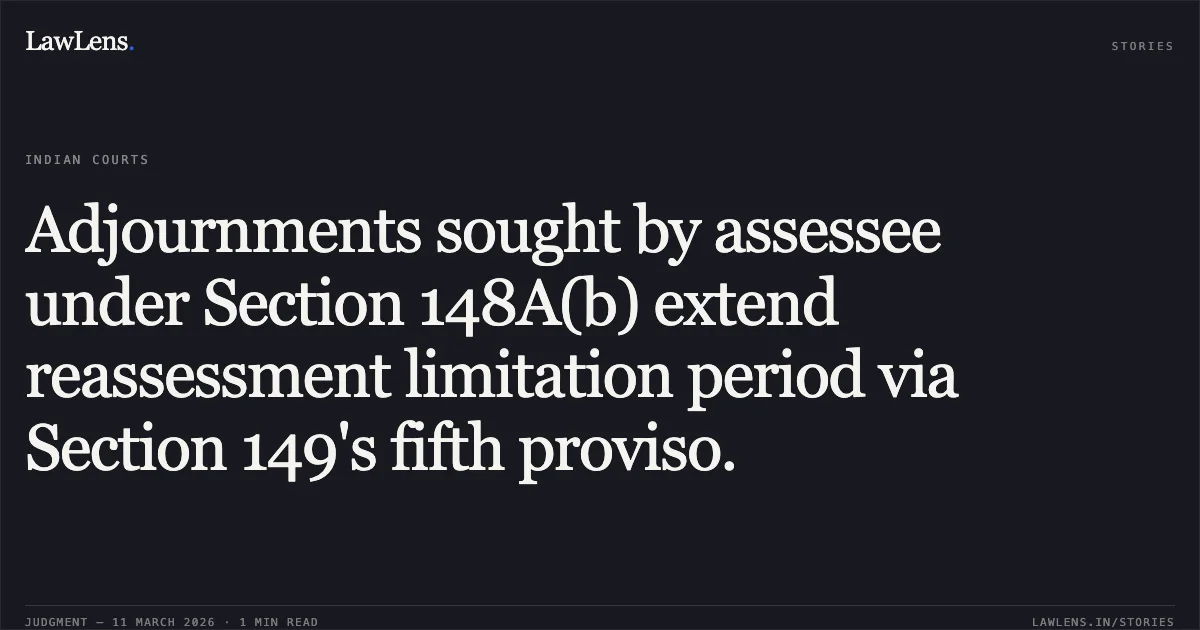
Source reference: para. 13Critically, the Fifth Proviso to Section 149(1) mandates the exclusion of "the time or extended time allowed to the assessee" per the show-cause notice issued under Section 148A(b) when computing the limitation period.
Source reference: para. 13The court also referenced *Raminder Singh v. ACIT* regarding the composite nature of the limitation framework.
Source reference: para. 11Reasoning
The court reasoned that since the Section 148A(b) proceedings were initiated on 21.03.2024, they were within the original six-year limitation ending 31.03.2024.
Source reference: para. 19The court rejected the petitioner’s isolationist reading of the First Proviso, holding that the Fifth Proviso must be read harmoniously to prevent it from becoming "otiose".
Source reference: para. 12Because the delay in concluding the 148A proceedings was directly attributable to the petitioner’s repeated requests for adjournments (from 28.03.2024 to 13.04.2024), this period must be excluded from the limitation count.
Source reference: paras. 16, 21, 30The court distinguished *Shree Cement Ltd. v. ACIT* (Rajasthan HC), noting that in the present case, the AO acted/initiated proceedings well before the deadline and granted extensions in good faith to comply with natural justice.
Source reference: paras. 26, 28Holding
The court answered the issue in the negative, holding that the impugned notice dated 15.04.2024 was valid and within limitation.
The court held that the period between 28.03.2024 and 15.04.2024 is excluded under the Fifth Proviso to Section 149.
Source reference: para. 30Both writ petitions were dismissed, and the AO was found to have acted within jurisdiction.
Source reference: paras. 31-32Acts & Sections Cited
10 provisions across 1 statute referred to in this judgment. Linked provisions open on LawLens.
Income Tax Act, 1961
Original Court PDF
BKR Capital Pvt. Ltd. v. Income Tax Officer, Ward 4.1, Delhi & Anr. (with connected matter Rajmani Securities Pvt Ltd v. Income Tax Officer); W.P.(C) 19738/2025 & W.P.(C) 19769/2025.
Click to open original judgment
Original judgment, available to read, download and summarize on LawLens.in