Facts
The Petitioner (complainant) filed a criminal complaint against Respondent No. 1 (SIL), its predecessor, and associated entities under Section 9 read with Section 9AA of the Central Excise Act, 1944.
Source reference: para. 2-3The complainant alleged that the respondents evaded excise duty by manufacturing black pipes and sending them for galvanization to Structural Galvanizing Industry (SGI) without entry passes, subsequently marketing the finished products without paying duty.
Source reference: para. 2-3Adjudicating authorities under the Act had previously found the respondents guilty and imposed penalties, which were upheld by the Appellate Tribunal (CEGAT).
Source reference: para. 3Upon recording pre-charge evidence, the Trial Court discharged the accused on 12.09.2011, noting that the complainant relied solely on administrative orders and lacked witnesses with personal knowledge of the alleged evasion.
Source reference: para. 5The Petitioner approached the High Court in revision against this discharge.
Source reference: no citationIssues
1. Whether there was sufficient material on record to establish a prima facie case for framing charges under the Central Excise Act.
Source reference: para. 62. Whether findings of liability or penalty by administrative/civil authorities are binding on a Criminal Court for the purpose of framing charges.
Source reference: para. 5-6Law Applied
Section 245 of the CrPC regarding discharge in warrant cases instituted otherwise than on a police report.
Source reference: para. 13Principle from State of Gujarat v. Dilip Singh Kishor Singh Rao and Union of India v. Prafulla K. Samal, establishing that while a Judge can sift and weigh evidence for the limited purpose of finding a prima facie case, they must discharge the accused if the material gives rise only to "suspicion" rather than "grave suspicion".
Source reference: para. 12, 17Doctrine that criminal proceedings are distinct from civil/adjudicatory proceedings; administrative findings have only persuasive value and do not substitute for independent evidence of the ingredients of an offence.
Source reference: para. 6, 29Reasoning
The Court examined the testimonies of six witnesses (CW1 to CW6) and found them legally insufficient. CW1, CW2, CW3, and CW5 admitted they had no personal knowledge of the case and were merely testifying based on records that were not properly produced or proved before the Court, rendering their testimony inadmissible.
Source reference: para. 20-25The Court noted that the testimony of Jodh Singh (CW2) regarding information derived from unproduced records was a violation of evidentiary rules.
Source reference: para. 22The Court reasoned that a Criminal Court cannot act as an "executing court" for administrative orders; the prosecution must independently prove the factual ingredients of the crime (evasion) rather than relying on the fact that a penalty was imposed by the Excise Department.
Source reference: para. 5, 29Holding
The Court held that there was insufficient material to transcend "mere suspicion" or to show the actual commission of the offence.
The High Court dismissed the revision petition and upheld the Trial Court’s order of discharge, concluding that the Criminal Court must apply an independent mind to the evidence rather than relying on show-cause notices or administrative penalties to sustain a prosecution.
Source reference: para. 29, 31Acts & Sections Cited
13 provisions across 2 statutes referred to in this judgment. Each provision opens on LawLens.
Central Excise Act, 19441
Original Court PDF
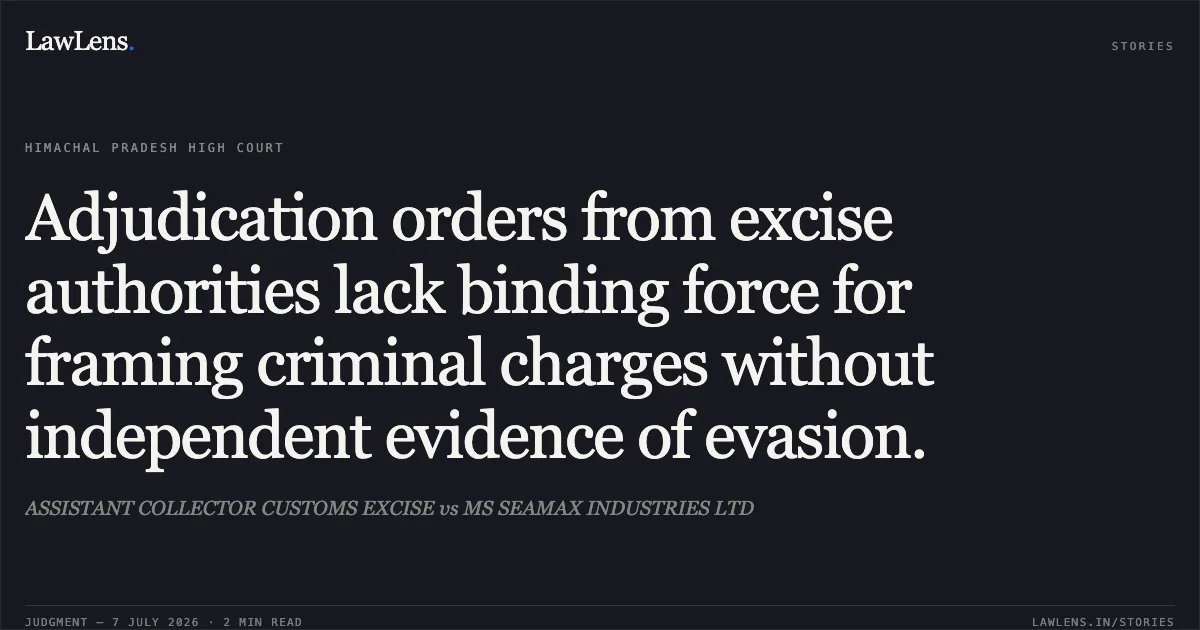
ASSISTANT COLLECTOR CUSTOMS EXCISEvsMS SEAMAX INDUSTRIES LTD
Click to open original judgment
Original judgment, available to read, download and summarize on LawLens.in


![Subsequent exoneration does not retrospectively invalidate a finalized promotion select list.. UNNIKRISHNAN M vs M/o Environment And Forests. CAT - ['Ernakulam']. LawLens](/stories/thumbnails/subsequent-exoneration-does-not-retrospectively-invalidate-a-finalized-promotion-select-li-ce80a0e84f2f4887857271e8b4341c42.webp)