Facts
The respondent, a Beldar in the Delhi Jal Board (DJB), was absent from work due to illness from October 2013 to November 2018
Source reference: p. 1Upon his retirement on December 31, 2019, the DJB initiated major penalty proceedings for unauthorized absence
Source reference: p. 1-2Based on an Inquiry Report dated March 25, 2021, the Member (Admn.) of the DJB issued an order on April 22, 2022, imposing a 20% pension cut for five years and treating the absence as dies non
Source reference: p. 2The respondent challenged this before the Central Administrative Tribunal (CAT) in OA 959/2024. The Tribunal quashed the punishment on May 23, 2025, ruling it was passed by an incompetent authority under the prevailing Office Order No. 51
Source reference: p. 2The DJB filed a review (RA 189/2025) citing a subsequent "Corrigendum" (Office Order No. 60) intended to validate the Member’s authority retrospectively, which was dismissed
Source reference: p. 3-4Issues
1. Whether the Member (Admn.) was the competent Disciplinary Authority to penalize a retired employee under the regulations existing at the time of the order
Source reference: p. 22. Whether a subsequent Corrigendum (Office Order No. 60) could retrospectively confer jurisdiction on an authority and validate a previously void-ab-initio order
Source reference: p. 4-5Law Applied
Under DJB Office Order No. 51 (dated March 4, 2021), the "Board" was designated as the competent Disciplinary Authority for retired officials in Category A, B, and C
Source reference: p. 3Legal principles establish that an administrative authority must act within the four corners of the delegated powers existing at the time of the order; any order passed by an incompetent authority is a nullity for want of jurisdiction
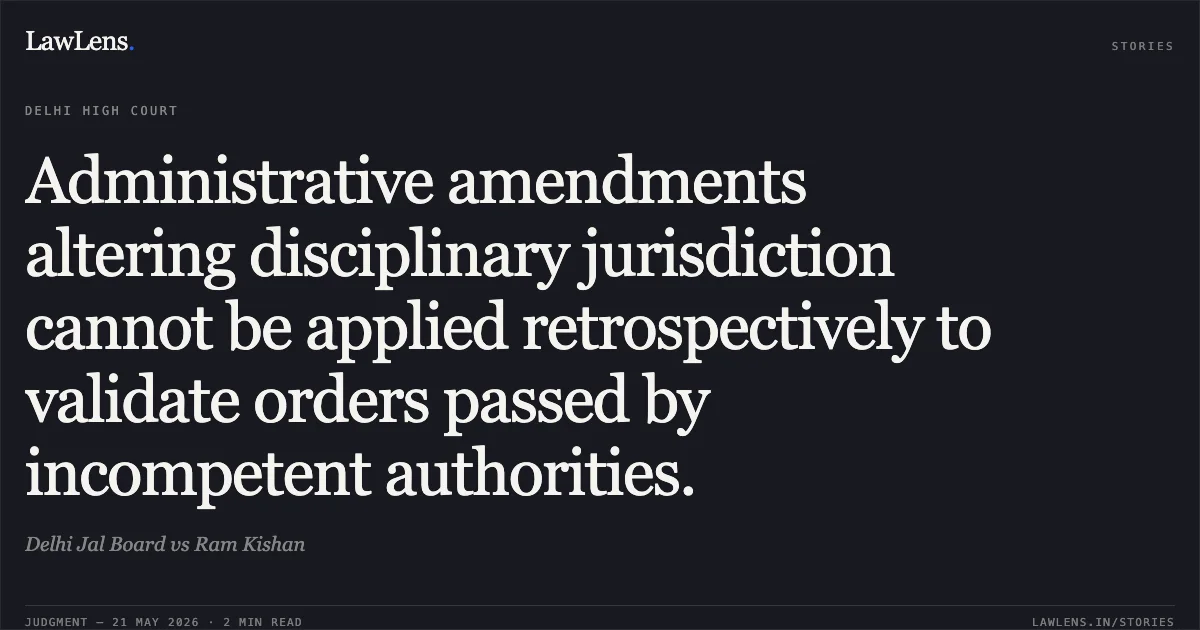
Source reference: p. 2Administrative orders or corrigendums cannot be applied retrospectively to affect civil rights unless expressly authorized by statute or a formal Board resolution
Source reference: p. 5Reasoning
The Court observed that at the time the punishment was awarded (April 2022), Office Order No. 51 clearly mandated that only "the Board" had the authority to penalize retired employees
Source reference: p. 2The DJB's attempt to justify the Member (Admn.)’s order via a 2025 Corrigendum was rejected because the Corrigendum lacked a supporting Board resolution for its retrospective application
Source reference: p. 5The Court reasoned that since the original punishment resulted in adverse civil consequences (pension cut), a subsequent administrative "correction" four years later could not cure the initial lack of jurisdiction
Source reference: p. 5The Court found no evidence of "inadvertent omission" and held that the DJB could not presume retrospective validity without explicit legal or administrative sanction
Source reference: p. 5Holding
The punishment order was legally infirm as it was passed by an incompetent authority (Member Admn. instead of the Board)
The High Court dismissed the writ petition in limine, upholding the Tribunal’s judgment; however, the Court maintained the liberty granted to the DJB to proceed against the respondent afresh in accordance with the law
Source reference: p. 5-6Acts & Sections Cited
1 provisions across 1 statute referred to in this judgment. Linked provisions open on LawLens.
Delhi Water Board Act, 19981
Original Court PDF
Delhi Jal BoardvsRam Kishan
Click to open original judgment
Original judgment, available to read, download and summarize on LawLens.in