Facts
The State and its officers appealed against the dismissal of a review petition, which had affirmed an order dated 2 May 2025 in the respondents’ writ petition.
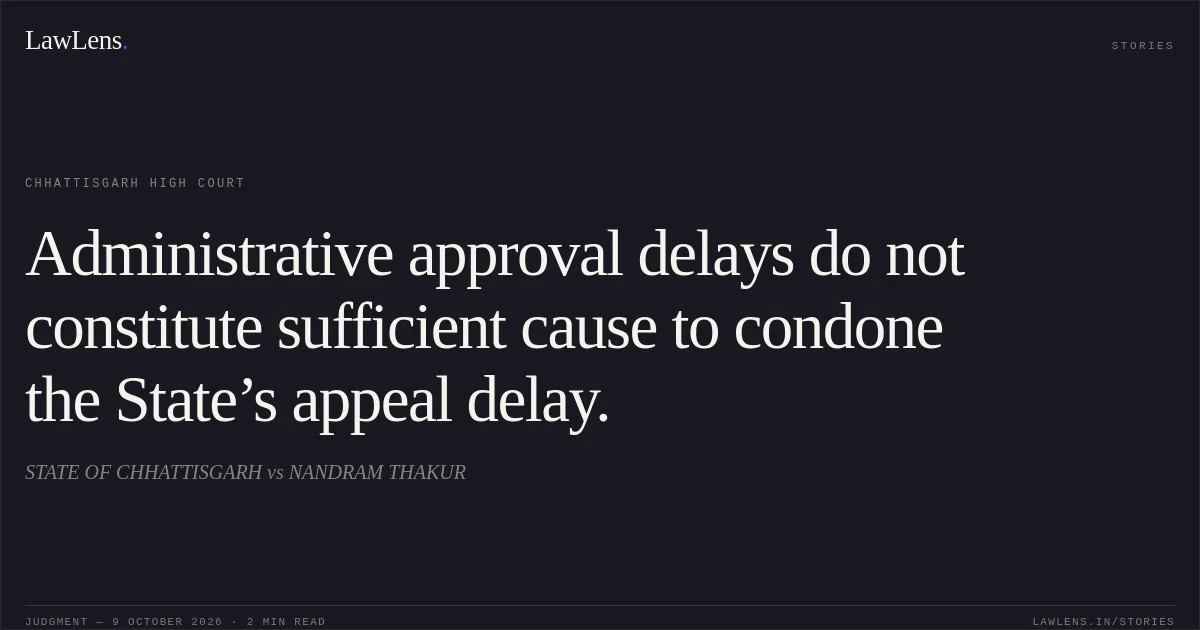
Source reference: para. 3The State sought condonation of a 40-day delay in filing the writ appeal, attributing it to the time taken to obtain administrative approval.
Source reference: para. 4The review petition had itself been filed on 22 May 2026, after the Department sought the Advocate General’s opinion on 25 March 2026; the appeal followed the review petition’s dismissal on 23 June 2026.
Source reference: paras. 8–9The respondents opposed condonation, relying on the State’s prolonged inaction and the principle that administrative approval does not, by itself, justify delay.
Source reference: paras. 5–6Issues
1. Whether the State demonstrated sufficient cause to condone the 40-day delay in filing the writ appeal.
Source reference: paras. 4, 7, 112. Whether time spent obtaining administrative approval, considered alongside the State’s earlier inaction, justified condonation.
Source reference: paras. 8–10Law Applied
The Court relied on the principle in Postmaster General & Others v. Living Media India Limited & Another, (2012) 3 SCC 563, that government departments are expected to act with diligence, that the law does not prescribe a different limitation period for the State, and that administrative processes do not automatically constitute sufficient cause for delay.
Source reference: para. 10The respondents also cited Smt. Jyoti v. General Manager, MCC No. 591 of 2016, concerning the applicability of the Limitation Act to writ proceedings; however, the Court did not decide that question, and instead determined the application on the adequacy of the State’s explanation for delay.
Source reference: para. 5Reasoning
Although the stated delay in the appeal was 40 days, the Court considered the State’s conduct in the full procedural context. The State waited almost a year after the original order before seeking the Advocate General’s opinion, did so after contempt proceedings had been initiated, and then followed a similar approval process before filing the appeal.
Source reference: paras. 8–9The Court held that the time taken for administrative approval did not explain the State’s lack of diligence and was not sufficient cause for condonation.
Source reference: paras. 10–11Holding
The Court held that the State had not established sufficient cause to condone the delay.
It dismissed I.A. No. 1 of 2026 and, consequently, dismissed the writ appeal as barred by limitation.
Source reference: para. 12Original Court PDF
STATE OF CHHATTISGARHvsNANDRAM THAKUR
Click to open original judgment
Original judgment, available to read, download and summarize on LawLens.in