Facts
The applicant, a Material Assistant at the Central Ordnance Depot (COD), Delhi, was transferred to the 41 Field Ammunition Depot in Leh, Ladakh via an order dated 14.02.2026.
Source reference: p.2The applicant suffers from acute asthma, hypertension, and respiratory issues, supported by a medical certificate dated 21.01.2026, which stated he is unfit for duty at high altitude and extreme cold.
Source reference: p.2, 5He submitted a representation on 02.03.2026 highlighting these medical hardships.
Source reference: p.3However, the respondents issued a subsequent order on 06.05.2026 rejecting his plea without providing specific reasons and directing him to report to Leh.
Source reference: p.3, 5The applicant challenged these orders before the Tribunal seeking to set aside the transfer.
Source reference: p.2Issues
1. Whether the respondents are required to consider personal medical hardships and provide a reasoned order when deciding on an employee's representation against a transfer order.
Source reference: p.5-62. Whether the applicant is entitled to interim protection from his transfer to a high-altitude area pending a fresh consideration of his grievances.
Source reference: p.6Law Applied
The Tribunal applied the principle that transfer is an incidence of service and judicial review is limited unless the order is mala fide or violates statutory provisions, as established in Namrata Verma v. State of U.P. (2021) and Union of India v. S.L. Abbas (1993).
Source reference: p.4-5Based on Rajendra Roy v. Union of India (1993), the department is reasonably expected to consider personal hardships and medical difficulties in a timely manner.
Source reference: p.5Under the doctrine established in M/s Kranti Associates Pvt. Ltd. v. Masood Ahmed Khan, even administrative decisions must be supported by recorded reasons to satisfy the principles of justice.
Source reference: p.6Reasoning
The Tribunal observed that while the employer has the prerogative to transfer employees based on administrative requirements, the applicant's medical condition—specifically acute asthma and hypertension—presents a "great risk of personal harm" at an altitude of 11,500 feet.
Source reference: p.2-3, 4The court noted that the respondents' order dated 06.05.2026 failed to assign any reasons for rejecting the medical grounds raised in the applicant's representation.
Source reference: p.5Applying the rule that administrative bodies must record reasons to support their conclusions, the Tribunal found that the applicant's personal difficulties required a meaningful and reasoned consideration by the competent authority rather than a summary rejection.
Source reference: p.6Holding
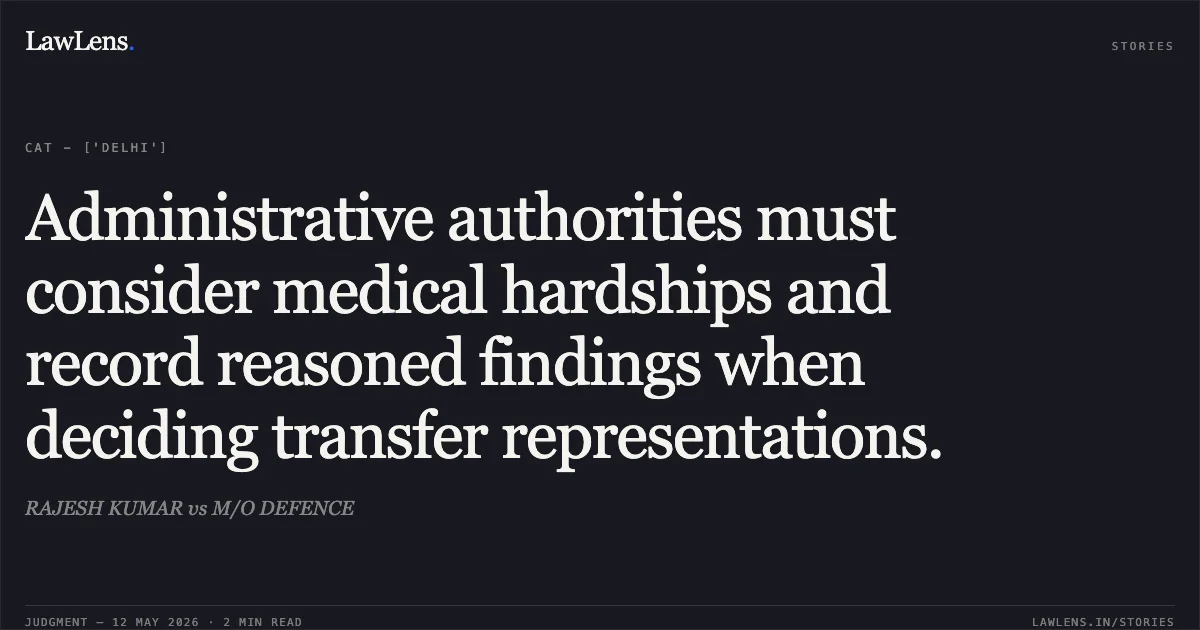
The Tribunal disposed of the O.A. at the admission stage by directing the competent authority to decide the applicant’s pending representation dated 02.03.2026 by passing a reasoned and speaking order within six weeks.
The Tribunal held that this decision must be made independently, without being influenced by the previous rejection order of 06.05.2026.
Source reference: p.6The Tribunal ordered that no coercive steps be taken against the applicant and that he be allowed to continue at his present posting in COD, Delhi, until the representation is decided.
Source reference: p.6-7Acts & Sections Cited
1 provisions across 1 statute referred to in this judgment. Each provision opens on LawLens.
Administrative Tribunals Act, 19851
Original Court PDF
RAJESH KUMARvsM/O DEFENCE
Click to open original judgment
Original judgment, available to read, download and summarize on LawLens.in