Facts
The applicant, an officer in the Intellectual Property Office, challenged a transfer order dated 08.12.2025 moving him from Delhi to Mumbai.
Source reference: para. 1-2He contested the transfer on three primary grounds: (i) spouse posting guidelines, as his wife is a permanent Gazetted Officer in Delhi; (ii) medical exigencies involving his father’s chronic hepatitis-B and status as a kidney donor; and (iii) violation of the rotational transfer policy regarding tenure length.
Source reference: para. 2-4The respondents rejected his representations via common orders dated 20.01.2026 and 08.04.2026 and subsequently relieved him on 13.04.2026 during the pendency of the matter.
Source reference: para. 4, 8.10Issues
1. Whether the impugned transfer and the subsequent rejection of representations were arbitrary, non-speaking, and in violation of the Revised Transfer Policy and DoPT guidelines.
Source reference: para. 12. Whether the administrative authority is required to pass a reasoned and speaking order when disposing of an employee's representation regarding personal hardships.
Source reference: para. 12-14Law Applied
The court relied on the principle that transfer is an incident of service and a government servant has no vested right to remain at a specific station (Shilpi Bose v. State of Bihar; Gujarat Electricity Board v. Atmaram Sungomal Poshani).
Source reference: para. 8.2, 8.6Judicial review is limited to cases involving mala fides, violation of statutory rules, or orders passed by incompetent authorities (Union of India v. S.L. Abbas; State of UP v. Govardhan Lal).
Source reference: para. 8.4, 8.7While DoPT guidelines on spouse postings should be followed as far as practicable, they do not confer a legally enforceable right if administrative exigencies dictate otherwise (Bank of India v. Jagjit Singh Mehta).
Source reference: para. 8.9Administrative authorities must consider individual grievances in a sensitive manner to maintain employee morale.
Source reference: para. 13Reasoning
The Tribunal observed that while the administration has the prerogative to rationalize manpower for efficiency, the respondents disposed of the applicant's representations in a "mechanical manner".
Source reference: para. 12-13The rejection orders dated 20.01.2026 and 08.04.2026 failed to address the specific medical and spouse-related grounds raised by the applicant, providing no individual reasoning for the decision.
Source reference: para. 11The court reasoned that although guidelines are not mandatory statutes, senior officers deserve a "sympathetic consideration" of their difficulties, and the failure to pass reasoned orders indicated a lack of sensitivity that could negatively impact organizational morale.
Source reference: para. 12-13The mechanical nature of the rejection necessitated judicial intervention despite the limited scope of review in transfer matters.
Source reference: para. 14Holding
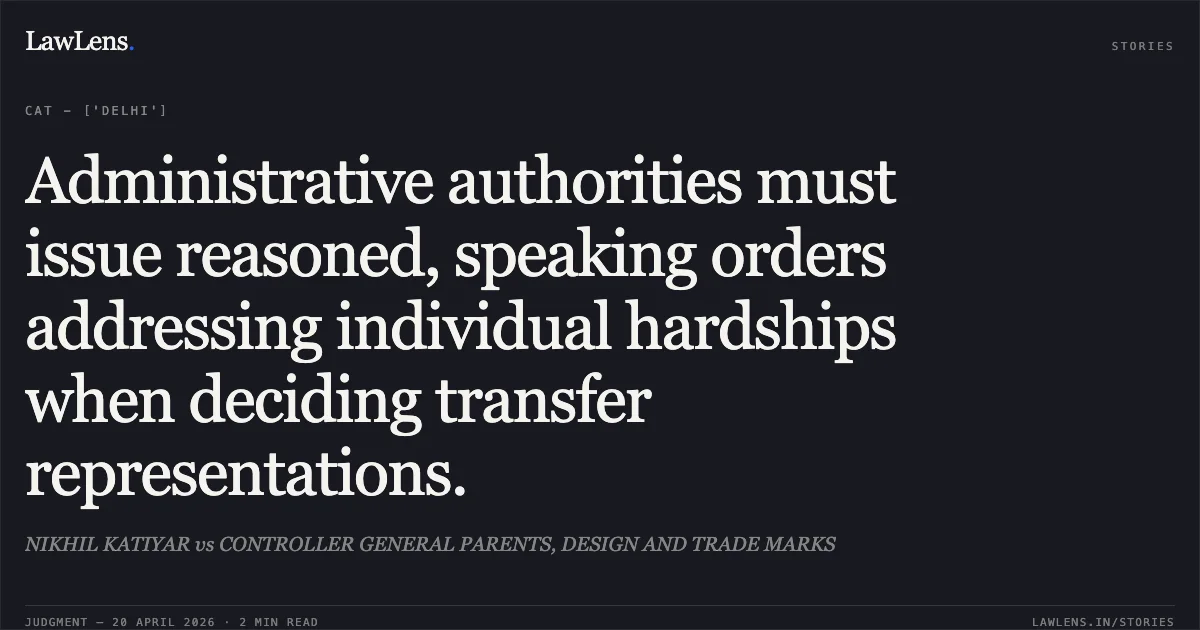
The Tribunal allowed the OA in part, holding that individual representations regarding personal difficulties deserve fair consideration through speaking orders.
The Tribunal quashed the transfer order dated 08.12.2025 and the relieving order dated 13.04.2026.
Source reference: para. 14(a)The respondents were directed to reconsider the applicant’s representation afresh in light of policy guidelines and judicial precedents, and to pass a reasoned and speaking order within 15 days.
Source reference: para. 14(b)The applicant was permitted to remain at his Delhi posting until the new order is passed.
Source reference: para. 14(b)Acts & Sections Cited
1 provisions across 1 statute referred to in this judgment. Each provision opens on LawLens.
Administrative Tribunals Act, 19851
Original Court PDF
NIKHIL KATIYARvsCONTROLLER GENERAL PARENTS, DESIGN AND TRADE MARKS
Click to open original judgment
Original judgment, available to read, download and summarize on LawLens.in


![Subsequent exoneration does not retrospectively invalidate a finalized promotion select list.. UNNIKRISHNAN M vs M/o Environment And Forests. CAT - ['Ernakulam']. LawLens](/stories/thumbnails/subsequent-exoneration-does-not-retrospectively-invalidate-a-finalized-promotion-select-li-ce80a0e84f2f4887857271e8b4341c42.webp)