Facts
The petitioners, serving as Superintendents of Land Records, filed a representation on January 27, 2006, requesting the fixation of their seniority in the cadre of Superintendent effective from January 1, 1997
Source reference: para. 2The respondent/State rejected this representation via an order dated July 14, 2006 (Annexure P/1)
Source reference: para. 2The petitioners challenged this rejection under Article 226 of the Constitution, contending that the order was non-speaking, unreasoned, and failed to consider the facts and grounds raised in their representation
Source reference: para. 2Issues
1. Whether the administrative order dated July 14, 2006, rejecting the petitioners' seniority claim, is legally sustainable in the absence of recorded reasons
Source reference: para. 6-72. Whether an administrative or quasi-judicial authority is mandated to pass a speaking and reasoned order when affecting the rights of parties
Source reference: para. 7-8Law Applied
Reasons are the "lifeblood" of judicial and administrative decision-making and are indispensable for transparency and judicial review [Kranti Associates Pvt. Ltd. & Anr v. Masood Ahmed Khan & Ors (2010)]
Source reference: paras. 10-11Administrative decisions must be self-sustaining and "impregnated with reasons" to prevent arbitrariness and ensure fairness under the rule of law [State of Punjab v. Bandip Singh (2016) and Oryx Fisheries Pvt. Ltd. v. Union of India (2010)]
Source reference: para. 8-9, 11Reasoning
Upon perusing the impugned order, the Court found it to be a "non-speaking" order that merely stated the representation was "rejected after full consideration" without disclosing the underlying rationale
Source reference: para. 5-6The Court reasoned that when discretion is vested in an authority, it must be exercised in a rational manner, and the "face of an order... must speak" so the affected party understands why their case was prejudicial
Source reference: para. 7The Court determined that the respondent's failure to provide "cogent, clear and succinct" reasons resulted in a "pretence of reasons" or "rubber-stamp reasons," which is contrary to settled legal principles
Source reference: para. 11(l)By failing to address the specific grounds raised in the 2006 representation, the respondent acted shifted away from the "broad doctrine of fairness" required in decision-making
Source reference: para. 10(n)Holding
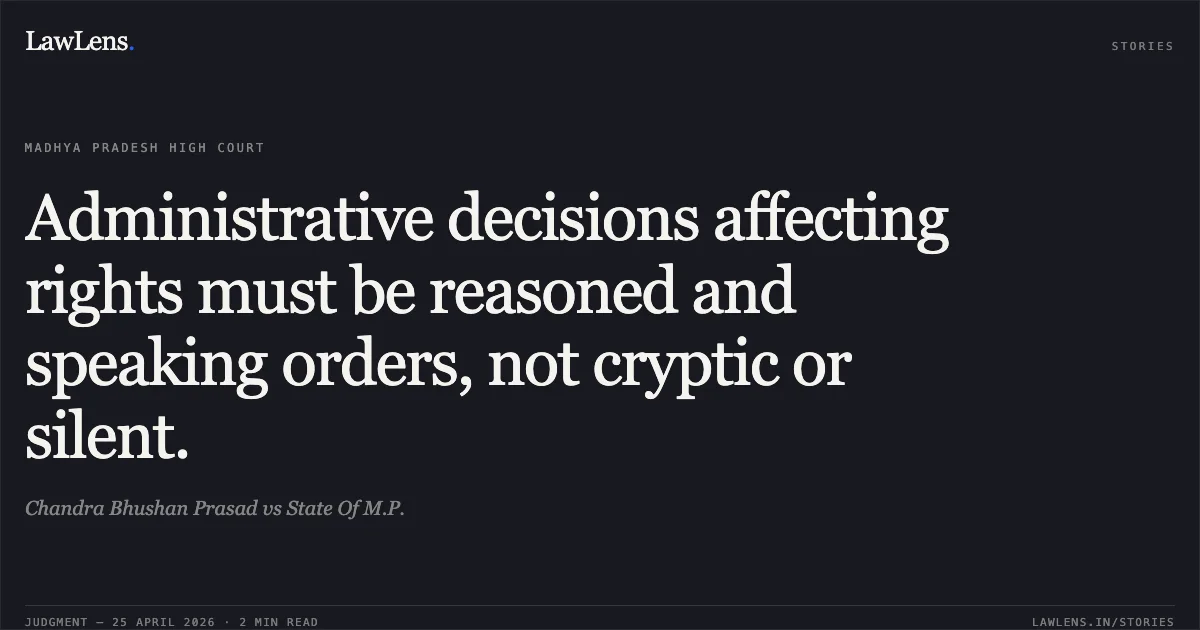
The Court held that the impugned order was legally infirm for lack of reasons.
Consequently, the petition was allowed, and the rejection order dated July 14, 2006, was set aside. The Court directed the petitioners to submit a fresh representation within three weeks and ordered the competent authority (Respondent No. 1) to decide the matter by passing a reasoned and speaking order within three months, after affording the petitioners a personal opportunity of being heard
Source reference: para. 12(i)-(iv)Original Court PDF
Chandra Bhushan PrasadvsState Of M.P.
Click to open original judgment
Original judgment, available to read, download and summarize on LawLens.in


![Subsequent exoneration does not retrospectively invalidate a finalized promotion select list.. UNNIKRISHNAN M vs M/o Environment And Forests. CAT - ['Ernakulam']. LawLens](/stories/thumbnails/subsequent-exoneration-does-not-retrospectively-invalidate-a-finalized-promotion-select-li-ce80a0e84f2f4887857271e8b4341c42.webp)