Facts
The respondent, promoted as Commissioner of Income Tax in 2003, was considered for promotion as Principal Commissioner of Income Tax (“PCIT”) by a Departmental Promotion Committee (“DPC”) in 2014.
Source reference: p.1 / para.1His name was omitted from the promotion list because the Department considered his Annual Performance Appraisal Report for 2009–2010, despite that year being declared a “No Report Year”.
Source reference: p.1 / para.1The respondent’s challenge before the Central Administrative Tribunal (“Tribunal”) in OA No. 852/2016 was allowed on 3 June 2016, with directions for a Review DPC and, if found fit, promotion within the prescribed timelines.
Source reference: p.2 / para.3Following contempt proceedings, he was promoted as PCIT on 20 February 2017, retrospectively from 30 January 2015, but the promotion was treated as notional, with actual benefits only from the date of assumption of charge.
Source reference: p.2 / paras.4, 6Meanwhile, certain batchmates and juniors, including T.P. Krishna Kumar, were promoted as Chief Commissioners of Income Tax (“CCIT”) on an ad hoc basis against the 2016–2017 panel year, by order dated 20 September 2016.
Source reference: p.2 / para.5; p.5 / para.15The respondent consequently filed OA No. 1360/2017 seeking promotion as CCIT from the date on which T.P. Krishna Kumar, his immediate junior, was promoted.
Source reference: p.3 / para.7The Tribunal allowed the application on 3 October 2024, directing consequential benefits. The Union of India challenged that order before the High Court on 6 July 2026, without explaining the delay or complying with the Tribunal’s order.
Source reference: p.5 / paras.17–18Issues
Whether the respondent was entitled to promotion as CCIT from the date on which his immediate junior, T.P. Krishna Kumar, was promoted, along with consequential benefits?
Source reference: p.3 / para.7; p.4 / paras.11–15Whether the petitioner could treat the respondent’s retrospective promotion as PCIT as merely notional and deny him the financial and consequential benefits of promotion?
Source reference: p.4 / paras.10–14Whether the writ petition ought to be dismissed on account of unexplained delay and the petitioner’s failure to comply with the Tribunal’s order?
Source reference: p.5 / paras.17–19Law Applied
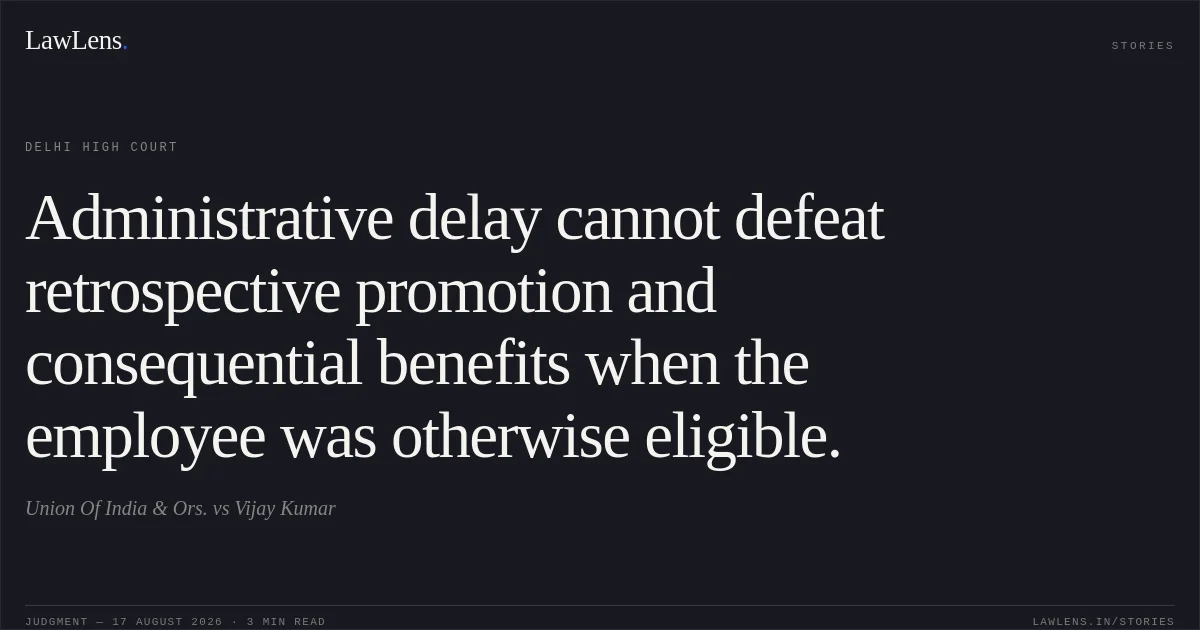
The Court applied the principle that an employee should not be denied the benefits of promotion where the delay in promotion is attributable to the employer’s mistake or administrative default.
Source reference: p.4 / para.13Relying on Food Corporation of India v. S.N. Nagarkar, (2002) 2 SCC 475, the Court affirmed that an officer is entitled to appropriate retrospective promotion and consequential relief where juniors were promoted earlier due to the employer’s fault.
Source reference: p.4 / para.13The Court also considered FR 17(1), relied upon by the Union to deny wages for the period during which the respondent had not actually performed CCIT duties, but held that the principle could not benefit the employer where the employee’s inability to assume duties resulted from the employer’s own mistake.
Source reference: p.4 / para.14Further, the equitable and discretionary jurisdiction under Article 226 of the Constitution may be refused to a litigant who approaches the Court belatedly, fails to explain the delay, and remains in non-compliance with the order under challenge.
Source reference: p.5 / paras.17–18Reasoning
The Court held that the respondent’s delayed promotion resulted from the Department’s initial reliance on an inadmissible APAR for a “No Report Year” and its subsequent failure to implement the Tribunal’s order promptly.
Source reference: p.5 / para.16Since the respondent was in service on 20 September 2016, the date on which his junior T.P. Krishna Kumar was promoted as CCIT, his subsequent superannuation could not defeat his claim to parity.
Source reference: p.5 / para.16The Department had no justification for unilaterally characterising his retrospective PCIT promotion as notional when the Tribunal had directed promotion if he was found fit.
Source reference: p.4 / paras.10–12Applying the principle in S.N. Nagarkar, the Court concluded that the respondent was entitled to promotion as CCIT from the date of his junior’s promotion, with consequential benefits; FR 17(1) could not be invoked to reward the Department for its own default.
Source reference: p.4 / paras.13–14Independently, the writ petition was filed nearly two years after the Tribunal’s order, without any explanation for the delay, and the Union had not complied with that order.
Source reference: p.5 / paras.17–18Holding
The High Court dismissed the writ petition both on merits and on the ground of unexplained delay.
It upheld the Tribunal’s direction granting the respondent promotion as CCIT with effect from the date on which T.P. Krishna Kumar was promoted, together with consequential relief.
Source reference: p.6 / para.19The Union of India was directed to comply with the Tribunal’s order positively within six weeks from 13 August 2026.
Source reference: p.6 / para.19Original Court PDF
Union Of India & Ors.vsVijay Kumar
Click to open original judgment
Original judgment, available to read, download and summarize on LawLens.in