Facts
Amulya Enterprises obtained a decree in its commercial suit against IRCTC.
Source reference: para. 1The appellant filed this appeal on 19 November 2024, 92 days late, and sought condonation of delay.
Source reference: para. 3–5It relied on the time taken to obtain certified copies and head-office approval, counsel’s mistaken belief that judgment would again be adjourned, a bereavement in counsel’s family, and advice to await the outcome of a related appeal.
Source reference: para. 3–5, 9–10The respondent opposed condonation, contending that the affidavits did not adequately explain the delay.
Source reference: para. 9–10Issues
Whether the appellant established sufficient cause to condone the 92-day delay in filing the commercial appeal
Source reference: para. 3–5, 9–11Whether the appellant’s reliance on adjournments in pronouncing judgment, administrative approval, counsel’s bereavement, or a pending related appeal justified condonation
Source reference: para. 3–5, 9–10Law Applied
Under Section 13(1-A) of the Commercial Courts Act, 2015, read with Section 37 of the Arbitration and Conciliation Act, 1996, the applicable limitation period for a commercial appeal is 60 days; under Government of Maharashtra (Water Resources Department) v. Borse Brothers Engineers and Contractors (P) Ltd., delay beyond that period is condonable only exceptionally, where the party acted bona fide and without negligence.
Source reference: para. 6“Sufficient cause” requires an adequate explanation showing diligence and absence of negligence or lack of bona fides; limitation cannot be extended on equitable grounds alone.
Source reference: para. 6Administrative file movement, without a reasonable and particularised explanation of bona fide efforts, does not by itself constitute sufficient cause, and public authorities are bound to pursue remedies diligently.
Source reference: para. 7A litigant must explain the relevant course of events and take timely steps to monitor proceedings and obtain the judgment; administrative laxity alone is insufficient.
Source reference: para. 7–8Reasoning
Although earlier adjournments could explain counsel’s mistaken impression on the judgment date, the appellant did not explain why it failed to verify the result afterward; the certified copies were sought only on 18 July 2024, more than a month after judgment.
Source reference: para. 9Nor did the affidavits state when the appeal proposal was submitted, what steps followed, or when head-office approval was obtained.
Source reference: para. 9–10The bereavement was not linked by particulars to the filing delay, and the pending related appeal did not prevent timely filing.
Source reference: para. 9–10The asserted merits of the appeal could not substitute for sufficient cause.
Source reference: para. 10Holding
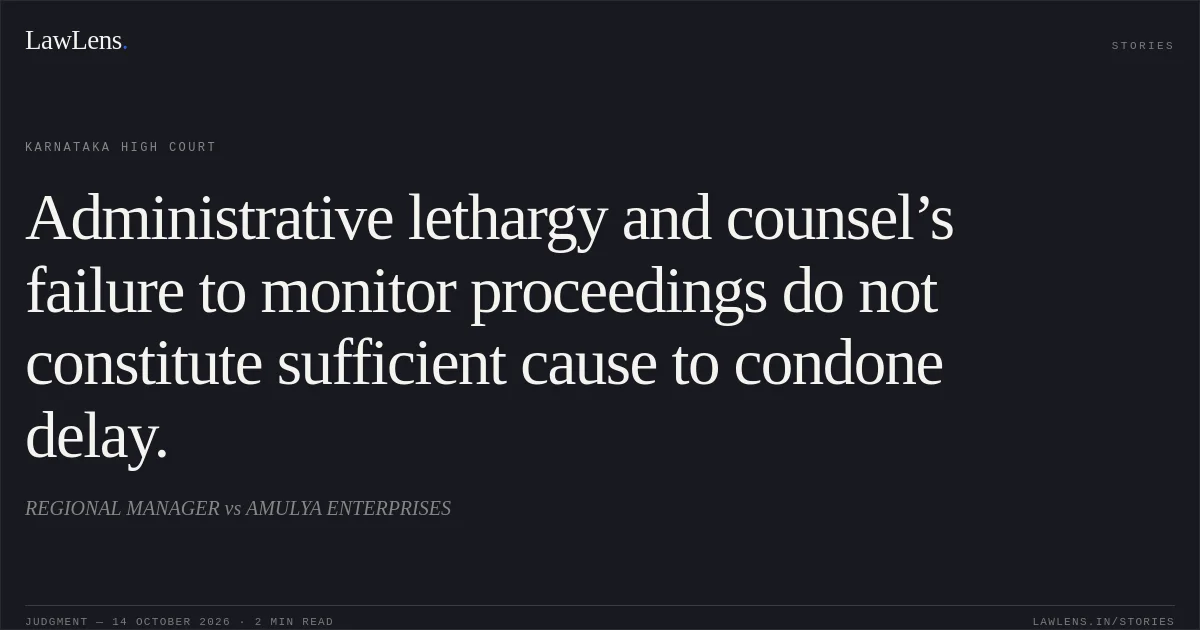
The Court held that the appellant failed to establish sufficient cause for condonation of the 92-day delay.
It dismissed I.A. No. 1/2026 seeking condonation and, consequently, dismissed the appeal.
Source reference: para. 11–13Pending interlocutory applications were also disposed of.
Source reference: para. 11–13Acts & Sections Cited
5 provisions across 3 statutes referred to in this judgment. Each provision opens on LawLens.
Arbitration and Conciliation Act, 19961
Commercial Courts Act, 20151
Limitation Act, 19633
Original Court PDF
REGIONAL MANAGERvsAMULYA ENTERPRISES
Click to open original judgment
Original judgment, available to read, download and summarize on LawLens.in


