Facts
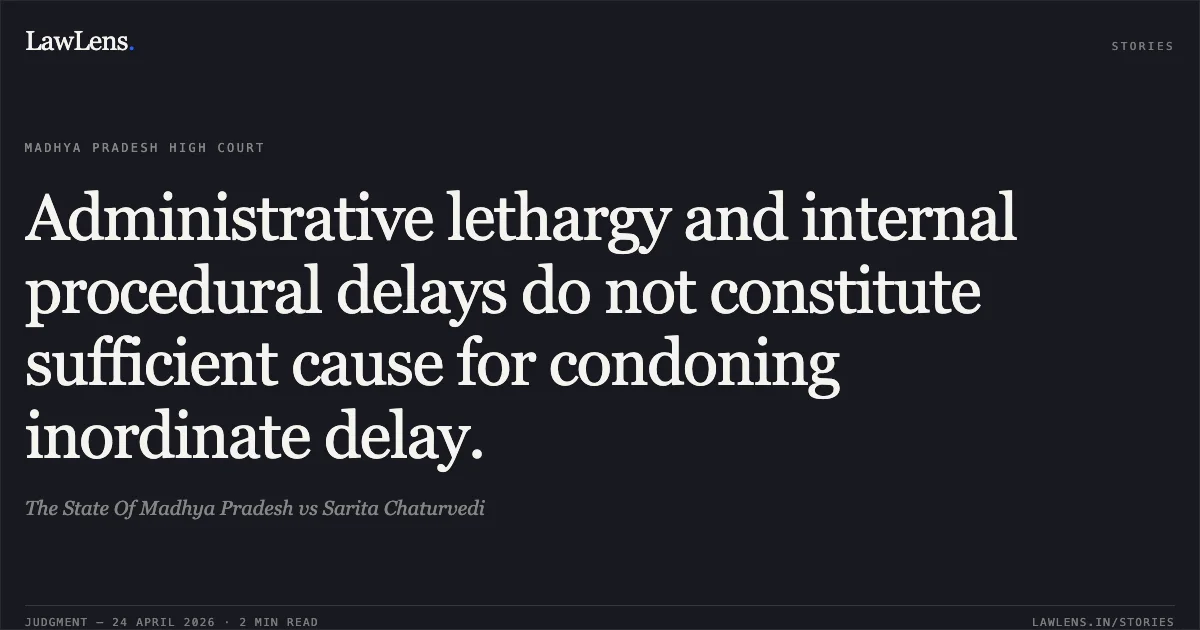
The petitioners (State of Madhya Pradesh) filed a review petition seeking to challenge the order dated 29.11.2022 passed in Writ Petition No. 23294/2022, which had been allowed in favor of the respondent.
Source reference: para. 2Along with the review petition, the petitioners filed I.A. No. 7374/2026, an application to condone a delay of 1185 days (approximately 3.2 years).
Source reference: para. 1The petitioners attributed the delay to "administrative reasons," specifically the time consumed in seeking legal opinions, obtaining departmental approvals, and internal file processing between 2023 and 2024.
Source reference: para. 3The respondent opposed the application, arguing that internal administrative lethargy does not constitute "sufficient cause".
Source reference: para. 4Issues
1. Whether the inordinate delay of 1185 days, attributed to administrative procedural formalities, constitutes "sufficient cause" for condonation under the law of limitation.
Source reference: para. 1, 32. Whether Government departments are entitled to a more lenient standard or special treatment regarding the expiry of limitation periods.
Source reference: para. 4, 6Law Applied
The court relied on the principle that "delay defeats equity" and that the law assists the vigilant, as established in Pundlik Jalam Patil v. Executive Engineer, Jalgaon Medium Project (2008) 17 SCC 448.
Source reference: para. 5Administrative lethargy and laxity cannot be sufficient grounds for condonation and that State machinery must establish bona fides and constant vigilance, as held in Shivamma v. Karnataka Housing Board (Civil Appeal No. 11794/2025).
Source reference: para. 6Delay cannot be condoned on "mere asking" without highlighting a specific, legitimate sufficient cause, per Shankargir v. State of M.P. (2025 SCC Online SC 2816).
Source reference: para. 7Reasoning
The Court examined the petitioners’ justification for the 1185-day delay and found it insufficient, noting that the petitioners relied on a general procedural timeline—such as seeking a writ appeal opinion only in late 2023 and waiting until 2024 for review filing permissions.
Source reference: para. 3Applying the Shivamma precedent, the Court reasoned that constitutional courts should not act as "surrogates for State laxity" or grant "legitimizing effect" to the callous attitude of authorities.
Source reference: para. 6, para. 262The Court observed that the petitioners failed to demonstrate diligence, noting that allowing such stale claims would frustrate the fruits of the decree obtained by the private litigant.
Source reference: para. 6, para. 262-263The Court rejected the petitioners' reliance on Aribam Juleshwar Sharma v. Aribam Pishak Sharma (AIR 1979 SC 1047), finding it misplaced in the context of such gross and unexplained delay.
Source reference: para. 4, 8Holding
The Court held that the delay had not been properly explained and that procedural bureaucracy does not exempt the State from limitation laws.
I.A. No. 7374/2026 seeking condonation of delay was rejected, and the review petition was dismissed as time-barred.
Source reference: para. 8Acts & Sections Cited
1 provisions across 1 statute referred to in this judgment. Each provision opens on LawLens.
Code of Civil Procedure, 19081
Original Court PDF
The State Of Madhya PradeshvsSarita Chaturvedi
Click to open original judgment
Original judgment, available to read, download and summarize on LawLens.in