Facts
Opposite Party No. 2 alleged that she maintained a savings account with Punjab National Bank, Raja Bazar Branch, and was allotted Locker No. 222 on 26 November 2011, in which she claimed to have deposited gold ornaments worth approximately ₹20–25 lakh.
Source reference: paras. 3–4When she visited the bank on 8 February 2016, she was allegedly informed that the locker had been allotted to another person. She alleged that the petitioner, the then Chief Manager, along with the locker custodian, had unlawfully taken or misappropriated her jewellery.
Source reference: para. 3Her complaint was referred for investigation under Section 156(3) Cr.P.C., resulting in registration of Shastrinagar P.S. Case No. 14 of 2017.
Source reference: para. 3The petitioner contended that he assumed charge only on 1 July 2014 and acted on the Senior Manager’s information that the locker had been surrendered and its key was missing. A duly constituted committee thereafter broke open the locker on 29 September 2014; no article was found and an inventory was prepared.
Source reference: paras. 5, 12The CBI enquiry and the bank’s internal enquiry allegedly found negligence or procedural irregularity, but no dishonest intention or criminal mens rea.
Source reference: para. 6Despite this, the Additional Chief Judicial Magistrate-IV, Patna, took cognizance of the offence under Section 409 IPC on 19 July 2021.
Source reference: para. 4Issues
Whether the materials on record disclosed the essential ingredients of criminal breach of trust by a banker under Section 409 IPC against the petitioner?
Source reference: paras. 10–17Whether the High Court should exercise its inherent jurisdiction under Section 482 Cr.P.C. to quash the order taking cognizance and the consequential criminal proceedings?
Source reference: para. 10Law Applied
Section 409 IPC applies where a public servant, banker, merchant or agent, having been entrusted with property or dominion over it, commits criminal breach of trust in respect of that property.
Source reference: paras. 11, 13Under Section 405 IPC, criminal breach of trust requires: (i) entrustment of property or dominion over property; and (ii) dishonest misappropriation, conversion, use or disposal of that property contrary to law or contract.
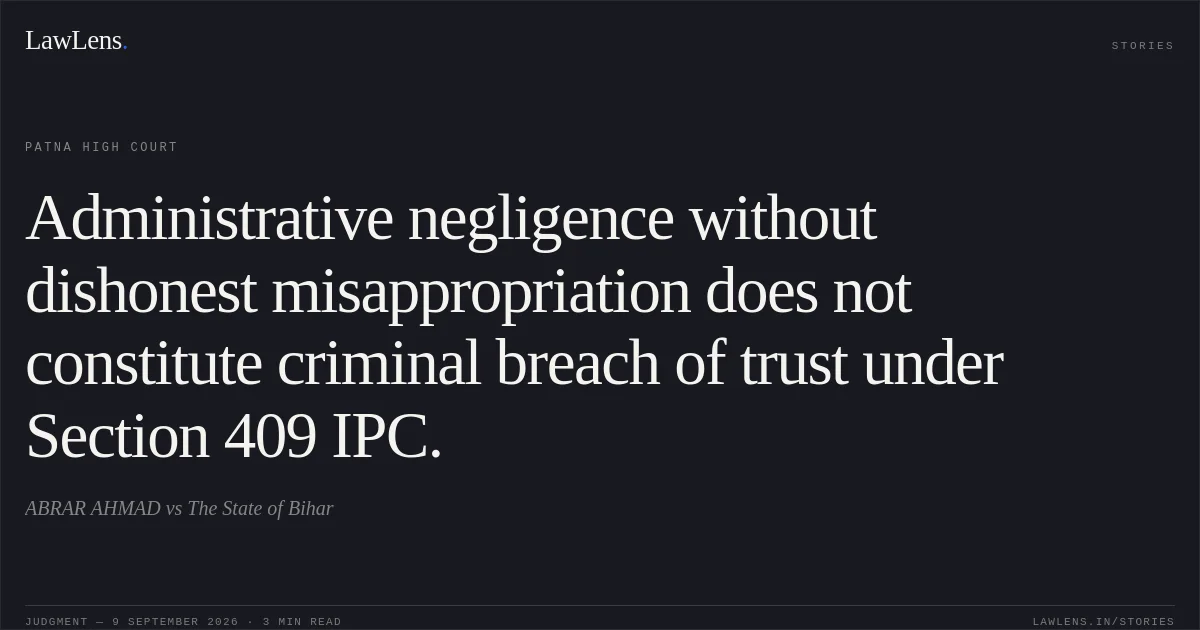
Source reference: para. 11The requirement of “dishonesty” imports mens rea; mere negligence, retention or procedural irregularity, without dishonest misappropriation or conversion, does not constitute criminal breach of trust.
Source reference: para. 11Relying on N. Raghavender v. State of Andhra Pradesh, CBI, (2021) 18 SCC 70, the Court held that personal entrustment or dominion and dishonest breach must be shown.
Source reference: para. 11Under Section 482 Cr.P.C., as explained in State of Haryana v. Bhajan Lal, 1992 Supp (1) SCC 335, proceedings may be quashed where the allegations and materials, even if accepted at face value, do not disclose the commission of the alleged offence.
Source reference: para. 16Reasoning
The Court found no material showing that the alleged ornaments were personally entrusted to the petitioner or that he had exclusive dominion over them; any entrustment was to the bank in the course of its banking operations, not to the petitioner individually.
Source reference: para. 13There was also no evidence that the petitioner misappropriated or dishonestly converted the ornaments. The locker was opened by a committee, an inventory was prepared, and no article was found inside; the complainant also did not produce receipts or other documentary evidence substantiating the alleged jewellery.
Source reference: para. 14The petitioner had acted on information supplied by the Senior Manager and had followed the formal break-open procedure, although the locker may have been erroneously identified and due caution may not have been exercised.
Source reference: para. 15These circumstances could support departmental or administrative action for negligence, but did not establish dishonest intention, misappropriation or conversion necessary for Section 409 IPC.
Source reference: paras. 15, 17Accordingly, continuation of the prosecution fell within the categories warranting interference under Bhajan Lal.
Source reference: para. 16Holding
The Court held that the essential ingredients of Section 409 IPC were absent: there was no personal entrustment of the alleged ornaments to the petitioner, no material showing dishonest misappropriation or conversion, and no evidence of the requisite mens rea.
The order dated 19 July 2021 taking cognizance under Section 409 IPC was set aside, and the entire criminal proceeding arising from Shastrinagar P.S. Case No. 14 of 2017 was quashed insofar as it concerned the petitioner.
Source reference: para. 18The criminal miscellaneous application was accordingly allowed.
Source reference: para. 19Acts & Sections Cited
4 provisions across 2 statutes referred to in this judgment. Each provision opens on LawLens.
Code of Criminal Procedure, 19732
Indian Penal Code, 18602
Original Court PDF
ABRAR AHMADvsThe State of Bihar
Click to open original judgment
Original judgment, available to read, download and summarize on LawLens.in