Facts
The petitioner, a registered Government Contractor, was transporting stone chips for road maintenance work under a five-year contract when his trucks (BR09GB-6708 and BR09GB-6709) were seized by the Mines Inspector on 17.10.2024 for alleged violations of the Bihar Mineral Rules.
Source reference: p. 2-3The respondent authorities claimed the drivers failed to produce valid transit challans during interception.
Source reference: p. 6-7During the pendency of the writ petition, the Mineral Development Officer (MDO) issued Letter No. 1005 dated 21.11.2024, imposing a penalty of ₹16,95,626/– without issuing a show-cause notice or granting a hearing to the petitioner.
Source reference: p. 2, 7-8Issues
1. Whether the order of penalty passed by the Mineral Development Officer was legally sustainable given it was issued without a show-cause notice or an opportunity for a hearing.
Source reference: p. 82. Whether the seizure of the vehicles was lawful under the Bihar Mineral Prevention of Illegal Mining, Transportation and Storage Rules, 2019.
Source reference: p. 3-4Law Applied
The court primarily applied the doctrine of audi alteram partem (the right to be heard) as an essential component of the Principles of Natural Justice.
Source reference: p. 8, 13-14Supreme Court precedent in Krishnadatt Awasthy v. State of M.P. (2025), which establishes that any administrative action involving civil consequences must be preceded by a fair hearing, and non-observance constitutes inherent prejudice.
Source reference: p. 8-13Rule 43 and Rule 56 of the Bihar Minerals (Concession, Prevention of Illegal Mining, Transportation & Storage) Rules, 2019, regarding mandatory transit challans and compounding procedures.
Source reference: p. 6Reasoning
The Court observed that while the respondents argued the seizure was valid due to the absence of transit challans, the MDO proceeded to pass a final recovery order while the writ petition was already under judicial scrutiny.
Source reference: p. 7-8The Court highlighted that the doctrine of audi alteram partem requires three essentials: notice to the affected party, a fair procedure, and a reasoned order.
Source reference: p. 13-14In this case, the MDO failed to issue a show-cause notice or provide any platform for the petitioner to present evidence (such as the invoices and e-receipts produced in Annexure P/2) before imposing a substantial financial penalty.
Source reference: p. 14The Court determined that since the order carried civil consequences, the total absence of a hearing made the administrative action void and necessitated a remand.
Source reference: p. 14-15Holding
The Court held that the impugned order dated 21.11.2024 violated the principles of natural justice and was therefore unsustainable.
The Court quashed and set aside the penalty order and remitted the matter to the Mineral Development Officer, Begusarai.
Source reference: p. 15The respondent was directed to pass a fresh, reasoned, and speaking order after providing the petitioner with an opportunity for a hearing.
Source reference: p. 15Original Court PDF
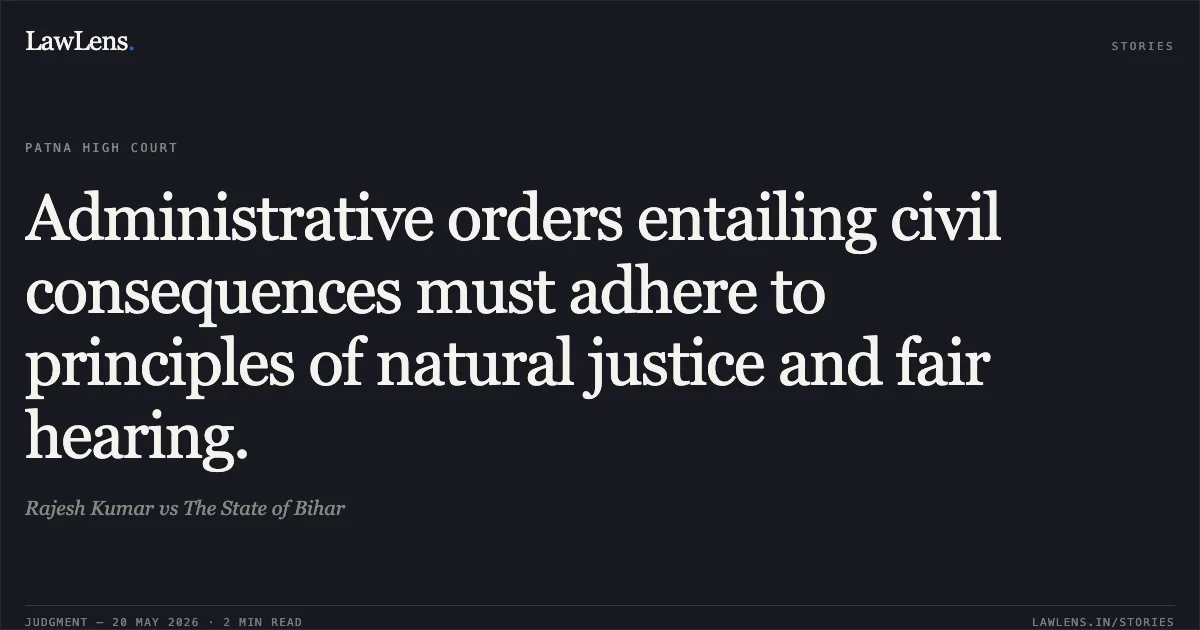
Rajesh KumarvsThe State of Bihar
Click to open original judgment
Original judgment, available to read, download and summarize on LawLens.in


![Subsequent exoneration does not retrospectively invalidate a finalized promotion select list.. UNNIKRISHNAN M vs M/o Environment And Forests. CAT - ['Ernakulam']. LawLens](/stories/thumbnails/subsequent-exoneration-does-not-retrospectively-invalidate-a-finalized-promotion-select-li-ce80a0e84f2f4887857271e8b4341c42.webp)