Facts
The petitioner, an Assistant Property Tax Officer at the Municipal Corporation, Gwalior, was issued show-cause notices in January and February 2016 for failing to meet property tax collection targets
Source reference: p. 2Despite submitting detailed replies, the Disciplinary Authority passed orders on 07.06.2016 and 12.07.2016 withholding two increments and one increment respectively, without cumulative effect
Source reference: p. 2-4The petitioner’s appeals were subsequently rejected by the Appellate Authority on 24.01.2017 via non-speaking orders
Source reference: p. 2The petitioner challenged these orders under Article 226 of the Constitution of India, contending they were unreasoned and failed to consider his defense
Source reference: p. 2Issues
1. Whether the disciplinary and appellate orders were legally sustainable since they were "non-speaking" and failed to consider the petitioner’s replies?
Source reference: p. 4 / para. 72. Whether the failure to reach property tax collection targets constitutes "misconduct" justifying the withholding of increments after the employee's retirement?
Source reference: p. 11 / para. 14(iii)Law Applied
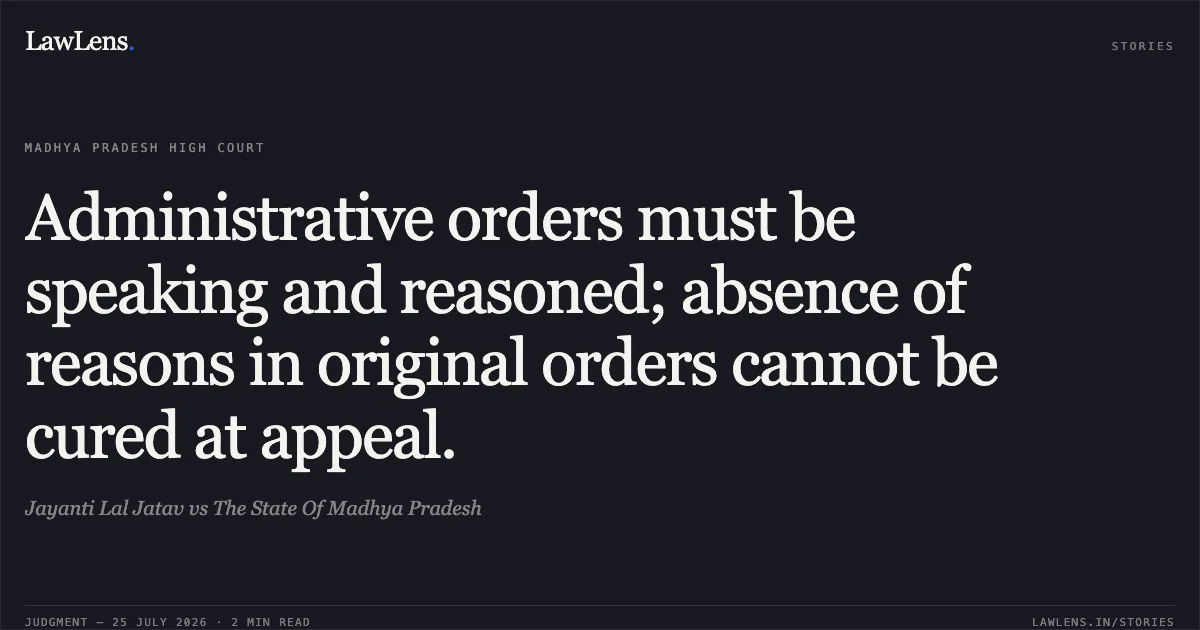
quasi-judicial and administrative authorities must pass "speaking orders" containing valid and justifiable reasons to ensure transparency and prevent arbitrariness
Source reference: p. 5 / para. 7-8Kranti Associates Pvt. Ltd. v. Masood Ahmed Khan (2010), which established that recording reasons is a component of natural justice and the "soul of justice"
Source reference: p. 6-7 / para. 11Oryx Fisheries Pvt. Ltd. v. Union of India (2010) to affirm that the absence of reasons in an original order cannot be cured by the appellate order
Source reference: p. 8-10 / para. 12S.D. Bind v. Union of India (2015) regarding the definition of misconduct in the context of performance targets
Source reference: p. 11 / para. 14(iii)Reasoning
The Court found that both the Disciplinary and Appellate Authorities exercised quasi-judicial powers but failed to apply their minds to the petitioner's specific defenses
Source reference: p. 4-5 / para. 7The punishment orders were deemed "non-speaking" and "unreasoned" because they did not address the facts or grounds mentioned in the petitioner's replies to the show-cause notices
Source reference: p. 4 / para. 5; p. 5 / para. 7The Court emphasized that for an order to be valid, the affected party must know how their defense was considered
Source reference: p. 5 / para. 8no specific show-cause notice was issued asking why the particular punishment of withholding increments should not be imposed
Source reference: p. 10 / para. 13following the ratio in S.D. Bind, the court determined that the allegations regarding tax collection did not amount to "misconduct"
Source reference: p. 11 / para. 14(iii)Holding
The Court allowed the petition and quashed the impugned orders dated 07.06.2016, 12.07.2016, and 24.01.2017
The respondents were directed to grant all consequential benefits to the petitioner within three months, with 6% interest per annum in case of delay. Since the petitioner had already retired and the allegations did not constitute misconduct, the Court denied the respondents liberty to take fresh action
Source reference: p. 11 / para. 14(ii)-(iii)Original Court PDF
Jayanti Lal JatavvsThe State Of Madhya Pradesh
Click to open original judgment
Original judgment, available to read, download and summarize on LawLens.in


