Facts
The State of Chhattisgarh and its officers filed a writ appeal challenging the order dated 19.03.2025 passed by the learned Single Judge in W.P.(S) No. 1872 of 2025.
Source reference: paras. 1–3The appeal was filed with a delay of 442 days, for which the appellants sought condonation on the ground that time was consumed in departmental processing, obtaining legal opinion, securing approval, collecting records, and authorising counsel to file the appeal.
Source reference: paras. 1–3The respondent opposed the application and submitted that an appeal involving similarly situated persons had already been dismissed in WA No. 614 of 2025, and that the Supreme Court had dismissed the State’s challenge to that decision on 22.07.2026.
Source reference: para. 4Issues
Whether the appellants had shown “sufficient cause” for condoning the delay of 442 days in filing the writ appeal.
Source reference: paras. 1–3, 8–9Whether the writ appeal was liable to be dismissed as barred by limitation if the delay was not condoned.
Source reference: para. 10Law Applied
The Court applied the principle governing condonation of delay under the law of limitation, namely that an applicant must establish a genuine, adequate, and acceptable “sufficient cause” for not approaching the Court within the prescribed period. Negligence, inaction, lack of bona fides, and unexplained administrative delay do not justify condonation.
Source reference: para. 5Relying on Postmaster General v. Living Media India Ltd., (2012) 3 SCC 563, the Court held that Government departments are bound by limitation and cannot claim a separate or privileged limitation period merely because of bureaucratic procedures.
Source reference: para. 5Relying on State of Madhya Pradesh v. Ramkumar Choudhary, 2024 INSC 932, and the principles reiterated from Basawaraj v. Special Land Acquisition Officer and Union of India v. Jahangir Byramji Jeejeebhoy, 2024 INSC 262, the Court held that delay must be considered judicially, not generously or mechanically; the applicant must show reasonable diligence, and the cause preventing filing must arise within the original limitation period.
Source reference: paras. 6–7Reasoning
The Court accepted that the appellants had provided a chronology of departmental steps, including legal consultation and administrative approval. However, it held that the explanation merely described the internal administrative process and did not identify any unavoidable circumstance that prevented filing within the prescribed limitation period.
Source reference: para. 8Applying the rule that Government departments are subject to the same limitation requirements as private litigants, and that procedural red tape is not by itself sufficient cause, the Court found that the chronology did not satisfactorily explain the 442-day delay or demonstrate due diligence.
Source reference: paras. 7–9The Court further observed that liberal consideration of “sufficient cause” cannot become mechanical where the delay is substantial and the explanation is inadequate.
Source reference: para. 9Holding
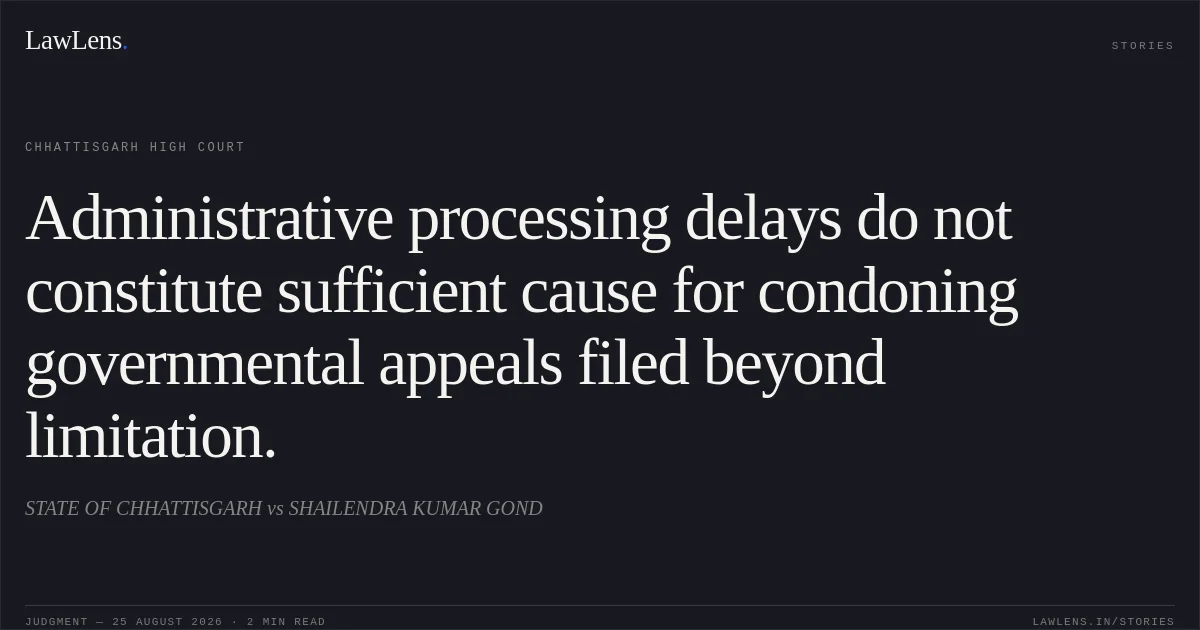
The Court held that the appellants failed to establish sufficient cause for condoning the delay of 442 days. I.A. No. 1 was accordingly rejected.
As the delay remained uncondoned, WA No. 796 of 2026 was dismissed as barred by limitation, without examination of the merits of the challenge to the Single Judge’s order.
Source reference: para. 10Original Court PDF
STATE OF CHHATTISGARHvsSHAILENDRA KUMAR GOND
Click to open original judgment
Original judgment, available to read, download and summarize on LawLens.in
![Courts will not interfere with transfers absent mala fides or violation of statutory rules.. M Ramya vs EMPLOYEES STATE INSURANCE CORPORATION (ESIC). CAT - ['Chennai']. LawLens](/stories/thumbnails/courts-will-not-interfere-with-transfers-absent-mala-fides-or-violation-of-statutory-rules-a6845e9ca6f548fca284c51c8351957f.webp)
![Courts cannot direct one-time recruitment age relaxation absent authority in the governing rules or advertisement.. UT OF PUDUCHERRY vs M ANDAL. CAT - ['Chennai']. LawLens](/stories/thumbnails/courts-cannot-direct-one-time-recruitment-age-relaxation-absent-authority-in-the-governing-895d78fde47143e2a8ed0207c4b6a44f.webp)
![A review cannot correct an allegedly erroneous decision absent an error apparent on the record.. Ajit Kumar Jha vs RAILWAY BOARD. CAT - ['Delhi']. LawLens](/stories/thumbnails/a-review-cannot-correct-an-allegedly-erroneous-decision-absent-an-error-apparent-on-the-re-8ac952fd4eba470c92f7da20af72a220.webp)