Facts
The Review Applicants (State of U.P. and Principal Chief Conservator of Forest) filed a review application along with a delay condonation application (MA No. 02 of 2026) seeking to review an order passed in OA No. 332/00027/2015.
Source reference: p. 1The applicants argued that the Tribunal possesses the powers of a Civil Court and can condone delay under Section 5 of the Limitation Act, 1963, citing a circular from the Principal Bench and a High Court judgment in Surendra Kumar v. Union of India.
Source reference: p. 1-2The primary matter for adjudication was whether the Tribunal has the statutory authority to condone delays in filing review applications.
Source reference: p. 1Issues
1. Whether the Central Administrative Tribunal has the power to condone delay in filing a review application under Section 5 of the Limitation Act, 1963.
Source reference: p. 5 / para. 92. Whether the limitation period prescribed under Rule 17 of the CAT (Procedure) Rules, 1987 is mandatory or can be extended by the Tribunal.
Source reference: p. 5 / para. 10Law Applied
The Tribunal applied Section 22 of the Administrative Tribunals Act, 1985, which grants the Tribunal certain powers of a Civil Court, including the power to review its decisions, but specifies that it is not bound by the Code of Civil Procedure.
Source reference: p. 2Rule 17(1) of the Central Administrative Tribunal (Procedure) Rules, 1987, which stipulates that no review application shall be entertained unless filed within 30 days of receipt of the order.
Source reference: p. 3The core governing precedent was the Supreme Court decision in The Property Company (P) Ltd. vs. Rohinten Daddy Mazda (2026), which established that quasi-judicial bodies or tribunals cannot resort to Section 5 of the Limitation Act to extend time unless such power is expressly indicated in their governing statute.
Source reference: p. 3-5 / para. 8Reasoning
The Tribunal reasoned that while it possesses the power to review its decisions under Section 22(3)(f) of the Act, this power is subject to the specific limitation period set out in Rule 17 of the CAT (Procedure) Rules, 1987.
Source reference: p. 2-3Citing the Supreme Court’s definitive ruling in The Property Company (P) Ltd., the Tribunal observed that unless a statute expressly empowers a quasi-judicial body to apply Section 5 of the Limitation Act, such power cannot be assumed or exercised through legal fiction.
Source reference: p. 4-5The Tribunal noted that Rule 17 contains no such express provision for delay condonation.
Source reference: p. 5The Bench held that the previous practice of condoning delay based on High Court rulings was superseded by the latest Supreme Court authority.
Source reference: p. 6 / para. 12-13The Tribunal rejected the applicants' argument that the Principal Bench’s circular could override statutory rules or the Supreme Court's mandate.
Source reference: p. 7 / para. 17Holding
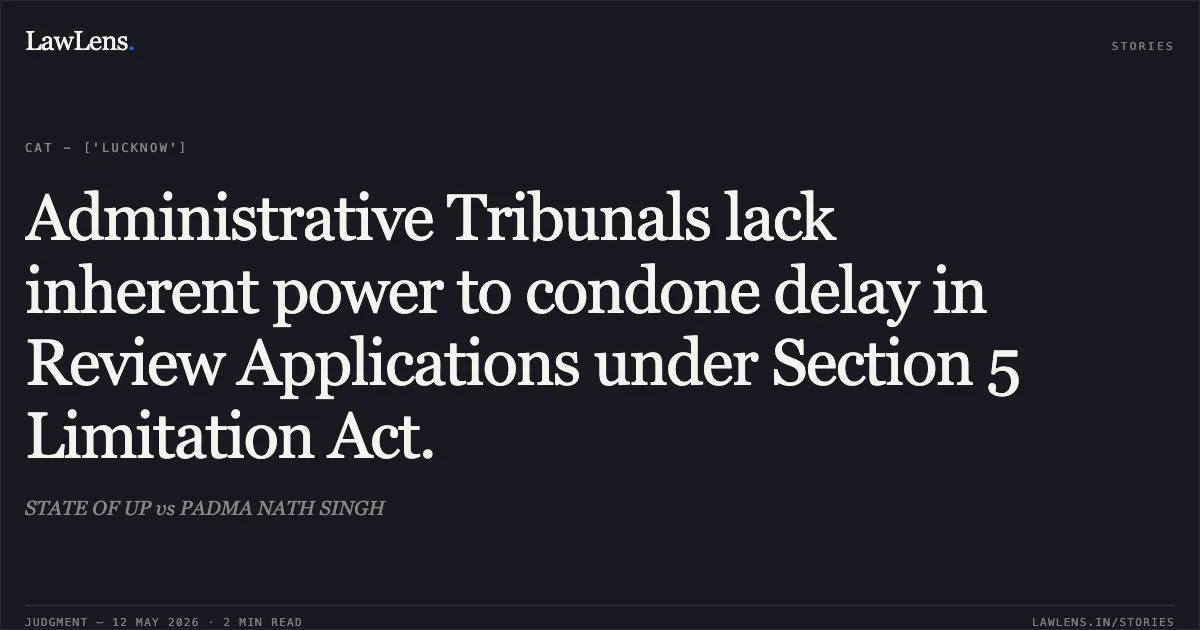
The Tribunal held that it lacks the power to condone delay in filing a review application as Rule 17 of the CAT (Procedure) Rules, 1987 does not provide for such an extension, and Section 5 of the Limitation Act is inapplicable to the Tribunal in this context.
Accordingly, the prayer for delay condonation (MA No. 02 of 2026) was rejected. As a logical consequence of the dismissal of the delay application, the Review Application was also rejected.
Source reference: p. 8 / para. 20Acts & Sections Cited
27 provisions across 3 statutes referred to in this judgment. Each provision opens on LawLens.
Limitation Act, 1963
Administrative Tribunals Act, 19853
Companies Act, 20132
Original Court PDF
STATE OF UPvsPADMA NATH SINGH
Click to open original judgment
Original judgment, available to read, download and summarize on LawLens.in


