Facts
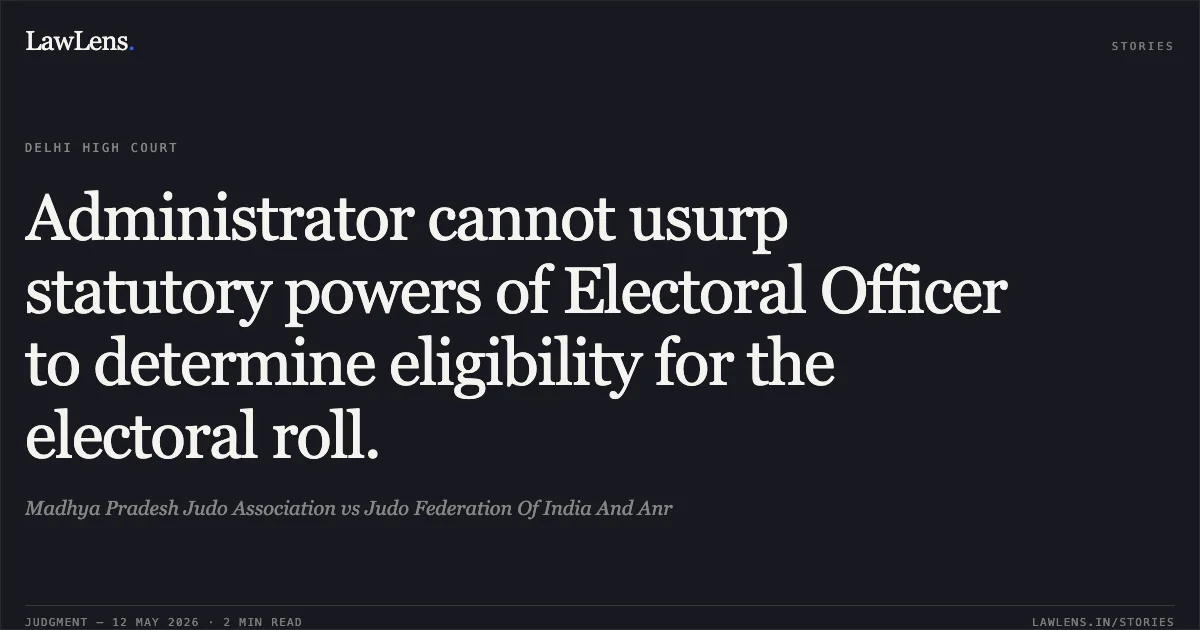
The petitioners, the Madhya Pradesh Judo Association and the All Assam Judo Association, are state-level bodies affiliated with the Judo Federation of India (JFI).
Source reference: para. 2Following a court direction, an Electoral Officer was appointed on 17.03.2026 to conduct elections for the Interim Executive Committee.
Source reference: para. 2The petitioners submitted their authorized representatives' names in Form-1 by the deadline of 10.04.2026.
Source reference: para. 2On 20.04.2026, the Administrator of the JFI issued a communication declaring the petitioners' representatives ineligible and excluded them from the Electoral College after performing his own scrutiny.
Source reference: para. 3The petitioners challenged this communication, arguing the Administrator lacked the authority to perform functions vested in the Electoral Officer.
Source reference: para. 3Issues
1. Whether the Administrator of the Judo Federation of India has the authority to scrutinize nominations and determine the eligibility of representatives for the Electoral College under the National Sports Governance Rules, 2026.
Source reference: para. 5-6Law Applied
Rule 10(5) of the National Sports Governance Rules, 2026, which mandates that the electoral roll must be prepared by the Electoral Officer, whose decision regarding inclusion or exclusion is final and binding.
Source reference: para. 5Foundational principle established in Taylor v. Taylor (1876) and affirmed by the Supreme Court in State of Uttar Pradesh v. Singhara Singh (1964), which dictates that if a statute prescribes a specific method for exercising a power, that power must be exercised in that manner and no other.
Source reference: para. 6The maxim expressio unius est exclusio alterius (the express mention of one thing excludes all others) to establish that vesting power in the Electoral Officer excludes that power from the Administrator.
Source reference: para. 6Reasoning
The court reasoned that Rule 10(5) creates a specific statutory scheme where the Electoral Officer is the sole authority responsible for the preparation and finalization of the electoral roll.
Source reference: para. 5The court noted that in the present case, an Electoral Officer had already been appointed prior to the impugned action.
Source reference: para. 5, 7By undertaking the scrutiny of nominations and declaring representatives ineligible, the Administrator performed a function that the law reserves exclusively for the Electoral Officer.
Source reference: para. 5-6Applying the rule in Taylor v. Taylor, the court held that since the statute (Rules of 2026) provides a specific mode for determining eligibility through the Electoral Officer, any exercise of that power by the Administrator is legally impermissible and renders the resulting communication void.
Source reference: para. 6Holding
The court answered the issue in the negative, holding that the Administrator exceeded his jurisdiction by performing the functions of the Electoral Officer.
The court quashed and set aside the impugned communication dated 20.04.2026.
Source reference: para. 8The court granted liberty to the duly appointed Electoral Officer to conduct the necessary scrutiny and pass appropriate orders regarding the petitioners' eligibility in accordance with the extant rules and regulations.
Source reference: para. 9Original Court PDF
Madhya Pradesh Judo AssociationvsJudo Federation Of India And Anr
Click to open original judgment
Original judgment, available to read, download and summarize on LawLens.in


![Authorities must decide pensionary and retiral-benefit claims through a reasoned order within eight weeks.. Habibullah khan vs HOME DEPARTMENT. CAT - ['Srinagar']. LawLens](/stories/thumbnails/authorities-must-decide-pensionary-and-retiral-benefit-claims-through-a-reasoned-order-wit-d0cbe8a8119c48fbabe7df9f2d353488.webp)