Facts
The petitioner, a partner in M/s Shiv Machine Tools, was implicated in a CBI FIR (2017) alleging a criminal conspiracy with a Senior Manager at MECON India Ltd (U.N. Mandal) to secure tenders at the Bokaro Steel Plant through illegal gratification
Source reference: para 5(i)-(ii)The Directorate of Enforcement (ED) registered an ECIR in 2021, alleging that the petitioner paid ₹94.42 lakhs as "proceeds of crime" (PoC) to Mandal, layered through sham transactions involving M/s Naskar Ceramics and "friendly loans" to Mandal’s relatives
Source reference: para 7-10, 81The Special Judge, PMLA, rejected the petitioner's discharge application on 06.08.2025 and subsequently framed charges on 25.03.2026
Source reference: para 3-4The petitioner challenged these orders via criminal revision, arguing the transactions were legitimate business advances and loans repaid through banking channels
Source reference: para 6Issues
1. Whether the orders dismissing the discharge application and framing charges suffered from any legal error or lacked a prima facie case
Source reference: para 15(i)2. Whether the materials collected during investigation adequately established the existence of "proceeds of crime" and the petitioner’s involvement in money laundering under Section 3 of the PMLA
Source reference: para 15(ii), 79Law Applied
The court primarily applied Section 3 (offence of money laundering) and Section 4 (punishment) of the PMLA, 2002
Source reference: para 26-29It relied on the definition of "proceeds of crime" under Section 2(1)(u), including the 2019 explanation clarifying that PoC includes property derived directly or indirectly from criminal activity relatable to a scheduled offence
Source reference: para 20-22Procedurally, the court applied Section 250 of the Bharatiya Nagarik Suraksha Sanhita (BNSS), 2023, regarding discharge
Source reference: para 35Key precedents included Vijay Madanlal Choudhary v. Union of India on the standalone nature of PMLA [para 30-33], Sajjan Kumar v. CBI on the principle that "grave suspicion" justifies framing charges [para 45], and Rohit Tandon v. ED regarding the admissibility of statements recorded under Section 50 of the PMLA
Source reference: para 104-108Reasoning
The court reasoned that at the stage of discharge and framing of charge, it must not conduct a "mini-trial" but only determine if there is a ground for presuming the commission of an offence
Source reference: para 39, 47It found that the ED’s financial trail evidenced the generation of ₹94.42 lakhs in PoC, which was layered through a tile vendor (Naskar Ceramics) via a backdated invoice issued only after the CBI’s preliminary enquiry began
Source reference: para 83, 100The court dismissed the petitioner’s "friendly loan" defence as a colorable device for layering, noting the use of proxy accounts of employees to disburse funds to the public servant’s family
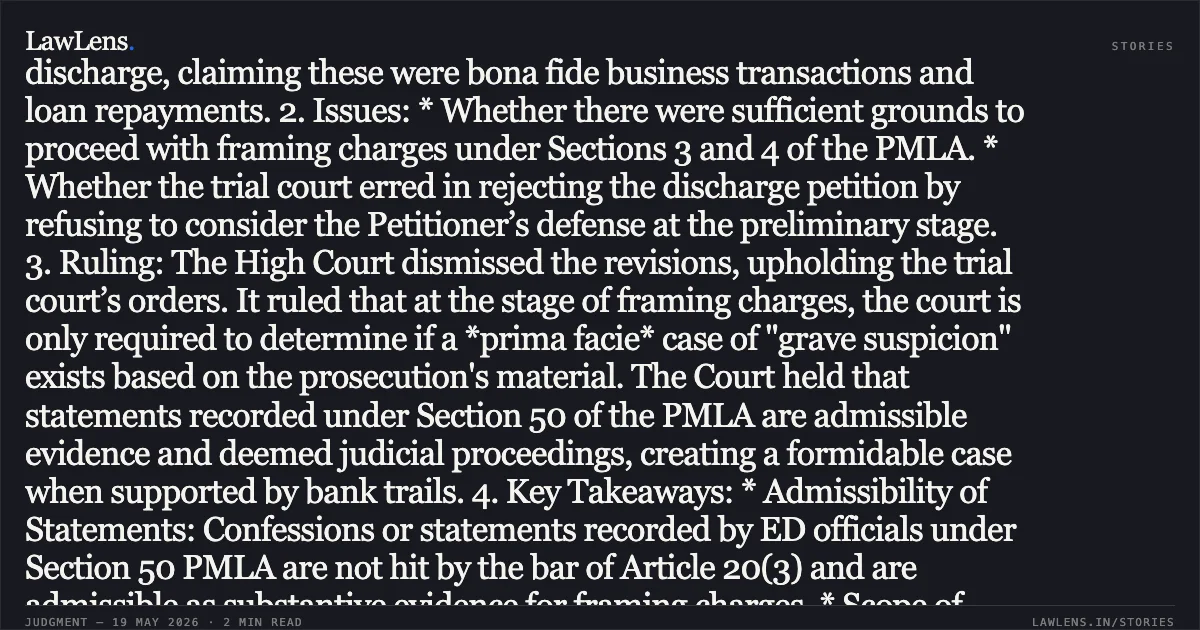
Source reference: para 84, 101It held that statements under Section 50 of the PMLA are admissible and, alongside banking records, created "grave suspicion"
Source reference: para 109-111The court also affirmed the territorial jurisdiction of the Ranchi court, as the core conspiracy was executed there
Source reference: para 98Holding
The evidence sufficiently established a prima facie case of the petitioner’s active involvement in concealing and layering proceeds of crime, which attracts Section 3 of the PMLA
The High Court dismissed the criminal revision petitions, upholding the Trial Court’s refusal to discharge the petitioner and the subsequent framing of charges
Source reference: para 127-129Acts & Sections Cited
36 provisions across 4 statutes referred to in this judgment. Each provision opens on LawLens.
Bharatiya Nagarik Suraksha Sanhita, 2023
Code of Criminal Procedure, 1973
Prevention of Money-Laundering Act, 2002
Prevention of Corruption Act, 19883
Original Court PDF
HITESH V. SHAHvsUNION OF INDIA THROUGH THE DIRECTORATE OF ENFORCEMENT
Click to open original judgment
Original judgment, available to read, download and summarize on LawLens.in


![Subsequent exoneration does not retrospectively invalidate a finalized promotion select list.. UNNIKRISHNAN M vs M/o Environment And Forests. CAT - ['Ernakulam']. LawLens](/stories/thumbnails/subsequent-exoneration-does-not-retrospectively-invalidate-a-finalized-promotion-select-li-ce80a0e84f2f4887857271e8b4341c42.webp)