Facts
The opposite party no. 2 alleged that he advanced a friendly loan of ₹6,35,000 to the petitioner and her husband in three instalments on 15 January 2014, repayable within six months. Upon their failure to repay, the petitioner allegedly issued account-payee cheque no. 455502 dated 20 November 2014. The cheque was presented and returned unpaid for “insufficient funds” on 27 November 2014. A statutory demand notice was issued on 20 December 2014, but payment was not made, leading to Complaint Case No. 167 of 2015 under, inter alia, Section 138 of the Negotiable Instruments Act, 1881 (“NI Act”).
Source reference: pp. 2–4, paras. 2–3The petitioner admitted her signature on the cheque but contended that the cheque had been lost in December 2013, that a Sanha had been lodged, and that instructions had been given to the bank to stop payment.
Source reference: pp. 6–8, para. 6The trial court convicted her under Section 138 of the NI Act on 3 June 2023 and sentenced her to six months’ imprisonment and a compensatory fine of ₹12,70,000, with one month’s simple imprisonment in default.
Source reference: pp. 4–5, para. 3In appeal, the conviction was upheld, but the imprisonment was set aside and the fine was reduced to ₹10,00,000, payable to the complainant within three months, with one month’s imprisonment in default.
Source reference: pp. 4–6, para. 4Issues
Whether the concurrent findings of conviction under Section 138 of the NI Act disclosed any illegality, impropriety, perversity, or manifest error warranting interference in revisional jurisdiction?
Source reference: pp. 11–14, para. 10Whether the petitioner had rebutted the statutory presumptions under Sections 118 and 139 of the NI Act by proving that the cheque was lost, payment had been stopped, and no legally enforceable debt or liability existed?
Source reference: pp. 17–22, paras. 13–16Whether the cheque-return memo and the statutory requirements under Section 138 of the NI Act were sufficiently proved?
Source reference: pp. 22–24, paras. 17–18Law Applied
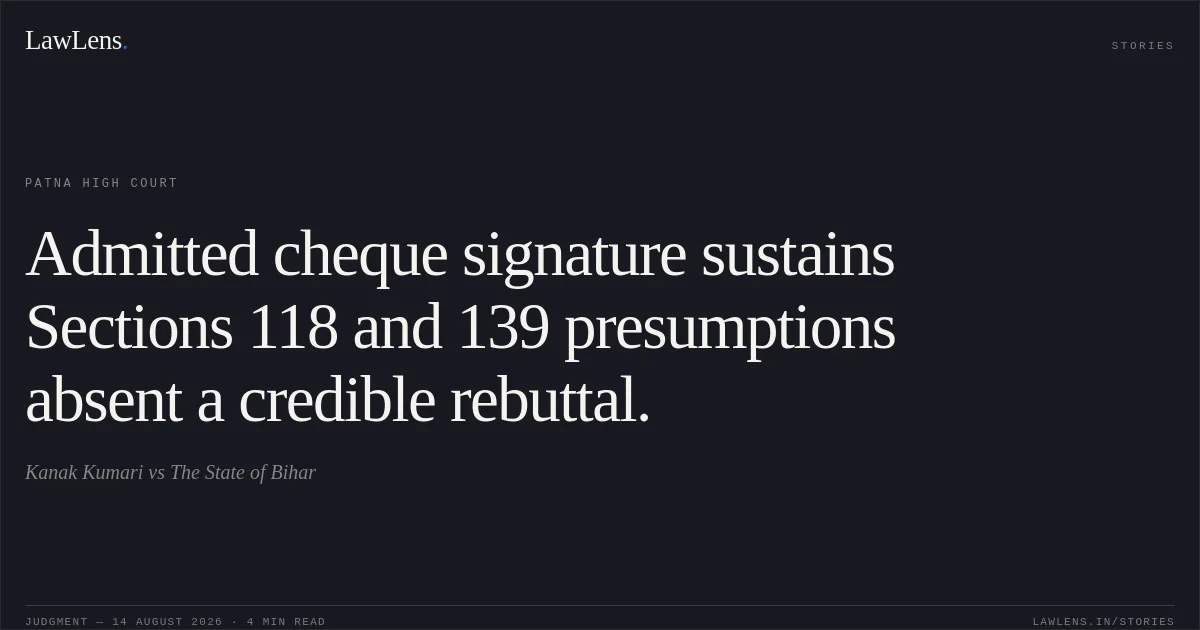
The Court applied Sections 118 and 139 of the NI Act, under which a signed negotiable instrument is presumed to have been issued for consideration and a cheque is presumed to have been received towards discharge of a debt or other liability, subject to rebuttal by the accused.
Source reference: pp. 18–21, paras. 13–15Section 138 of the NI Act requires, inter alia, presentation of the cheque within its validity period, issuance of a demand notice within the prescribed period after dishonour, and failure to pay within fifteen days of receipt of notice; the underlying debt must be legally enforceable.
Source reference: pp. 22–23, para. 17In revision under Sections 438 and 442 of the Bharatiya Nagarik Suraksha Sanhita, 2023, the High Court may examine the correctness, legality, propriety, and regularity of the proceedings, but does not ordinarily re-appreciate evidence as an appellate court.
Source reference: pp. 11–14, para. 10Relying on Kuntegowda v. Thurubaiah, 2026 INSC 790, the Court held that revisional interference is justified only where the lower court’s finding is perverse, grossly erroneous, based on irrelevant or no material, or reflects arbitrary or capricious exercise of discretion.
Source reference: p. 14, para. 10Reasoning
The petitioner’s admitted signature attracted the presumptions under Sections 118 and 139 of the NI Act. The Court found that the complainant’s witnesses consistently supported the advancement of the ₹6,35,000 loan and issuance of the cheque.
Source reference: pp. 15–16, para. 11The defence of a lost cheque was rejected because the petitioner’s version was inconsistent, no police witness was examined to prove the Sanha, and the alleged loss was not satisfactorily established.
Source reference: pp. 15–16, para. 11The defence of stop-payment instructions was also disbelieved: the return memo recorded “insufficient funds,” no bank official was examined to corroborate the alleged instructions, and the petitioner did not produce reliable evidence showing that sufficient funds existed when the cheque was presented.
Source reference: pp. 16–17, para. 11The objection to the return memo was rejected because it bore the branch seal and initials of the authorised bank official, and the petitioner had not previously specifically pleaded that it was forged or fabricated.
Source reference: p. 17, para. 12The Court further held that the complainant’s oral evidence established the debt, whereas the petitioner did not produce significant defence evidence and did not examine her husband, who was allegedly involved in the transaction.
Source reference: pp. 21–22, para. 16Since the cheque was presented on 27 November 2014, notice was issued on 20 December 2014, and the complaint was filed on 8 January 2015 after non-payment, the statutory ingredients of Section 138 were satisfied.
Source reference: p. 24, para. 18No perversity or manifest illegality was found in the concurrent findings of the subordinate courts.
Source reference: pp. 24–25, paras. 19–20Holding
The High Court answered the issues against the petitioner. It held that she failed to rebut the statutory presumptions under Sections 118 and 139 of the NI Act and that the requirements of Section 138 had been fulfilled.
Finding no ground for revisional interference, the Court dismissed Criminal Revision No. 393 of 2025 and affirmed the judgments dated 15 January 2025 and 3 June 2023. The appellate sentence—₹10,00,000 compensation/fine payable to the opposite party no. 2, with one month’s simple imprisonment in default—therefore remained operative.
Source reference: p. 25, paras. 20–22Acts & Sections Cited
16 provisions across 3 statutes referred to in this judgment. Each provision opens on LawLens.
Negotiable Instruments Act, 18813
Indian Penal Code, 18604
Bharatiya Nagarik Suraksha Sanhita, 2023
Original Court PDF
Kanak KumarivsThe State of Bihar
Click to open original judgment
Original judgment, available to read, download and summarize on LawLens.in