Facts
The complainant alleged that the petitioner, whom she had known since 2023, called her to Bengaluru on 29 May 2025, had forcible sexual intercourse with her on a promise of marriage, and later harassed and threatened her, including by threatening to circulate intimate images.
Source reference: p. 2She lodged her complaint on 29 March 2026, and Gokul Road Police registered Crime No. 51/2026 for offences under Sections 69, 74, 351(2), 352 and 249 of the Bharatiya Nyaya Sanhita, 2023, and Section 67 of the Information Technology Act, 2000.
Source reference: p. 2The petitioner sought anticipatory bail, contending that the relationship was consensual, the complainant was an adult, and he would cooperate with the investigation.
Source reference: p. 3The State opposed the petition, relying on the complaint and the complainant’s statement.
Source reference: p. 4Issues
1. Whether the petitioner was entitled to anticipatory bail in the circumstances of the case.
Source reference: pp. 4–62. Whether the material considered by the Court—including the complainant’s statement, messages and the delay in lodging the complaint—provided sufficient grounds to refuse anticipatory bail.
Source reference: pp. 4–6Law Applied
The petition was considered under Section 482 of the Bharatiya Nagarik Suraksha Sanhita, 2023, identified in the judgment as corresponding to Section 438 of the Code of Criminal Procedure, 1973, which provides for anticipatory bail.
Source reference: pp. 1–2In deciding bail, the Court stated that relevant considerations include the nature and circumstances of the alleged offence, the accused’s position in relation to the victim and witnesses, the risk of absconding, repetition of offences or interference with witnesses, and the accused’s character and antecedents.
Source reference: p. 5The Court also observed that a bail proceeding is not a mini-trial requiring a detailed assessment of the prosecution case.
Source reference: p. 5Reasoning
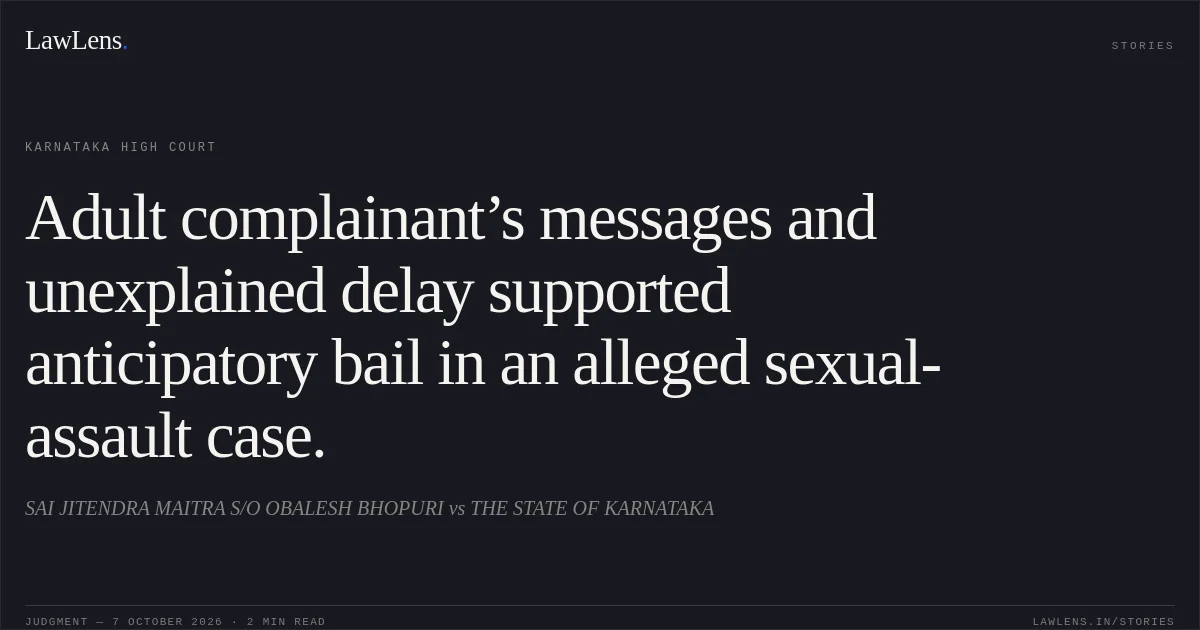
The Court considered the complainant’s statement, which it said indicated that she had visited places with the petitioner and that they had sexual intercourse, as well as WhatsApp messages in which she said she did not wish to marry him and that they should stop the relationship. It regarded this material as prima facie indicating consent and noted that the complainant was an adult at the time of the alleged offence.
Source reference: p. 5The Court also considered the approximately ten-month delay between the alleged incident and the complaint, which it found had not been properly explained.
Source reference: p. 5Applying the stated bail considerations without conducting a mini-trial, it concluded that there were no reasonable and sufficient grounds at that stage to believe the petitioner was guilty of the alleged offences.
Source reference: pp. 5–6Holding
The High Court allowed the petition and directed that the petitioner be released on bail in the event of arrest in Crime No. 51/2026, subject to conditions.
These included executing a personal bond of ₹1,00,000 with two sureties for the like amount, attending court unless exempted, cooperating with the trial, not threatening witnesses or tampering with evidence, not committing similar offences, and reporting to the police every Sunday for six months or until the final report is filed, whichever occurs first.
Source reference: pp. 7–8The Court clarified that its observations were confined to disposal of the bail petition.
Source reference: p. 8Acts & Sections Cited
10 provisions across 4 statutes referred to in this judgment. Each provision opens on LawLens.
Code of Criminal Procedure, 19732
Bharatiya Nagarik Suraksha Sanhita, 20232
Bharatiya Nyaya Sanhita, 20235
Information Technology Act, 20001
Original Court PDF
SAI JITENDRA MAITRA S/O OBALESH BHOPURIvsTHE STATE OF KARNATAKA
Click to open original judgment
Original judgment, available to read, download and summarize on LawLens.in