Facts
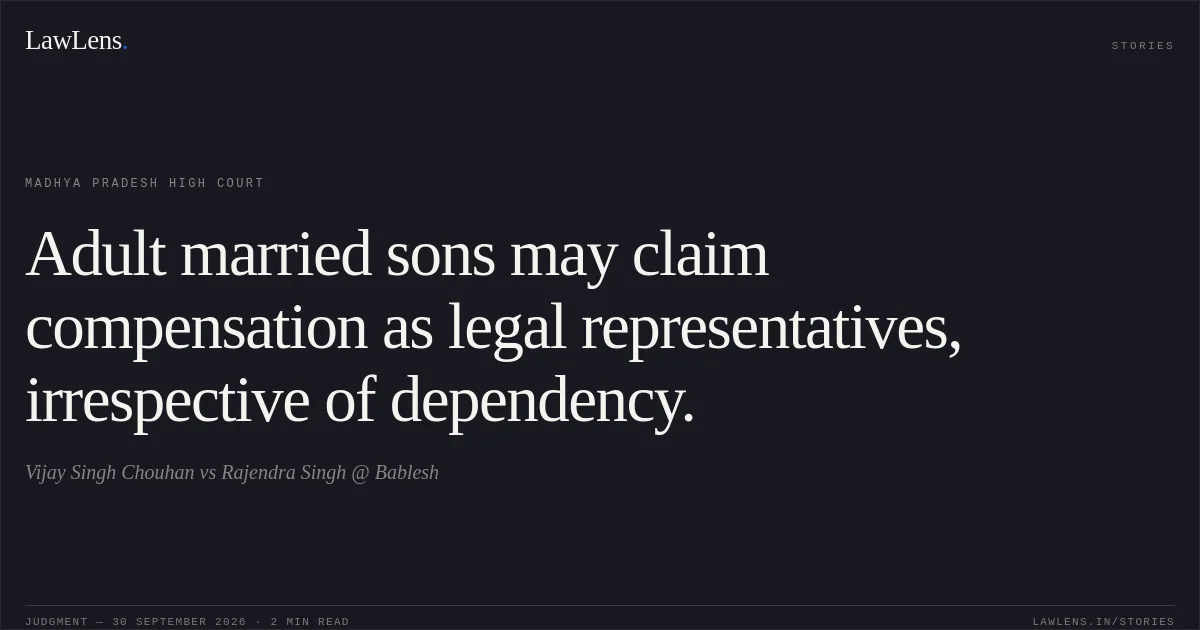
The appellants challenged the Motor Accident Claims Tribunal’s award dated 30 November 2019, which declined to entertain their compensation claim on the merits because the deceased’s sons were adults and exonerated the insurer because the tractor’s trolley was uninsured.
Source reference: para. 1, p. 1The High Court considered whether the adult sons could claim compensation and whether the insurer was properly exonerated.
Source reference: paras. 2–5, pp. 1–3Issues
Whether the deceased’s adult sons were entitled to claim compensation as legal representatives, notwithstanding their age or dependency status.
Source reference: paras. 2–4, pp. 1–2Whether the insurer could be exonerated on the ground that the trolley attached to the tractor was not separately insured.
Source reference: para. 5, pp. 2–3Whether, and to what extent, compensation should be enhanced on the facts of the case.
Source reference: para. 4, p. 2Law Applied
Section 166(1)(c) of the Motor Vehicles Act permits all or any legal representatives of a deceased person to claim compensation; a legal representative’s lack of dependency does not by itself extinguish the right to compensation. The Court applied National Insurance Co. Ltd. v. Birender, (2020) 11 SCC 356, and the principle in Manjuri Bera that a major, married, or earning son may remain a legal representative entitled to maintain a claim.
Source reference: para. 2, p. 1On insurance, the Court relied on National Insurance Co. Ltd. v. Chinnamma, 2004 (7) JT 167, and Saudan Singh v. Nanhi Devi, F.A. No. 2952/2017 (Allahabad High Court, decided 2 February 2021), as applied in M.A. No. 3934/2023, for the proposition that separate insurance of a tractor trolley was not required in the circumstances where the tractor and trolley were being used for agricultural purposes.
Source reference: para. 5, pp. 2–3Reasoning
Applying Birender and Manjuri Bera, the Court held that the appellants’ status as adult sons did not bar their claim and treated appellants 1 and 2 as dependents.
Source reference: paras. 2–3, p. 1It assessed the deceased’s monthly income at the minimum wage for a skilled labourer—₹8,810—deducted one-third for personal expenses, applied a multiplier of seven based on the deceased’s age of 65, and allowed no future prospects.
Source reference: para. 4, p. 2It added ₹80,000 for loss of consortium, but limited the enhancement to the appeal’s valuation of ₹5,00,000.
Source reference: para. 4, p. 2On insurance, it concluded that the insurer had been wrongly exonerated under the authorities it cited and made the owner, driver, and insurer jointly and severally liable.
Source reference: para. 5, pp. 2–3Holding
The appeal was allowed and disposed of.
The Court enhanced the compensation, subject to the appeal’s valuation, to ₹5,00,000, carrying interest at 6% per annum from the date of filing of the claim petition until payment.
Source reference: paras. 4–6, pp. 2–3The owner, driver, and insurer were held jointly and severally liable to satisfy the award.
Source reference: paras. 4–6, pp. 2–3Acts & Sections Cited
1 provisions across 1 statute referred to in this judgment. Each provision opens on LawLens.
Motor Vehicles Act, 19881
Original Court PDF
Vijay Singh ChouhanvsRajendra Singh @ Bablesh
Click to open original judgment
Original judgment, available to read, download and summarize on LawLens.in