Facts
The plaintiff (respondent) agreed to purchase three flats (Nos. 101, 201, and 4th floor) from the defendant builder (appellant).
Source reference: no citationWhile the 4th-floor transaction was completed, the plaintiff paid ₹30,00,000 each (total ₹60,00,000) as advance booking for Flat Nos. 101 and 201.
Source reference: p. 2Due to demonetization and alleged additional demands by the builder, the plaintiff sought a refund via notice in 2016.
Source reference: p. 3The defendant refused, claiming the amount was forfeited due to non-payment of the balance within 30 days.
Source reference: p. 4The Trial Court rejected the defendant’s leave to defend and decreed the suit in favor of the plaintiff for ₹60,00,000 with interest.
Source reference: p. 1-2The defendant appealed, arguing the suit involved triable issues and did not fall under the summary scope of Order XXXVII CPC.
Source reference: p. 5Issues
Whether the amount paid for booking the flats constitutes "earnest money" (liable for forfeiture) or "advance payment" (refundable) in the absence of a formal contract.
Source reference: p. 7 / para. 9Whether the defendant was entitled to forfeit the said amount upon the plaintiff's failure to complete the transaction.
Source reference: p. 31 / para. 13Law Applied
The Court primarily relied on the principles established in K.R. Suresh v. R. Poornima (2025 SCC OnLine 1014), which distinguishes between "earnest money" (a guarantee for performance) and "advance money" (part-payment of consideration).
Source reference: p. 8-9It applied the doctrine that unless the contract explicitly stipulates a forfeiture clause as a guarantee for performance, part-payment cannot be forfeited.
Source reference: p. 11, citing Satish Batra v. Sudhir RawalFurthermore, under Section 74 of the Indian Contract Act, 1872, for a forfeiture to be valid as a penalty, the party must generally prove reasonable compensation for actual loss.
Source reference: p. 17, citing Fateh Chand v. Balkishan DassReasoning
The Court observed that no formal agreement existed between the parties beyond simple signed receipts acknowledging the "booking amount".
Source reference: p. 7-8Following the K.R. Suresh precedent, the Court looked at the intention of the parties and surrounding circumstances, finding no explicit stipulation that the payment served as security for contractual obligations or was subject to a time-bound forfeiture clause.
Source reference: p. 30-31The Court reasoned that since the receipts did not characterize the sum as a "guarantee" and no formal contract governed the breach, the amount was mere "advance payment" toward the purchase price.
Source reference: p. 31Additionally, the Court noted that the defendant had already sold the flats to third parties and received consideration, negating any claim of loss that would justify retaining the plaintiff's funds.
Source reference: p. 32Holding
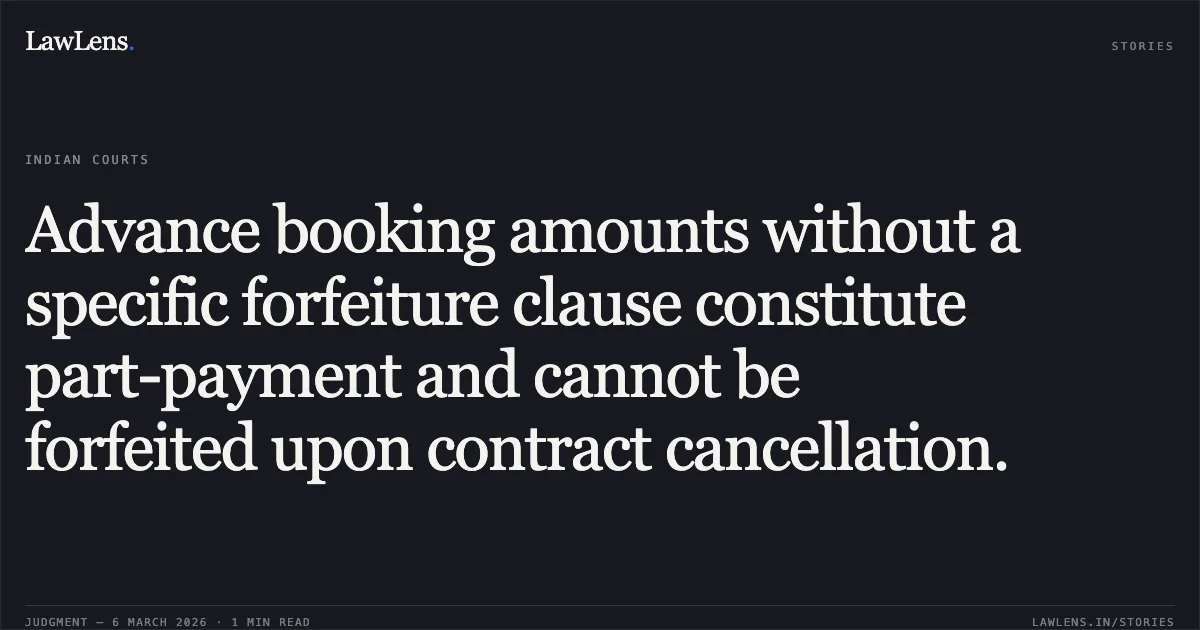
The Court held that the defendant was not entitled to forfeit the advance booking amount because it was not proven to be "earnest money" intended as a performance guarantee.
The High Court dismissed the appeal and confirmed the Trial Court’s judgment dated 28.04.2025, upholding the decree for the refund of ₹60,00,000 plus interest and costs to the plaintiff.
Source reference: p. 32Acts & Sections Cited
5 provisions across 4 statutes referred to in this judgment. Each provision opens on LawLens.
Code of Civil Procedure, 19081
Indian Contract Act, 18722
Specific Relief Act, 19631
Transfer of Property Act, 18821
Original Court PDF
Gautam Nandlal Kapasi v. Ambalal Shivabhai Mistry & Anr., R/First Appeal No. 177 of 2026
Click to open original judgment
Original judgment, available to read, download and summarize on LawLens.in