Facts
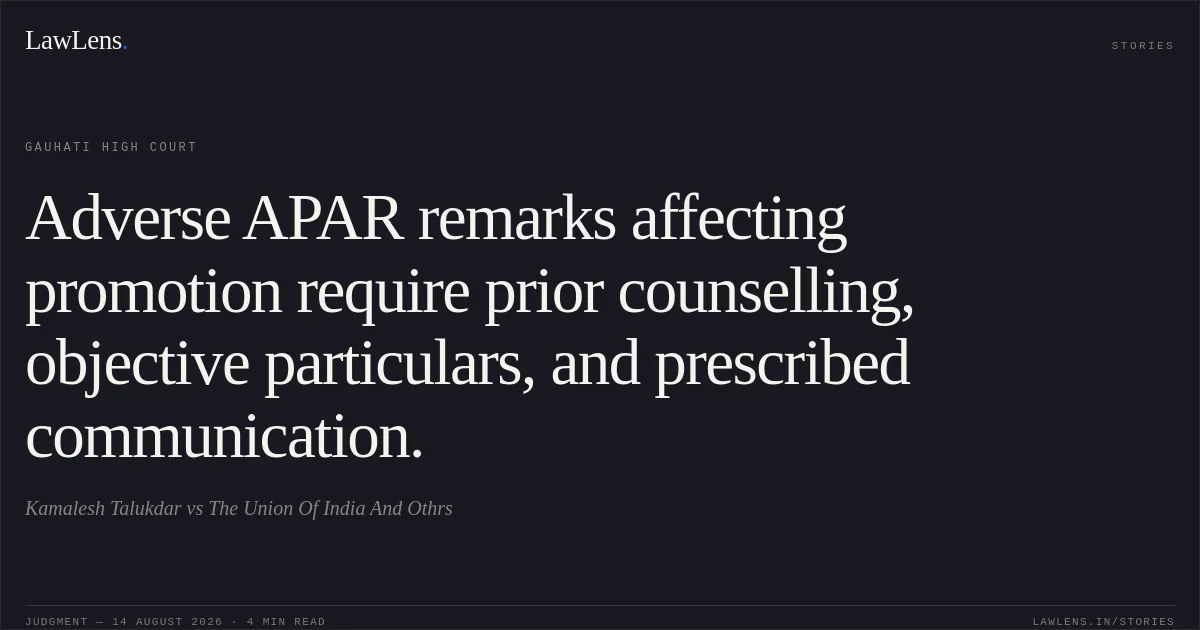
The petitioner, an Assistant Sub-Inspector (Radio Operator) in the BSF, challenged an adverse/advisory observation in his APAR for 01.04.2022–31.03.2023. Although he was graded “Very Good” by the Reporting Officer, and that grading was accepted by the Reviewing Officer and Accepting Authority, the APAR stated that he needed to work with colleagues, understand their difficulties, and show greater dedication.
Source reference: paras. 4; p. 2The petitioner contended that he had not been counselled or apprised of any shortcomings during the reporting period, and that the observation was vague and unsupported by any specific incident. His representations were rejected by the competent authorities.
Source reference: paras. 5, 7–12; pp. 3–5Subsequently, his case for promotion to Sub-Inspector (Radio Operator) for the vacancy years 2025 and 2026 was not recommended because of the APAR entry. He therefore sought expunction of the entry and a Review DPC with consequential benefits.
Source reference: para. 6; p. 3Issues
1. Whether the adverse/advisory observation in the petitioner’s APAR could validly be recorded and relied upon without counselling, guidance, or apprising the petitioner of his alleged shortcomings during the reporting period, as required by Clauses 2.26 and 4.9 of the APAR Procedure and Instructions, 2012.
Source reference: paras. 23–26; pp. 9–102. Whether a vague APAR observation, unsupported by any specific incident or conduct, could subsequently be supplemented or justified through comments furnished by the Reporting Officer during the representation proceedings.
Source reference: paras. 27–29; pp. 10–113. Whether the respondents complied with Clause 4.8 of the APAR Procedure and Instructions, 2012 concerning the prescribed communication of adverse/advisory remarks.
Source reference: paras. 30–31; pp. 11–124. Whether the impugned APAR entry could be relied upon to deny or adversely affect the petitioner’s consideration for promotion.
Source reference: paras. 32–34; pp. 12–13Law Applied
The Court applied Clauses 2.26 and 4.9 of the APAR Procedure and Instructions, 2012, which require the Reporting/Initiating Officer to counsel, guide, and apprise the employee of shortcomings during the reporting period, so that adverse remarks do not come as a surprise and the employee has an opportunity to improve.
Source reference: paras. 24–25; p. 9Clause 4.8 requires adverse/advisory remarks to be communicated in the prescribed manner, including by highlighting and underlining the remarks, specifying their nature, and supplying the full APAR.
Source reference: para. 30; p. 11The Court further relied on Prakhar Trivedi v. Union of India, for the principle that an APAR assessment must be clear, objective, confined to the relevant reporting period, and supported by specific material; subsequent facts cannot be used to supplement an inadequate original assessment.
Source reference: para. 29; p. 11Dev Dutt v. Union of India, (2008) 8 SCC 725, and Abhijit Ghosh Dastidar v. Union of India, (2009) 16 SCC 146, establish that entries having an adverse effect on promotion must be communicated and cannot operate prejudicially without procedural fairness.
Source reference: para. 32; pp. 12–13Paragraph 8(K) of the promotion instructions dated 21.01.2019, which treated an adverse CR/PAR entry as affecting promotion eligibility, did not dispense with compliance with the APAR procedure.
Source reference: para. 33; p. 13Reasoning
The Court found that the respondents admitted that no written counselling, warning, or guidance could be traced for the relevant reporting period; the assertion that verbal advice was given as a matter of practice did not establish that the petitioner had been specifically apprised of the alleged deficiencies.
Source reference: para. 26; p. 10The APAR observation itself was general and identified no specific incident, date, duty, or conduct. The Reporting Officer’s later comments referring to particular instances could not supplement the original APAR because those particulars had neither been recorded contemporaneously nor communicated to the petitioner during the reporting period.
Source reference: para. 27; p. 10The “Very Good” overall grading, accepted by the Reviewing Officer and Accepting Authority, further required that any adverse observation affecting promotion be supported by a clear and objective basis, which was absent here.
Source reference: para. 28; p. 11The respondents also failed to demonstrate that the remark had been communicated in the specific manner prescribed by Clause 4.8; the petitioner’s subsequent representations did not cure these procedural defects.
Source reference: paras. 30–34; pp. 11–13Since the entry directly resulted in the petitioner’s non-recommendation for promotion, it could not be permitted to operate to his prejudice.
Source reference: paras. 32–34; pp. 12–13Holding
The Court set aside and expunged the adverse/advisory observation recorded in the petitioner’s APAR for 01.04.2022–31.03.2023.
The respondents were directed to convene a Review DPC and reconsider the petitioner’s promotion to Sub-Inspector (Radio Operator) without relying on the expunged observation.
Source reference: para. 35; p. 13The exercise was to be completed within three months of receipt of the certified order, and, if the petitioner was found fit, he was to receive consequential service benefits in accordance with law.
Source reference: para. 36; p. 14The writ petition was accordingly allowed and disposed of, with no order as to costs.
Source reference: para. 37; p. 14Acts & Sections Cited
2 provisions across 1 statute referred to in this judgment. Linked provisions open on LawLens.
APAR Procedure and Instructions, 20122
Original Court PDF
Kamalesh TalukdarvsThe Union Of India And Othrs
Click to open original judgment
Original judgment, available to read, download and summarize on LawLens.in