Facts
The appellants claimed ownership of land in Gwalior (Survey No. 2029) as ancestral property.
Source reference: p. 2They filed a suit in 1989 for declaration of title and permanent injunction after respondent officers attempted to remove fencing and structures.
Source reference: p. 2The Trial Court decreed the suit in 1996, relying on a 1984 decree obtained by the appellants' predecessors against the State of Madhya Pradesh.
Source reference: p. 3, 7On appeal, the High Court of Madhya Pradesh set aside the decree, noting the Union of India was not a party to the 1984 suit and that the land had vested in the Union in 1953.
Source reference: p. 6, 8During the High Court proceedings, the appellants filed an application under Order XLI Rule 27 of the CPC to introduce the General Land Register (GLR) as additional evidence, which was initially ignored in the main judgment but later dismissed during a review petition.
Source reference: p. 3-4Issues
Whether the High Court’s omission to expressly adjudicate the application for additional evidence under Order XLI Rule 27 CPC during the initial appeal resulted in a miscarriage of justice.
Source reference: para. 8Whether the appellants established a valid legal title to the suit property independent of the 1984 decree.
Source reference: para. 11.9, 11.12Law Applied
The court primarily applied Order XLI Rule 27 of the Code of Civil Procedure (CPC), 1908, which prohibits additional evidence in appellate courts except when the trial court refused admissible evidence, the party establishes due diligence in its inability to produce it earlier, or the appellate court requires it to pronounce judgment.
Source reference: para. 11.2, 11.3It relied on *Union of India v. Ibrahim Uddin* (2012), which clarified that the power to admit additional evidence is discretionary, should be used sparingly, and only to remove a lacuna.
Source reference: para. 11.4It further cited *State of Karnataka v. K.C. Subramanya* (2014), establishing that such evidence cannot be allowed at a party's "leisure or sweet will."
Source reference: para. 11.5Reasoning
The Court reasoned that while the High Court initially failed to address the Order XLI Rule 27 application, it rectified this by dismissing it with reasons during the review stage.
Source reference: para. 11.1The Court found that the appellants failed to meet the "due diligence" threshold, as they should have produced all title evidence during the trial.
Source reference: para. 11.10Regarding the merit of the evidence, the Court noted that the 1984 decree was *non-est* (not binding) against the Union of India because they were not impleaded.
Source reference: para. 11.8Furthermore, even if the GLR entries were admitted to show the land was "private," it would not benefit the appellants’ claim of ownership in the absence of foundational title deeds.
Source reference: para. 11.11The Court emphasized that the land had legally vested in the Union in 1953 via Gazette Notification, and the appellants were essentially encroachers attempting to cure a fundamentally flawed case at the appellate stage.
Source reference: para. 11.14, 11.17Holding
The Supreme Court answered that the High Court’s handling of the application did not cause manifest injustice as the evidence sought was unnecessary for a satisfactory judgment.
The Court affirmed the High Court’s judgments dated 12th August 2009 and 15th March 2011, dismissing the appeals.
Source reference: para. 13-14The Court expressed strong disapproval of the appellants’ conduct in seeking an *ex-parte* decree behind the back of the true owner (Union of India) and attempting to fill gaps in their evidence through late-stage applications.
Source reference: para. 11.16, 11.17Original Court PDF
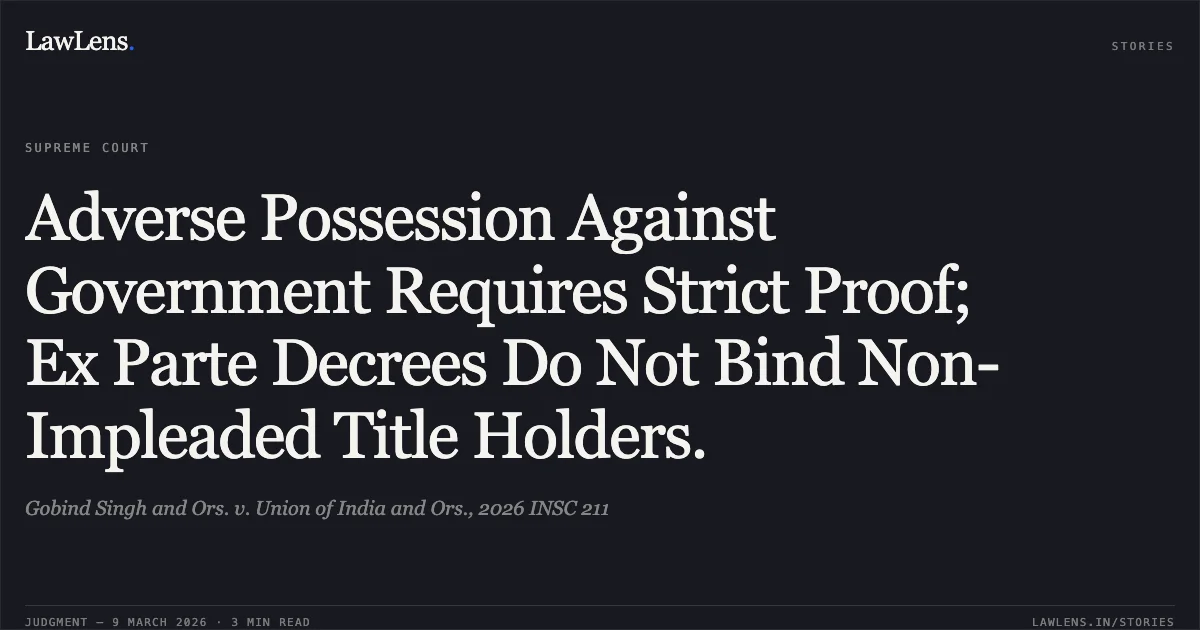
Gobind Singh and Ors. v. Union of India and Ors., 2026 INSC 211
Click to open original judgment
Original judgment, available to read, download and summarize on LawLens.in