Facts
The Complainant filed a suit for perpetual injunction against accused Nos. 1 and 2 to prevent the copying or sharing of confidential information
Source reference: para. 12In Writ Petition No. 32999 of 2024, the High Court of Karnataka appointed a Court Commissioner to conduct search and seizure at the respondents' premises
Source reference: para. 14The Commissioner reported that the accused obstructed the execution of the warrant
Source reference: para. 14The Complainant thereafter filed this criminal contempt petition under Article 215 of the Constitution and Section 15 of the Contempt of Courts Act, 1971
Source reference: p. 2The Registry raised office objections on maintainability as the Complainant had not obtained the prior written consent of the Advocate General
Source reference: para. 4On 24.02.2026, the Court initially overruled these objections, prompting the accused to file I.A. No. 1 of 2026 to recall that order
Source reference: para. 2-4Issues
Whether the Criminal Contempt of Court case filed seeking to take action against an alleged contemnor without the consent of the Advocate General is maintainable?
Source reference: para. 3Law Applied
Section 15(1) of the Contempt of Courts Act, 1971, which mandates that criminal contempt actions (other than those under Section 14) can only be initiated by the Court on its own motion, by the Advocate General, or by a person with the Advocate General's written consent
Source reference: para. 15The precedent in P.N. Duda v. P. Shiv Shanker, which established that while a private person can provide "information" to the Court, they cannot move a formal petition for criminal contempt without consent
Source reference: para. 20Principles from Bal Thackrey v. Harish Pimpalkhute, which clarified that the procedural requirements of Section 15 are mandatory safeguards to prevent frivolous petitions and must be followed even when invoking Article 215 of the Constitution
Source reference: para. 21Rules 5(v), 7, and 8 of the High Court of Karnataka (Contempt of Court Proceedings) Rules, 1981, regarding the administrative process for handling such information
Source reference: para. 24Reasoning
The Court reasoned that while Article 215 grants the High Court inherent power to punish for contempt, the procedure for exercising that power, when triggered by a private individual, is governed by Section 15 of the Contempt of Courts Act
Source reference: para. 19, 21The Court found that the Complainant had filed a formal petition instead of merely providing information, and had done so without the mandatory written consent of the Advocate General
Source reference: para. 16, 25Citing P.N. Duda, the Court observed that when a private person lacks consent, the "petition" should not be styled as a judicial proceeding or placed for admission on the judicial side; instead, it must be placed before the Chief Justice on the administrative side to determine if suo motu action is warranted
Source reference: para. 20, 25The Court rejected the Complainant’s argument that Rule 5(v) allows information to bypass Section 15, clarifying that a private motion prosecuted as a petition without consent is fundamentally incompetent
Source reference: para. 21-22Therefore, the previous order overruling the office objection was legally flawed as it ignored the mandatory statutory procedure
Source reference: para. 26-27Holding
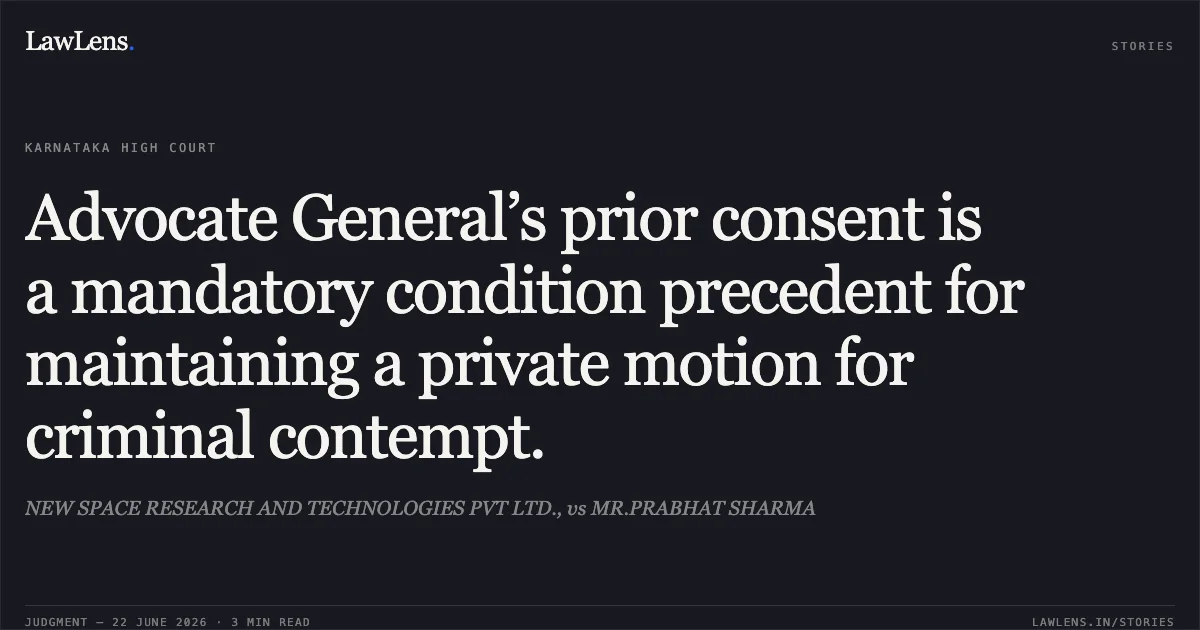
The Court held that a criminal contempt petition filed by a private party without the written consent of the Advocate General is not maintainable as a judicial petition
The Court allowed I.A. No. 1 of 2026 and recalled its order dated 24.02.2026 which had overruled the maintainability objection. It directed the Registry to treat the petition as "information" under Rule 7 of the High Court of Karnataka (Contempt of Court Proceedings) Rules, 1981, and place it before the Hon'ble Chief Justice on the administrative side for necessary orders. The criminal contempt petition was closed for statistical purposes
Source reference: para. 27, 28Acts & Sections Cited
7 provisions across 2 statutes referred to in this judgment. Each provision opens on LawLens.
Contempt of Courts Act, 19715
Code of Civil Procedure, 19082
Original Court PDF
NEW SPACE RESEARCH AND TECHNOLOGIES PVT LTD.,vsMR.PRABHAT SHARMA
Click to open original judgment
Original judgment, available to read, download and summarize on LawLens.in


![Subsequent exoneration does not retrospectively invalidate a finalized promotion select list.. UNNIKRISHNAN M vs M/o Environment And Forests. CAT - ['Ernakulam']. LawLens](/stories/thumbnails/subsequent-exoneration-does-not-retrospectively-invalidate-a-finalized-promotion-select-li-ce80a0e84f2f4887857271e8b4341c42.webp)