Facts
The petitioners (plaintiffs) instituted Title Suit No. 37/2006 for eviction and perpetual injunction against the respondents (defendants)
Source reference: p. 4Despite the issuance of summons, the defendants did not appear, leading to an ex-parte decree on 02.07.2009
Source reference: p. 4Respondent No. 1 subsequently filed an application under Order IX Rule 13 of the CPC (Misc. (J) Case No. 24/2013) to set aside the decree, asserting lack of knowledge of the proceedings until execution
Source reference: p. 4, 6The Trial Court rejected this application on 30.09.2014, concluding summons were duly served and refused
Source reference: p. 4On appeal, the Additional District Judge set aside the Trial Court’s order and the ex-parte decree on 06.09.2018, finding the service of summons defective
Source reference: p. 5The petitioners challenged this appellate order before the Gauhati High Court under Section 115 of the CPC
Source reference: p. 3Issues
1. Whether the procedure for affixing summons under Order V Rule 17 of the CPC is mandatory or merely directory.
Source reference: p. 7, 92. Whether substituted service via newspaper publication under Order V Rule 20 is valid if the foundational requirements of personal service and affixation are not met.
Source reference: p. 9-103. Whether the High Court, in its revisional jurisdiction under Section 115 of the CPC, should interfere with the findings of the Appellate Court regarding the perversity of service reports.
Source reference: p. 10Law Applied
The court primarily applied Order V Rules 17 and 20 of the CPC, which dictate that if a defendant refuses service or cannot be found, the serving officer must affix the summons to the defendant's residence
Source reference: p. 6It further applied Order IX Rule 13 of the CPC, which allows setting aside an ex-parte decree if summons were not "duly served"
Source reference: p. 6The court relied on the principle that the word "shall" in Order V Rule 17 makes the affixation procedure mandatory, as established in Shri K. Raja v. V. Prabhakar
Source reference: p. 7-9Regarding revisional powers, the court applied Section 115 of the CPC, which limits interference to jurisdictional errors
Source reference: p. 10Reasoning
The Court examined the service reports, noting they were inconsistent—alternating between "refusal" and "inability to locate" the defendant
Source reference: p. 6-7It reasoned that even if a defendant refuses service, the mandatory requirement of affixation under Order V Rule 17 must be strictly followed to constitute "due service"
Source reference: p. 7, 9The Court rejected the petitioners' argument that newspaper publication (substituted service) cured procedural defects, holding that such service is only permissible once the Court is satisfied that ordinary service is not feasible after due diligence
Source reference: p. 6, 10Relying on Shri K. Raja, the Court emphasized that the procedural requirements for service are not hyper-technicalities but mandatory safeguards
Source reference: p. 8-9Consequently, the Court found that the Appellate Court correctly identified the Trial Court’s findings as perverse because the foundational requirement of affixation was ignored before resorting to substituted service
Source reference: p. 7, 10Holding
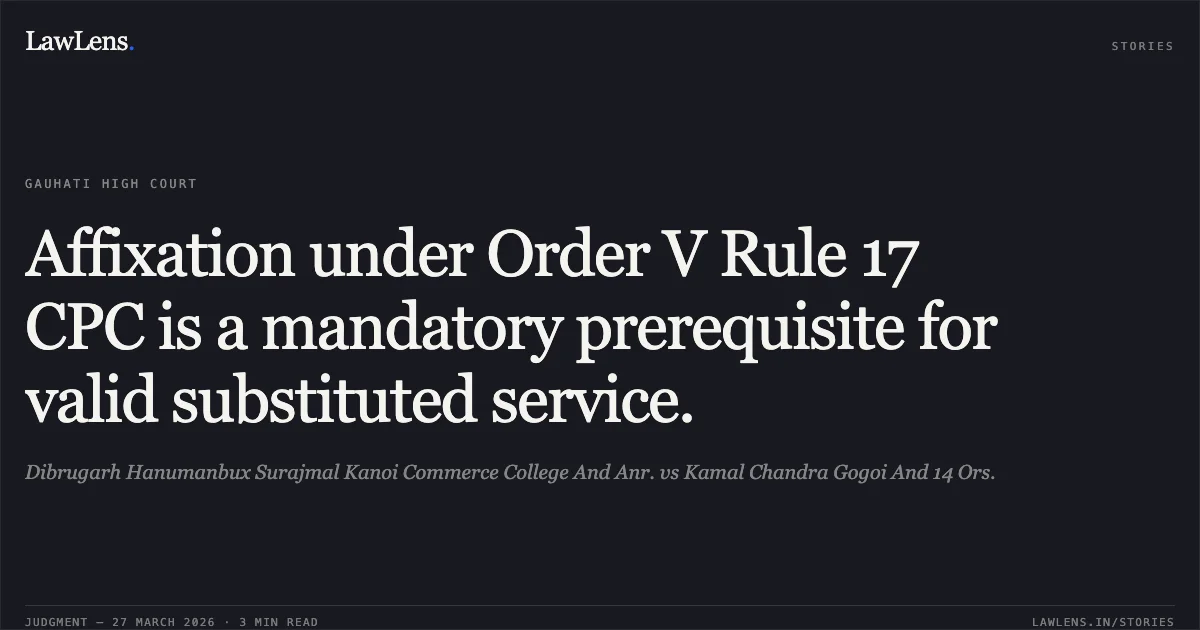
The Court held that compliance with Order V Rule 17 of the CPC is mandatory and that substituted service via newspaper publication is invalid without prior compliance with affixation requirements
Finding no jurisdictional error in the Appellate Court’s judgment, the High Court dismissed the Civil Revision Petition
Source reference: p. 10The ex-parte decree remains set aside, allowing the suit to be contested on its merits.
Source reference: p. 10No order as to costs was passed
Source reference: p. 10Original Court PDF
Dibrugarh Hanumanbux Surajmal Kanoi Commerce College And Anr.vsKamal Chandra Gogoi And 14 Ors.
Click to open original judgment
Original judgment, available to read, download and summarize on LawLens.in


