01Facts
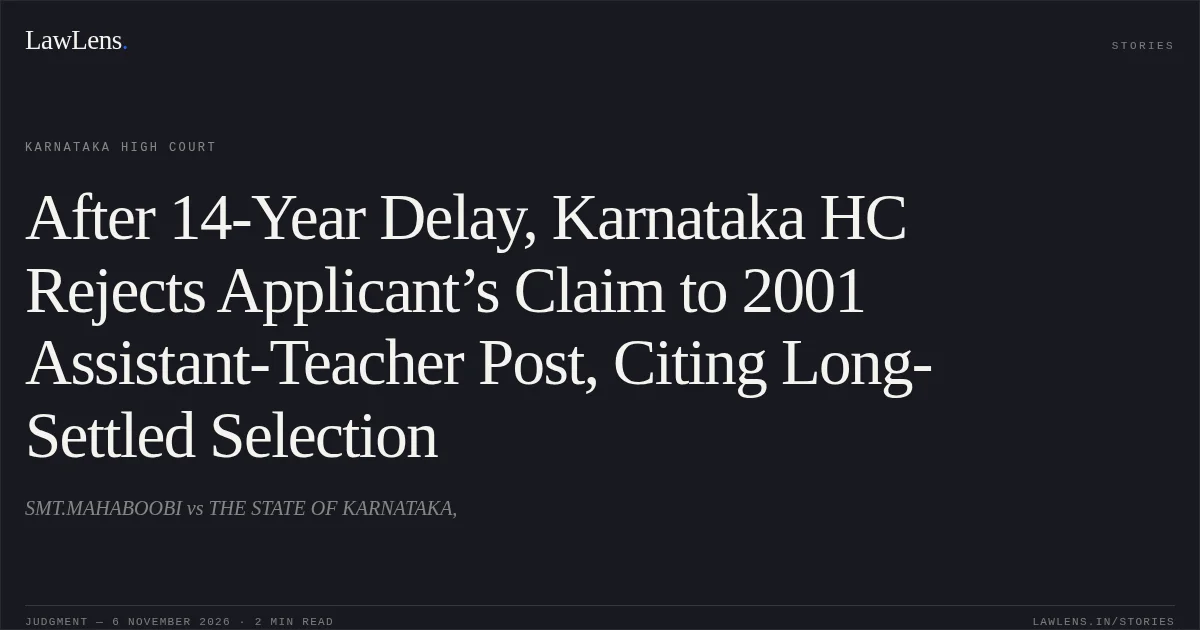
In 2001, the State invited applications for Assistant Teacher (Hindi) posts in the Chikkodi Educational District.
pp. 3–4The petitioner applied but was not selected; an endorsement dated 29 January 2002 stated that she lacked the required knowledge of Kannada.
pp. 3–4, 6She challenged her non-selection before the Karnataka State Administrative Tribunal in 2013, which dismissed her application on 11 January 2016 for delay.
p. 4, 6She then sought to quash the Tribunal’s order and obtain appointment, including through creation of a supernumerary post.
pp. 4–502Issues
i.Whether the Tribunal was justified in rejecting the petitioner’s challenge to her non-selection on the ground of delay.
p. 4, 6ii.Whether the petitioner could obtain appointment or other consequential relief despite the delay in challenging the 2001 selection process and 2002 endorsement.
pp. 5–703Law Applied
The Court relied on the limitation principles discussed in Shivamma v. Karnataka Housing Board, 2025 SCC OnLine SC 1969, particularly the principle that Sections 4–24 of the Limitation Act, including Section 5, must be applied consistently with the broader purposes of limitation law and do not provide an unrestricted basis to excuse delay.
pp. 7–9It reiterated the maxims interest reipublicae ut sit finis litium (it is in the public interest that litigation end) and vigilantibus non dormientibus jura subveniunt (the law assists the vigilant, not those who sleep on their rights), and the principle that lapse of time may result in forfeiture of a right.
pp. 7–9The Court also held that misplaced sympathy alone cannot justify issuing a writ.
p. 6Provisions in the judgment · 21 · Linked ones open on LawLens
04Reasoning
The petitioner had received notice of the reason for her non-selection in January 2002 but waited approximately 14 years before approaching the Tribunal; by the time the writ petition was considered, the challenge concerned a selection process initiated about 24 years earlier.
pp. 6–7, 9Applying the limitation principles in Shivamma, the Court held that such prolonged inaction did not warrant judicial indulgence.
pp. 6–9It declined to assess the petitioner’s claimed eligibility as a basis for appointment, reasoning that delay and the settled position arising from the completed selection process could not be overcome by sympathy or a request for a supernumerary post.
pp. 6–905Holding
The Court dismissed the writ petition, leaving intact the Tribunal’s order rejecting the petitioner’s application for delay.
pp. 9–10It declined to quash the selection or direct the petitioner’s appointment, including through creation of a supernumerary post.
pp. 9–10Original Court PDF
SMT.MAHABOOBIvsTHE STATE OF KARNATAKA,
Click to open original judgment
Original judgment, available to read, download and summarize on LawLens.in