Facts
Respondent No. 1, a lecturer employed by the petitioners since 1991, was terminated on 31 January 2009 following a disciplinary inquiry in which the committee found nine of ten charges proved.
Source reference: p. 1He appealed under Section 9 of the Maharashtra Employees of Private Schools (Conditions of Service) Regulation Act, 1977.
Source reference: p. 3The School Tribunal held that the inquiry violated Rule 37(5) of the MEPS Rules because he had not been given an opportunity to submit a further explanation after receiving the summary of proceedings; it set aside the termination and directed reinstatement for a fresh inquiry, with salary pending its completion.
Source reference: pp. 4–5, 9–10The Management challenged that order.
Source reference: p. 5The High Court noted that the Tribunal’s order had been stayed and that, by the time of judgment, the employee had reached superannuation.
Source reference: pp. 5–6, 11Issues
Whether the failure to seek the employee’s further explanation under Rule 37(5) of the MEPS Rules vitiated the inquiry, absent demonstrated prejudice
Source reference: pp. 7–10Whether, in the circumstances, termination was a proportionate penalty and what relief should be granted
Source reference: pp. 10–12Law Applied
Rule 37(5) of the MEPS Rules requires the inquiry committee to provide the delinquent employee with the summary of proceedings and an opportunity to submit a further explanation.
Source reference: p. 9Under State Bank of Patiala v. S.K. Sharma, procedural violations in a disciplinary inquiry do not automatically invalidate the proceedings; except in cases involving no notice, opportunity, or hearing, the court must assess whether the violation caused prejudice to the employee’s ability to defend himself.
Source reference: p. 7State Bank of India v. Bidyut Kumar Mitra reiterates that prejudice must be pleaded and proved.
Source reference: p. 8The Division Bench decision in Surabhi Keshav Sahu v. State of Maharashtra applies the overall test of whether, considering all circumstances, the employee received a fair hearing.
Source reference: p. 8Reasoning
The Court found that the employee had not shown prejudice from the failure to seek a further explanation.
Source reference: p. 8He did not submit an explanation to the statement of allegations, had a representative of his choice on the inquiry committee, cross-examined the Management’s witness, was given numerous opportunities to present evidence, and did not examine witnesses; the inquiry comprised 38 sittings.
Source reference: pp. 8–10Applying the prejudice and fair-hearing tests, the Court held that the procedural omission did not justify setting aside the inquiry.
Source reference: pp. 9–10It then considered the charges and the circumstances, including the employee’s 18 years of service before termination, the time remaining until retirement, the absence of conclusive evidence of gainful employment, and the apparent timing of the inquiry after he sought service-related dues.
Source reference: pp. 10–12It concluded that termination was disproportionate and that lump-sum compensation was appropriate.
Source reference: pp. 11–12Holding
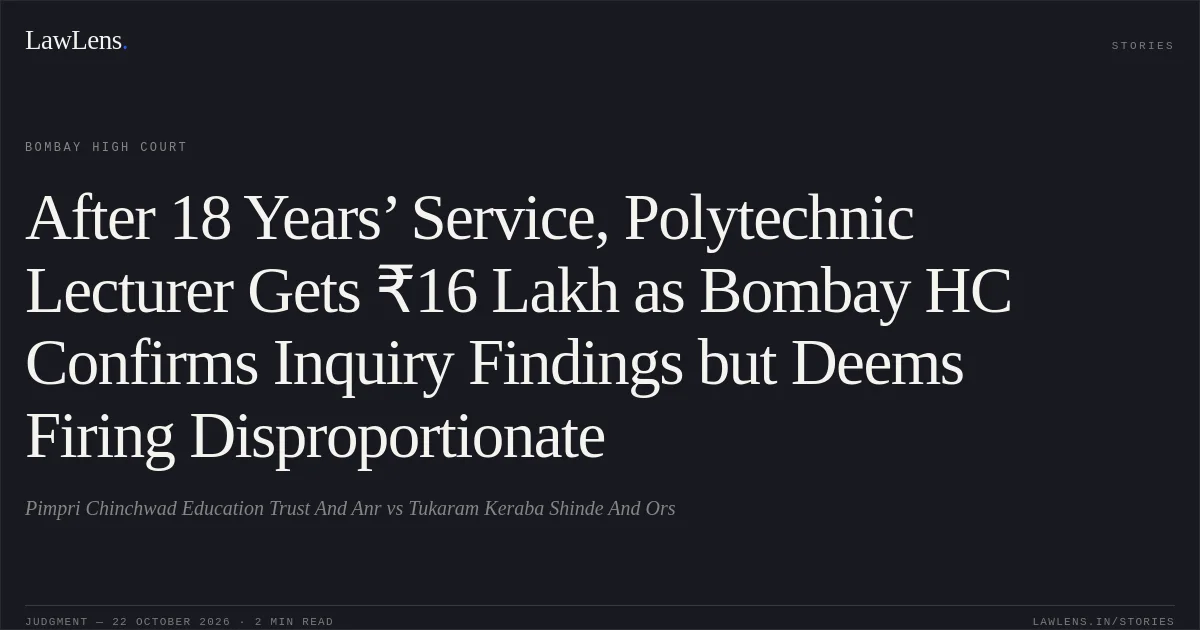
The Court partly allowed the petition, quashed the Tribunal’s order, and confirmed the inquiry committee’s findings.
It held that termination was disproportionate and directed the Management to pay the employee Rs. 16 lakh as lump-sum compensation within six weeks, failing which the amount would carry interest at 9% per annum from the end of that period until realization.
Source reference: pp. 12–13The Rule was made partly absolute, with no order as to costs.
Source reference: p. 13Acts & Sections Cited
1 provisions across 1 statute referred to in this judgment. Each provision opens on LawLens.
Maharashtra Employees of Private Schools (Conditions of Service) Regulation Act, 1977.1
Original Court PDF
Pimpri Chinchwad Education Trust And AnrvsTukaram Keraba Shinde And Ors
Click to open original judgment
Original judgment, available to read, download and summarize on LawLens.in