Facts
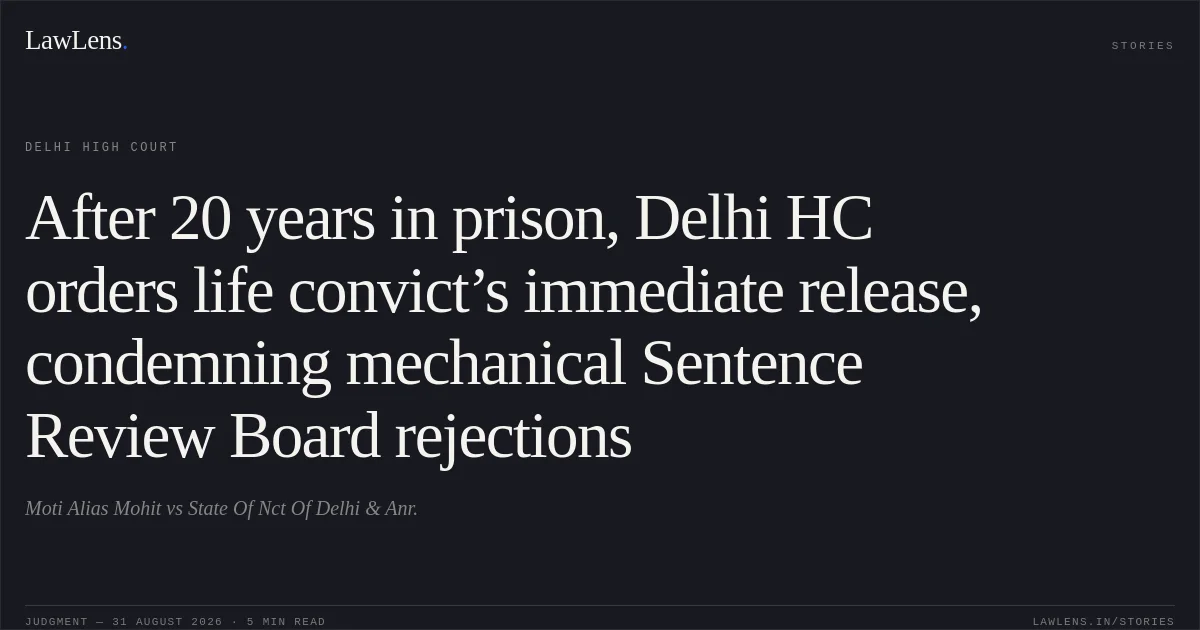
The petitioner was convicted under Sections 302/380/34 IPC for the murder of two persons and theft, and was sentenced to imprisonment for life by the trial court on 2 March 2010. His conviction and sentence were affirmed by the High Court and the Supreme Court
Source reference: pp. 3–4, para. 4.1The petitioner became eligible for consideration under the Delhi Government’s premature-release policy dated 16 July 2004 after completing 20 years’ imprisonment including remission.
Source reference: pp. 4–5, paras. 4.2–4.5His request for premature release was rejected on four earlier occasions, principally on the grounds of the gravity of the offence, alleged unsatisfactory jail conduct, police opposition, and perceived risk of reoffending
Source reference: pp. 4–5, paras. 4.2–4.5The fourth rejection was quashed by the High Court on 25 July 2025 with a direction for reconsideration in accordance with the applicable guidelines.
Source reference: p. 5, para. 4.6Upon reconsideration, the Sentence Review Board (“SRB”) again rejected the request on 16 October 2025, relying on the double murder, the petitioner’s 2018 punishment for possessing two grams of tobacco in semi-open jail, the police report, and the alleged possibility of reoffending.
Source reference: pp. 5–6, para. 5The record showed that he was a first-time offender, had completed graduation in prison, worked in various prison occupations, had been released on parole and furlough several times without misuse, and had favourable observations in the Social Investigation Report and the underlying police verification report
Source reference: pp. 31–33, paras. 11.1–11.4He had undergone more than 20 years of actual imprisonment and more than 24 years including remission.
Source reference: p. 6, para. 5Issues
Whether the SRB’s decision dated 16 October 2025 was vitiated by non-application of mind, mechanical reasoning, and failure to consider the mandatory factors under the 2004 premature-release policy and the Delhi Prison Rules, 2018
Source reference: pp. 25–29, paras. 9–9.3Whether the gravity and circumstances of the original offence, the petitioner’s solitary prison punishment in 2018, and the adverse covering recommendation of the DCP could lawfully justify rejection of premature release despite the petitioner’s subsequent conduct and rehabilitation
Source reference: pp. 34–36, paras. 12.1–12.4Whether, after finding the SRB’s decision unlawful and considering the petitioner’s prolonged incarceration and repeated unsuccessful reviews, the High Court could direct immediate premature release instead of remanding the matter for reconsideration
Source reference: pp. 37–39, paras. 14–14.5Law Applied
The Court applied the Delhi Government policy dated 16 July 2004, under which a life convict meeting the eligibility threshold does not acquire an automatic right to release but is entitled to meaningful consideration based on the circumstances of the crime, whether the convict has lost the potential to commit crime, the possibility of rehabilitation as a useful member of society, and the socio-economic condition of the family
Source reference: pp. 24–25, para. 8.1Rule 1251 of the Delhi Prison Rules, 2018 similarly requires consideration of overall jail conduct, rehabilitative potential, and family circumstances, while Rule 1244 recognises reformation, rehabilitation, reintegration, and protection of society as the objectives of premature release
Source reference: p. 12–13, para. 7.2; p. 20, para. 7.8Under Laxman Naskar v. Union of India and State of Haryana v. Jagdish, the relevant factors include the effect of the offence on society, probability and potential of reoffending, whether continued imprisonment serves a fruitful purpose, and the socio-economic condition of the convict’s family
Source reference: p. 14, para. 7.3The Court relied on Satish @ Sabbe v. State of Uttar Pradesh and Joseph v. State of Kerala for the proposition that the gravity or length of the original sentence cannot alone justify refusal of premature release and that future criminality must be assessed objectively through antecedents and prison conduct
Source reference: pp. 15–17, paras. 7.5, 7.1It further applied the principles in Asif alias Naeem v. State of NCT of Delhi that eligibility triggers fair and structured consideration, but not automatic release, and that the decision must be supported by intelligible reasons
Source reference: pp. 20–21, para. 7.8Although remission lies within the executive domain under Sections 432–433A CrPC and Article 161 of the Constitution, judicial review is available against arbitrary, irrational, or mechanically reasoned decisions; following Rohit Chaturvedi v. State of Uttarakhand, remand is unnecessary where the authority has repeatedly taken an unsustainable position and the relevant material is already before the Court
Source reference: pp. 21–23, paras. 7.9–7.10Reasoning
The Court held that the impugned SRB decision was not a genuine reconsideration but substantially repeated the reasoning of the earlier rejections, without demonstrating fresh application of mind or an assessment of the policy factors
Source reference: pp. 28–29, paras. 9.2–9.3The DCP’s covering communication stated that premature release was not recommended, although the underlying police verification report recorded that the petitioner had no criminal antecedents beyond the present case, did not belong to any gang, had no propensity to reoffend, and had not misused parole or furlough; the DCP’s later explanation did not cure this contradiction
Source reference: pp. 26–28, para. 9.1; p. 32, para. 11.4The SRB also failed to properly weigh the petitioner’s favourable post-conviction conduct: he was a first-time offender, had completed graduation, maintained gainful prison employment, repeatedly complied with parole and furlough conditions, and had a rehabilitative plan for release
Source reference: pp. 31–33, paras. 11.1–11.3The solitary punishment for possessing two grams of tobacco in 2018 was considered too remote and disproportionate to justify indefinite denial of release, particularly since the petitioner had already been punished by transfer from semi-open to closed prison and was subsequently granted furloughs
Source reference: p. 34, para. 12.1While acknowledging the seriousness of the double murder, the Court held that the offence could not operate as a permanent veto against consideration of reform after more than two decades of incarceration
Source reference: pp. 34–36, paras. 12.3–12.5Given the repeated mechanical rejections, disregard of prior judicial directions, and absence of any meaningful prospect that the same SRB structure would reconsider the matter fairly, remand was held to be futile and unjust.
Source reference: pp. 37–39, paras. 14.1–14.5Holding
The High Court allowed the writ petition and quashed the SRB’s decision/minutes dated 16 October 2025 rejecting the petitioner’s premature release, holding that the decision was vitiated by non-application of mind, mechanical reasoning, and failure to consider relevant rehabilitative and familial factors
Instead of remanding the matter, the Court directed the petitioner’s immediate release from prison, subject to the life sentence imposed in the concerned criminal case.
Source reference: p. 40, para. 15The judgment was directed to be forwarded to the Jail Superintendent, the Chairperson of the Delhi SRB, and the Director General of Prisons for compliance and consideration of reforms to the SRB’s composition, functioning, and decision-making process.
Source reference: p. 40, paras. 15.1–15.2Acts & Sections Cited
7 provisions across 2 statutes referred to in this judgment. Each provision opens on LawLens.
Indian Penal Code, 18605
Code of Criminal Procedure, 19732
Original Court PDF
Moti Alias MohitvsState Of Nct Of Delhi & Anr.
Click to open original judgment
Original judgment, available to read, download and summarize on LawLens.in