01Facts
The petitioner, a former Secondary Grade Teacher, retired in 1996.
p. 1She had made a representation claiming benefits for services rendered between 1961 and 1963.
p. 1She filed this writ petition under Article 226 seeking a mandamus directing the respondents to grant her the secondary grade scale of pay for that period, on par with secondary grade teachers covered by G.O. (Ms) No. 103, School Education Department, dated 24.05.2017.
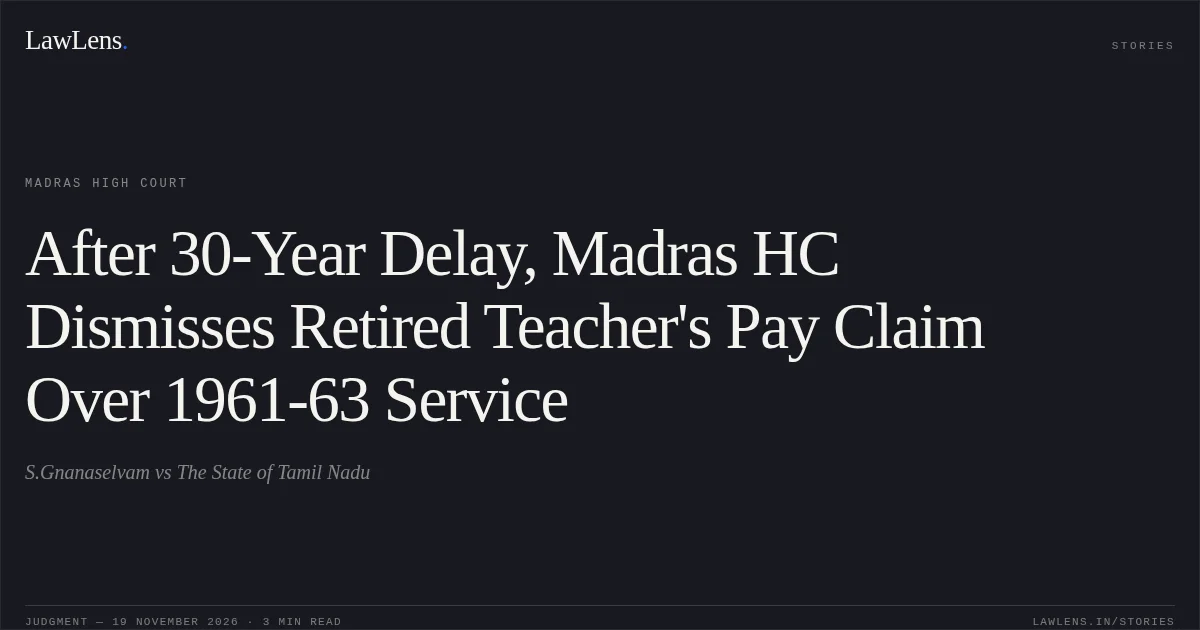
p. 1 · p. 2 · ¶ 1The Court noted that the petition was filed about 30 years after her retirement and stated it was not inclined to entertain it on that ground.
p. 2 · ¶ 2Counsel relied on the order in W.P.(MD) No. 17636 of 2023 dated 30.08.2023, where the Court directed the respondents to consider similar representations, and argued that the petitioner was therefore entitled to similar relief.
pp. 2–3 · ¶ 302Issues
i.1. Whether a writ of mandamus can be issued directing the grant of secondary grade pay scale for past service, where the petition is filed about 30 years after retirement, merely because similar directions to consider representations were issued in other cases.
p. 3 · ¶ 4ii.2. Whether the petitioner's claim is barred by delay and laches.
pp. 3–5 · ¶ 4 · p. 5 · ¶ 503Law Applied
The Court relied on State of Uttaranchal v. Shiv Charan Singh Bhandari (2013) 12 SCC 179, which in turn draws on the following principles: Filing representations does not save limitation, and delay or laches is a relevant factor that may deprive a government servant of a benefit granted to others, since Article 14 is not attracted in favour of those who are not vigilant (State of T.N. v. Seshachalam).
pp. 3–5 · ¶ 4 · p. 3 · ¶ 4 (quoting para. 18)Equality-based claims for promotion or service benefits must be made within a reasonable time (Ghulam Rasool Lone v. State of J&K).
p. 3 · ¶ 4 (quoting para. 19)Although no limitation period applies to Article 226, writ petitions should ordinarily be filed within a reasonable time, and courts may refuse discretionary relief to persons who sleep over their rights (New Delhi Municipal Council v. Pan Singh).
pp. 3–4 · ¶ 4 (quoting para. 20)Persons aggrieved by promotion of a junior should approach the Court within six months to a year (P.S. Sadasivasway v. State of T.N.), and stale claims should not be entertained merely because others have obtained relief.
pp. 4–5 · ¶ 4 (quoting paras. 21–22)04Reasoning
The Court held that the petitioner's reliance on directions issued in W.P.(MD) No. 17636 of 2023 could not by itself justify a writ of mandamus. Those directions only required consideration of other petitioners' representations and did not decide the merits or confer any enforceable right on the petitioner.
pp. 2–3 · ¶ 3 · p. 3 · ¶ 4Applying Shiv Charan Singh Bhandari, the Court found that the claim pertained to service between 1961 and 1963, was raised roughly 30 years after retirement, and was supported only by a representation, which does not save limitation.
p. 2 · ¶ 2 · pp. 3–5 · ¶ 4The Court treated the delay as inordinate and held that equality cannot be invoked at such a late stage to revive a stale claim affecting pay and pension and the State exchequer.
p. 5 · ¶ 5 · pp. 4–5 · ¶ 4 (quoting para. 22)The Court did not rule on the entitlement under G.O. (Ms) No. 103 dated 24.05.2017; the dismissal rests on delay and laches.
p. 5 · ¶ 505Holding
The Court held that, in view of inordinate delay and laches, it was not inclined to entertain the writ petition.
p. 5 · ¶ 5The mere issuance of similar directions in other cases does not justify a mandamus for a stale claim.
p. 3 · ¶ 4The writ petition is dismissed without costs, and the connected miscellaneous petition is closed. The order is a dismissal on delay and laches grounds, and the Court did not decide the merits of the petitioner's entitlement.
p. 5 · ¶ 5Original Court PDF
S.GnanaselvamvsThe State of Tamil Nadu
Click to open original judgment
Original judgment, available to read, download and summarize on LawLens.in