Facts
Hindustan Construction Co. Ltd. (“Decree Holder”) was awarded a civil works contract by National Hydro Electric Power Corporation Ltd. (“Judgment Debtor”) for the Teesta Low Dam H.E. Project, Stage IV.
Source reference: pp.1–3Disputes arising from the contract were referred to arbitration, and the Arbitral Tribunal passed an award dated 31 December 2015 directing payment of Rs.53,73,94,463/-, comprising the awarded claims, pre-award interest and other amounts, with future interest at 18% per annum from the date of the award until payment.
Source reference: pp.1–3The award was upheld by the High Court in OMP (COMM.) 224/2018 by judgment dated 2 April 2024.
Source reference: p.1Pending challenge to the award, the Judgment Debtor released interim payments pursuant to two Office Memorandums dated 5 September 2016 issued by NITI Aayog, under which 75% of the award amount could be paid against a bank guarantee, without prejudice to the outcome of the proceedings.
Source reference: pp.3–8The Decree Holder received Rs.47,55,94,100/- on 18 August 2017 and Rs.37,10,29,058/- on 29 June 2024.
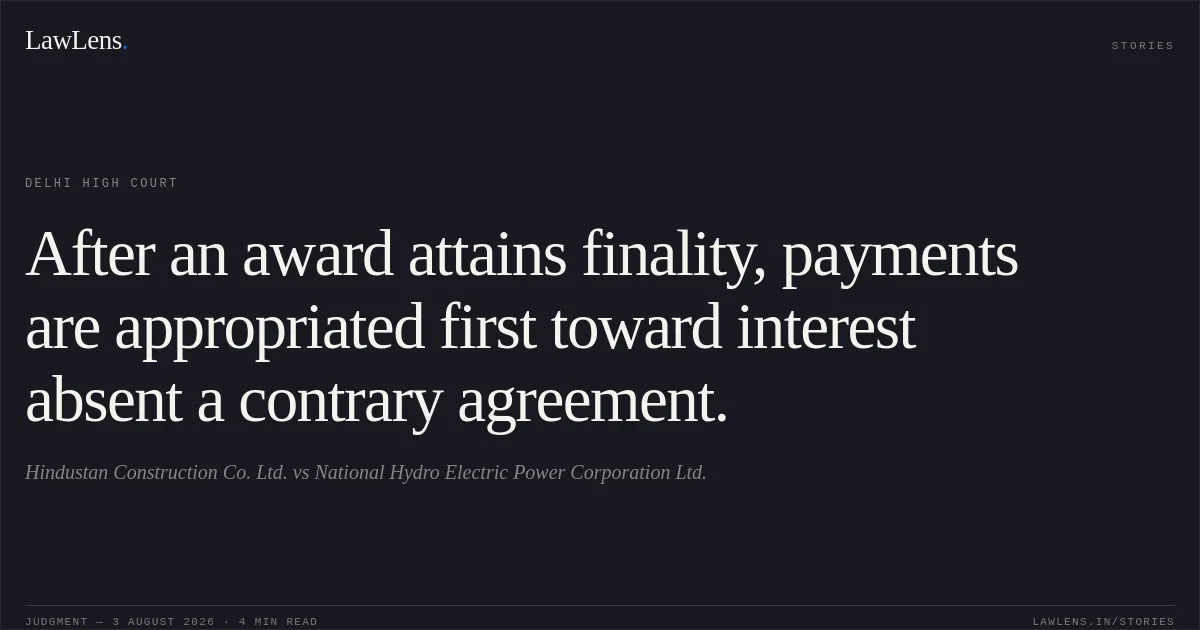
Source reference: p.8After the award attained finality, the Decree Holder sought payment of the balance amount, contending that prior payments were required to be appropriated first towards interest and thereafter towards principal, in accordance with Leela Hotels Ltd. v. Housing & Urban Development Corpn. Ltd., (2012) 1 SCC 302.
Source reference: pp.9–12The Judgment Debtor contended that the payments had been made and accepted on the basis of the Decree Holder’s earlier calculation under the NITI Aayog Office Memorandums, and that the Decree Holder was estopped from subsequently changing the method of appropriation.
Source reference: pp.13–20Issues
1. Whether amounts paid in execution of the arbitral award were required to be appropriated first towards accrued interest and thereafter towards the principal amount, or whether they had been validly appropriated towards principal pursuant to the parties’ correspondence under the NITI Aayog Office Memorandums.
Source reference: para.10; pp.9–122. Whether the Decree Holder was estopped from applying the rule of appropriation laid down in Leela Hotels because it had earlier furnished calculations treating part of the interim payments as payment towards principal.
Source reference: paras.14–22; pp.13–203. Whether any further amount remained payable after adjusting the payments of Rs.47,55,94,100/- and Rs.37,10,29,058/-.
Source reference: paras.9–12; pp.8–12Law Applied
The Court applied the rule in Leela Hotels Ltd. v. Housing & Urban Development Corpn. Ltd., (2012) 1 SCC 302, that where there is no agreement to the contrary, a payment made towards a debt carrying both principal and interest is to be appropriated first towards interest and only thereafter towards principal.
Source reference: paras.11, 14; pp.9–12The Court also considered Sections 59 and 60 of the Contract Act, 1872, concerning appropriation of payments, as discussed in Leela Hotels and Kerala State Electricity Board v. Kurien E. Kalathil, (2018) 4 SCC 793.
Source reference: paras.11, 21–22; pp.9–20Kerala SEB recognises that a party may be bound by its own prior appropriation where its statements and conduct clearly indicate that payments were intended to be adjusted towards principal; however, the Court held that that principle was factually distinguishable here.
Source reference: paras.21, 25; pp.15–20The NITI Aayog Office Memorandums were treated as interim measures intended to facilitate partial payment during the pendency of challenges to arbitral awards, rather than as agreements altering the legal rule applicable after the award attained finality.
Source reference: paras.6–8, 26–27; pp.3–8, 20–23Reasoning
The Court held that the Decree Holder’s communications and calculations were made in the context of obtaining interim payments under the NITI Aayog Office Memorandums and did not constitute an agreement permanently governing appropriation after the award became final.
Source reference: para.24; pp.20–21The Office Memorandums were intended to provide liquidity assistance to contractors while arbitral awards remained under challenge and required security because the amounts might have to be refunded if the award was set aside.
Source reference: paras.6–8, 26; pp.3–8, 20–21Once the award was upheld, the payments had to be adjusted against the final decretal liability in accordance with Leela Hotels.
Source reference: no citationThe Court distinguished Kerala SEB because, in that case, the contractor’s own earlier statements had unequivocally appropriated payments towards principal, whereas the present correspondence arose only from the interim-payment mechanism and was expressly without prejudice to the Decree Holder’s right to claim the balance under the award.
Source reference: paras.25–27; pp.20–23Accordingly, the Court accepted the Decree Holder’s calculation applying payments first towards interest and then towards principal, and found that Rs.16,39,87,708/- remained payable as on 2 July 2026.
Source reference: paras.12–14, 27–29; pp.11–14, 23Holding
The Court answered the issues in favour of the Decree Holder.
It held that the interim payments made under the NITI Aayog Office Memorandums did not amount to an agreement contrary to the rule in Leela Hotels, nor did the Decree Holder’s interim calculations estop it from seeking appropriation first towards interest and then towards principal after the award attained finality.
Source reference: paras.24–27; pp.20–23The application was allowed, and the Judgment Debtor was directed to pay Rs.16,39,87,708/- as due on 2 July 2026 within six weeks from uploading of the judgment.
Source reference: paras.28–29The execution petition and pending applications were disposed of accordingly.
Source reference: para.30Original Court PDF
Hindustan Construction Co. Ltd.vsNational Hydro Electric Power Corporation Ltd.
Click to open original judgment
Original judgment, available to read, download and summarize on LawLens.in