Facts
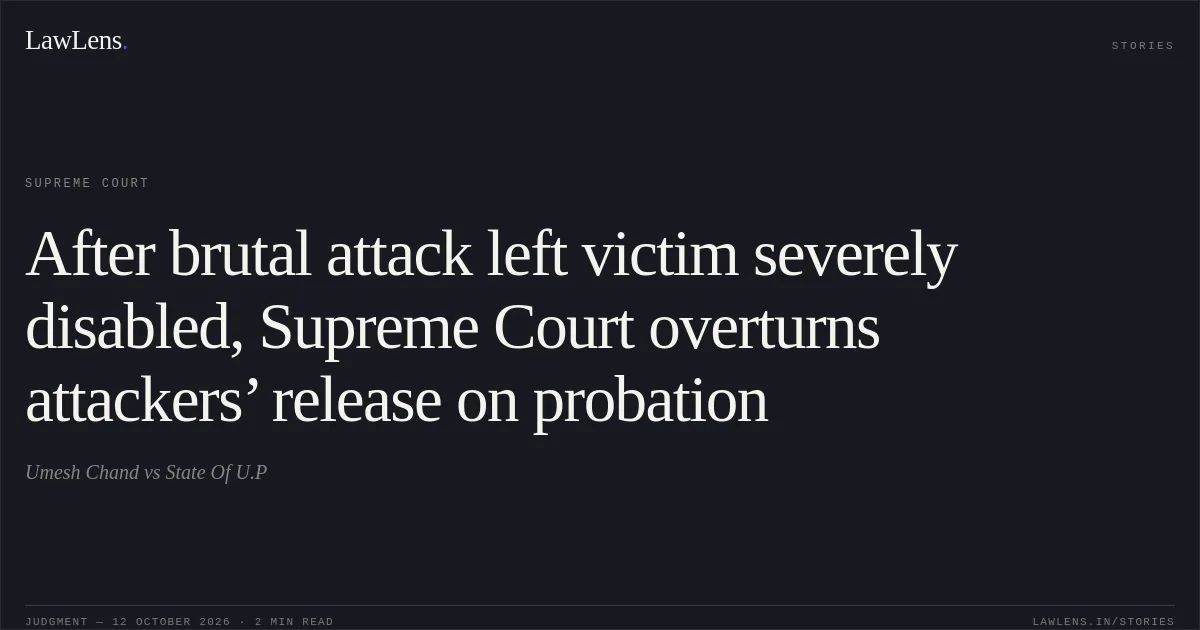
The victim was attacked by two accused with a cutting weapon and a firearm, sustaining grievous injuries with continuing effects on his mobility and use of his hands.
Source reference: p. 2–3, p. 7–8The trial court convicted the accused under Section 308 IPC and sentenced them to five years’ rigorous imprisonment and a fine.
Source reference: p. 1The High Court affirmed the conviction but released them under Section 4 of the Probation of Offenders Act, 1958, relying principally on the passage of time and the absence of prior convictions.
Source reference: p. 4–5The victim’s brother, the first informant, appealed.
Source reference: no citationA Probation Officer’s report before the Supreme Court listed multiple criminal cases involving both accused and documented the victim’s continuing disabilities.
Source reference: p. 6–8Issues
1. Whether the High Court was justified in releasing the accused under Section 4 of the Probation of Offenders Act, having regard to the offence’s nature, the accused’s character and antecedents, and the absence of a Probation Officer’s report before it.
Source reference: p. 4–5, p. 8–102. Whether the High Court’s order should be set aside and the accused required to surrender before the restored criminal appeal is heard.
Source reference: p. 10–11Law Applied
Section 4 of the Probation of Offenders Act, 1958 permits release on probation only after the court considers whether release is expedient in light of the circumstances of the case, including the nature of the offence and the character of the offender.
Source reference: p. 8–10Under Section 4(2), the court must take into consideration any Probation Officer’s report before making an order under Section 4(1).
Source reference: p. 8–10The absence of a prior conviction, or the passage of time during which an accused remained on bail, does not by itself justify probation; the offender’s actual conduct and the seriousness of the offence remain material considerations.
Source reference: p. 9Reasoning
The High Court relied on the accused’s asserted lack of prior convictions and the 22-year interval since the incident, but did not adequately account for the brutal attack, the victim’s grievous and continuing injuries, or the accuseds’ adverse criminal antecedents.
Source reference: p. 4–5, p. 7–10The Supreme Court considered the Probation Officer’s report, which recorded multiple cases involving both accused, and noted that the State had also brought their antecedents to the High Court’s attention.
Source reference: p. 6–7, p. 9–10In those circumstances, the High Court’s reliance on good conduct and delay was misplaced, and its order failed to give proper weight to the statutory considerations governing release under Section 4.
Source reference: p. 8–10The Court also observed that the injuries appeared to fall within “grievous hurt” and that Section 307 IPC, rather than Section 308 IPC, appeared applicable, but stated that little could be done at that stage because the trial had proceeded on the Section 308 charge.
Source reference: p. 3Holding
The Supreme Court allowed the appeals and set aside the High Court’s order granting probation.
It directed the accused to surrender within two weeks; failing that, the trial court was to take immediate steps to apprehend them.
Source reference: p. 10–11The criminal appeals were restored before the Allahabad High Court, Lucknow Bench, which was directed to hear them only after the accused had been taken into custody.
Source reference: p. 11Acts & Sections Cited
19 provisions across 4 statutes referred to in this judgment. Each provision opens on LawLens.
Indian Penal Code, 1860
Probation of Offenders Act, 19581
Code of Criminal Procedure, 19732
Scheduled Castes and the Scheduled Tribes (Prevention of Atrocities) Act, 19891
Original Court PDF
Umesh ChandvsState Of U.P
Click to open original judgment
Original judgment, available to read, download and summarize on LawLens.in
![Competent authority must reconsider transfer-waiting-list priority through a reasoned order.. Prabhat Kumar Srivastwa vs NORTH CENTRAL RAILWAY. CAT - ['Allahabad']. LawLens](/stories/thumbnails/competent-authority-must-reconsider-transfer-waiting-list-priority-through-a-reasoned-orde-e23ccd4eaf154e82b09ea183b25e32fb.webp)
![Excess-pay recovery from retired Group C employees is impermissible absent fraud or misrepresentation.. SATYA NAND YADAV vs NORTH EASTERN RAILWAY. CAT - ['Allahabad']. LawLens](/stories/thumbnails/excess-pay-recovery-from-retired-group-c-employees-is-impermissible-absent-fraud-or-misrep-c357cbdd195c44d68331385eea2a3c9a.webp)