Facts
Punjabi Academy, a society fully funded, supervised and controlled by the GNCTD, introduced a need-based Punjabi Language Teaching Scheme in schools.
Source reference: no citationThe writ petitioners were part-time Punjabi teachers appointed by the Punjabi Academy, mostly between 1986 and 1991, and placed in schools run by the Municipal Corporation of Delhi.
Source reference: pp. 6–7, paras. 5–6Although they had continued teaching for several decades and also performed administrative functions such as setting examinations, invigilation and evaluating answer books, they were paid substantially lower monthly remuneration than regularly appointed teachers.
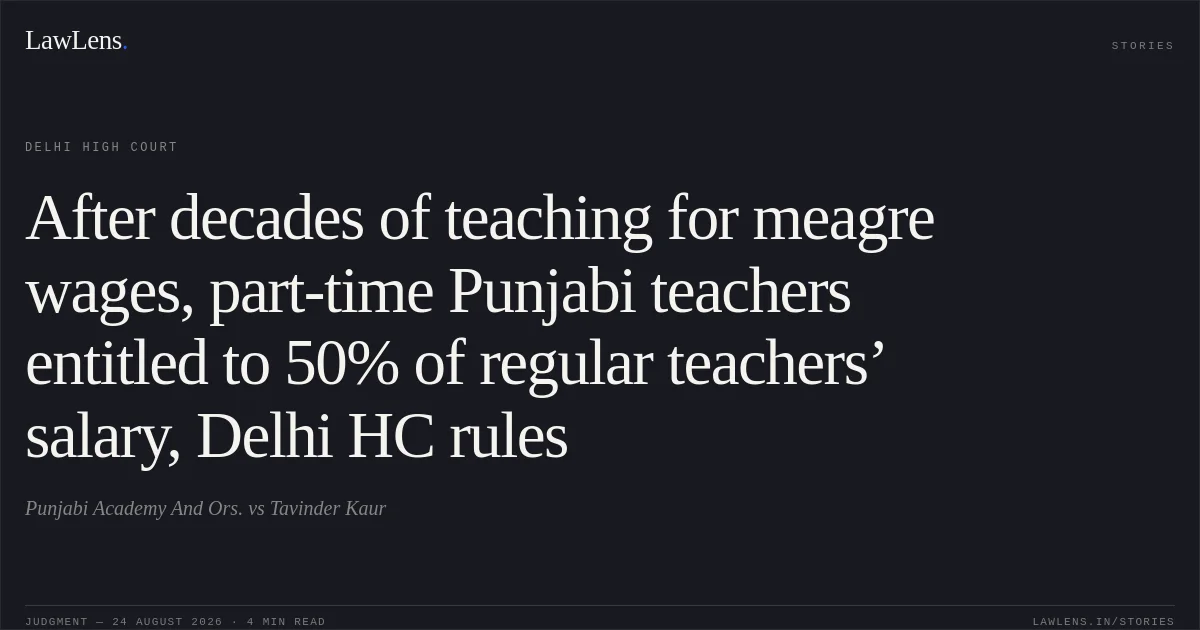
Source reference: pp. 6–7, paras. 5–6Relying principally on Durraj Fatima Naqvi v. Govt. of NCT of Delhi, the teachers sought payment equivalent to 50% of the salary and allowances payable to regularly appointed Assistant/Primary Teachers.
Source reference: no citationThe learned Single Judge allowed the writ petitions, directed refixation of their salaries at 50% of the regular teachers’ salary, payment of arrears, and interest at 6% per annum.
Source reference: p. 5, para. 3Punjabi Academy and the Directorate of Education challenged that decision through the connected intra-Court appeals.
Source reference: no citationIssues
Whether the part-time Punjabi teachers were entitled under Rule 101(2) of the Delhi School Education Rules, 1973, to salary and allowances equivalent to one-half of those payable to full-time regularly appointed teachers.
Source reference: pp. 10–12, paras. 12–13; p. 15, para. 18Whether the teachers’ educational qualifications, including the absence of B.Ed. degrees in some cases, disentitled them from the benefit of the principle laid down in Durraj Fatima Naqvi.
Source reference: pp. 12–14, paras. 16–17Whether the notification prescribing minimum qualifications under the Right of Children to Free and Compulsory Education Act, 2009, could defeat the teachers’ claim for payment of 50% of the regular teachers’ salary.
Source reference: pp. 13–15, paras. 17–19Law Applied
The Court applied Rule 101(1) and Rule 101(2) of the Delhi School Education Rules, 1973, under which part-time teachers may be engaged on a regular basis and their salary and allowances must be one-half of those payable to full-time teachers appointed on a regular basis; the proviso also extends medical and other non-pensionary benefits to part-time teachers.
Source reference: pp. 10–12, paras. 12–13It relied on Durraj Fatima Naqvi v. Govt. of NCT of Delhi, which held that executive action and contractual appointments cannot contravene the statutory mandate and that part-time teachers cannot be paid less than half the salary and allowances of regular full-time teachers.
Source reference: p. 12, para. 13It also followed Rani v. Government of NCT of Delhi, which treated similarly placed part-time Punjabi teachers as entitled to the same benefit.
Source reference: p. 14, para. 15The Court further invoked Articles 14 and 23 of the Constitution, together with the constitutional directives concerning fair and humane employment conditions, holding that payment below even the minimum wage and denial of a statutorily mandated wage parity were arbitrary and inconsistent with the State’s obligation to act as a model employer.
Source reference: pp. 8–10, paras. 10–11; p. 16, para. 21The qualifications notifications issued under the RTE Act were held relevant primarily to regularisation, not to the teachers’ independent claim for statutory wage protection.
Source reference: pp. 13–15, paras. 17–19Reasoning
The Court found the Punjabi teachers materially indistinguishable from the Urdu teachers in Durraj Fatima Naqvi: both groups were part-time language teachers appointed by GNCTD-controlled academies and deployed in government or municipal schools, where they continuously performed teaching and related duties.
Source reference: pp. 10–12, paras. 12–15Their long and uninterrupted service established that they had been appointed with the qualifications prescribed in the relevant advertisements and that their qualifications had not prevented them from performing their duties.
Source reference: pp. 12–14, paras. 16–17The Court rejected the appellants’ attempt to distinguish Durraj Fatima Naqvi on the basis that the Punjabi teachers lacked B.Ed. qualifications, observing that the earlier decision was not founded on the teachers’ educational qualifications but on the statutory mandate of Rule 101(2) and the unconscionably low remuneration paid for decades.
Source reference: pp. 8–9, paras. 8–9; p. 15, para. 18Since the teachers were regularly serving as part-time teachers without breaks, the statutory entitlement to 50% of the salary and allowances of regular full-time teachers applied directly.
Source reference: no citationTheir remuneration was also below the minimum wage prescribed even for unskilled labour, rendering the State’s conduct arbitrary under Article 14 and contrary to the constitutional prohibition against economic exploitation.
Source reference: pp. 6–7, para. 6; p. 16, para. 21Holding
The Division Bench dismissed all the appeals as meritless and affirmed the learned Single Judge’s judgment dated 15.07.2025.
It held that the part-time Punjabi teachers were entitled to salary and allowances at 50% of those payable to regularly appointed full-time teachers under Rule 101(2) of the Delhi School Education Rules, 1973, irrespective of the appellants’ objections concerning their educational qualifications or the RTE qualification notifications.
Source reference: p. 15, paras. 18–19The appellants were directed to comply with the Single Judge’s judgment, including refixation of salaries, payment of arrears and applicable interest, within eight weeks from 24.08.2026.
Source reference: p. 17, para. 24There was no order as to costs, and all pending applications were disposed of.
Source reference: p. 17, paras. 25–26Acts & Sections Cited
1 provisions across 1 statute referred to in this judgment. Each provision opens on LawLens.
Right of Children to Free and Compulsory Education Act, 20091
Original Court PDF
Punjabi Academy And Ors.vsTavinder Kaur
Click to open original judgment
Original judgment, available to read, download and summarize on LawLens.in