01Facts
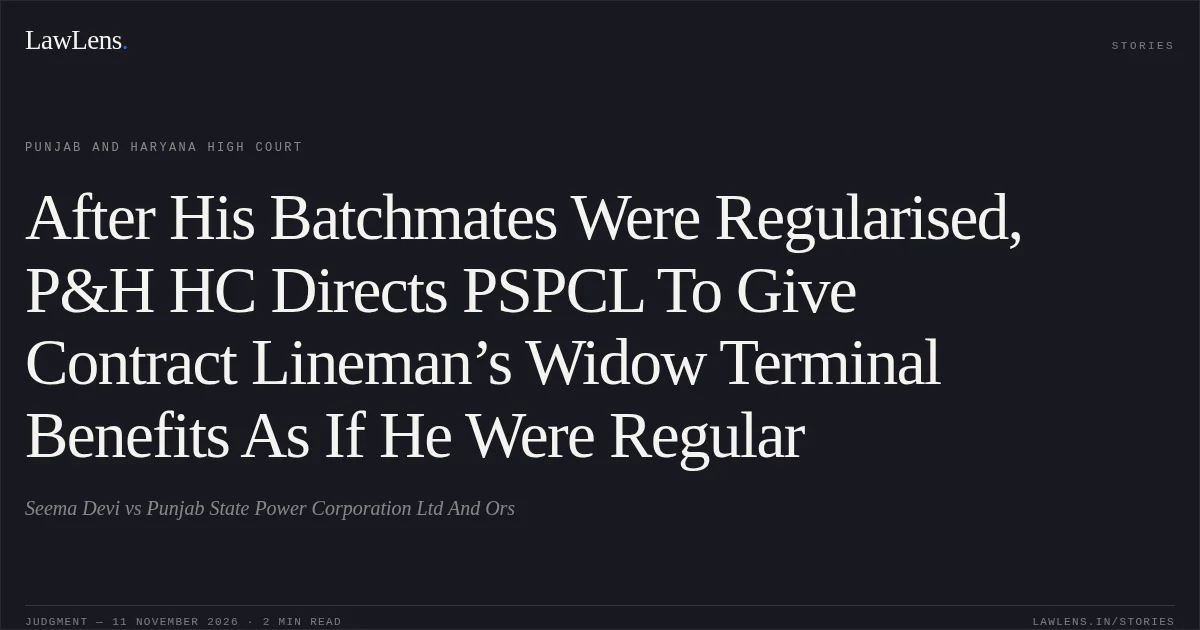
The petitioner’s husband, Balbir Singh, was appointed as a Lineman on a two-year contractual basis by the respondent Corporation on 29 September 2016. He died in an accident on 1 January 2018 while in service.
¶ 3–4The appointment terms provided for fixed remuneration and statutory EPF/ESI contributions, but excluded other benefits except those specified and stated that the Corporation was not obliged to offer regular employment.
¶ 3, 6Employees appointed with him were later granted an extension and regularised in 2019; he could not be considered for regularisation because he had died during his initial contract.
¶ 4, 8The petitioner initially sought compassionate appointment and terminal benefits, but confined her claim to terminal dues.
¶ 1–2She relied on Paramjit Kaur v. State of Punjab and others, where a claim by the widow of a contractual employee had been allowed.
¶ 5, 902Issues
i.1. Whether the petitioner could be considered for terminal benefits by treating her deceased husband as a regular employee, although he died while serving under a fixed-term contract.
¶ 8–10ii.2. Whether the contractual terms excluding benefits beyond those specified defeated the petitioner’s claim to terminal benefits.
¶ 3, 6, 1003Law Applied
The Court applied the principle in Paramjit Kaur v. State of Punjab and others, decided 11 January 2016, which had accepted a claim for benefits where a contractual employee died before a subsequent regularisation decision.
¶ 9That judgment, in turn, relied on Beant Kaur v. State of Punjab, 2001(3) SCT 321, and Dalbir Kaur v. State of Punjab and others, CWP No. 1731 of 2011, decided 10 January 2012.
¶ 9The Court treated Paramjit Kaur as governing the present claim and directed that the husband be treated as a regular employee for the purpose of considering terminal benefits.
¶ 10Articles 226 and 227 of the Constitution were invoked in the petition.
¶ 104Reasoning
The Court found that the material circumstances—contractual appointment, death during service, and subsequent regularisation of similarly situated employees—were comparable to those in Paramjit Kaur.
¶ 8–9It held that the petitioner’s claim was squarely covered by that decision.
¶ 10Although the respondents relied on the appointment terms restricting benefits and disclaiming an obligation to provide regular employment, the Court did not separately analyse those clauses; it resolved the claim by applying Paramjit Kaur.
¶ 6, 1005Holding
The petition was partly allowed.
¶ 10The respondents were directed to consider the petitioner’s claim for terminal benefits by treating her husband as a regular employee and to release the benefits within three months of receiving a certified copy of the order.
¶ 10The petitioner’s claim for compassionate appointment had been restricted and was not determined; the order expressly directed payment of terminal benefits but did not separately address the requested interest.
¶ 2, 10Original Court PDF
Seema DevivsPunjab State Power Corporation Ltd And Ors
Click to open original judgment
Original judgment, available to read, download and summarize on LawLens.in