Facts
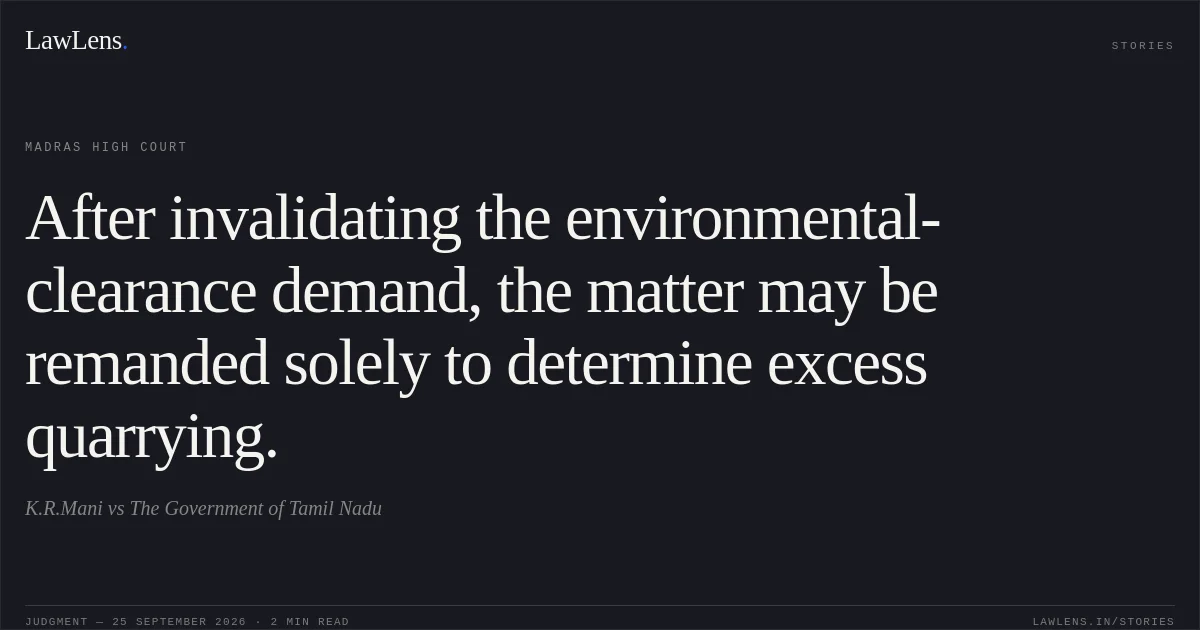
The appellant was conducting quarrying activities under a mining lease.
Source reference: no citationThe District Collector, by order dated 14 September 2024, directed him to remit 100% of the mineral cost on the allegations that he had quarried without valid environmental clearance between 15 January 2016 and 10 January 2017 and had also carried out excess quarrying.
Source reference: p.3The appellant challenged the order in W.P. No. 1910 of 2025, contending, inter alia, that he had obtained environmental clearance on 10 August 2016 and that the impugned demand had been passed without affording him an opportunity of hearing.
Source reference: pp.2, 4The learned Single Judge set aside the Collector’s order insofar as it related to quarrying without environmental clearance and remanded the matter to the District Collector to determine, after hearing the appellant, whether any excess quarrying had been undertaken.
Source reference: p.4The appellant filed the present intra-court appeal under Clause 15 of the Letters Patent challenging that limited remand.
Source reference: p.1Issues
Whether the learned Single Judge was justified in setting aside the Collector’s order and remanding the matter for the limited purpose of determining whether excess quarrying had taken place.
Source reference: pp.4–5Whether the appellant’s contention that the matter ought not to have been remanded, particularly because the original order was allegedly passed without a hearing and the appellant possessed environmental clearance, warranted interference in the intra-court appeal.
Source reference: pp.2, 5Law Applied
The appeal was considered under Clause 15 of the Letters Patent, which permits an intra-court appeal against a judgment of a Single Judge.
Source reference: p.1The Court applied the principle that where an administrative demand is founded on multiple grounds, and one ground is legally unsustainable, the matter may be remanded for fresh consideration on the surviving ground, subject to observance of natural justice.
Source reference: no citationThe relevant regulatory framework was the Tamil Nadu Minor Mineral Concession Rules, 1959, under which further action could be taken for unauthorised or excess quarrying, as referred to in the Collector’s order.
Source reference: p.3Reasoning
The Collector’s demand rested on two distinct allegations: quarrying without environmental clearance and excess quarrying.
Source reference: p.3Since the appellant had obtained environmental clearance on 10 August 2016, the Single Judge correctly held that the demand based on the allegation of quarrying without clearance during the entire period from 15 January 2016 to 10 January 2017 could not be sustained.
Source reference: p.4However, the separate allegation of excess quarrying had not been finally adjudicated.
Source reference: no citationThe Single Judge therefore limited the remand to that issue and directed the District Collector to conduct an enquiry and afford the appellant a reasonable opportunity of hearing.
Source reference: pp.4–5The Division Bench held that this limited remand was neither arbitrary nor perverse and that the appellant’s objection to remand had no legal basis.
Source reference: p.5Holding
The Division Bench dismissed the writ appeal, finding no error or perversity in the Single Judge’s order.
The matter remained remitted to the District Collector solely to determine whether the appellant had undertaken excess quarrying, after providing him a reasonable opportunity of hearing and passing appropriate orders in accordance with law.
Source reference: p.4There was no order as to costs, and the connected miscellaneous petition was also dismissed.
Source reference: p.5Original Court PDF
K.R.ManivsThe Government of Tamil Nadu
Click to open original judgment
Original judgment, available to read, download and summarize on LawLens.in