01Facts
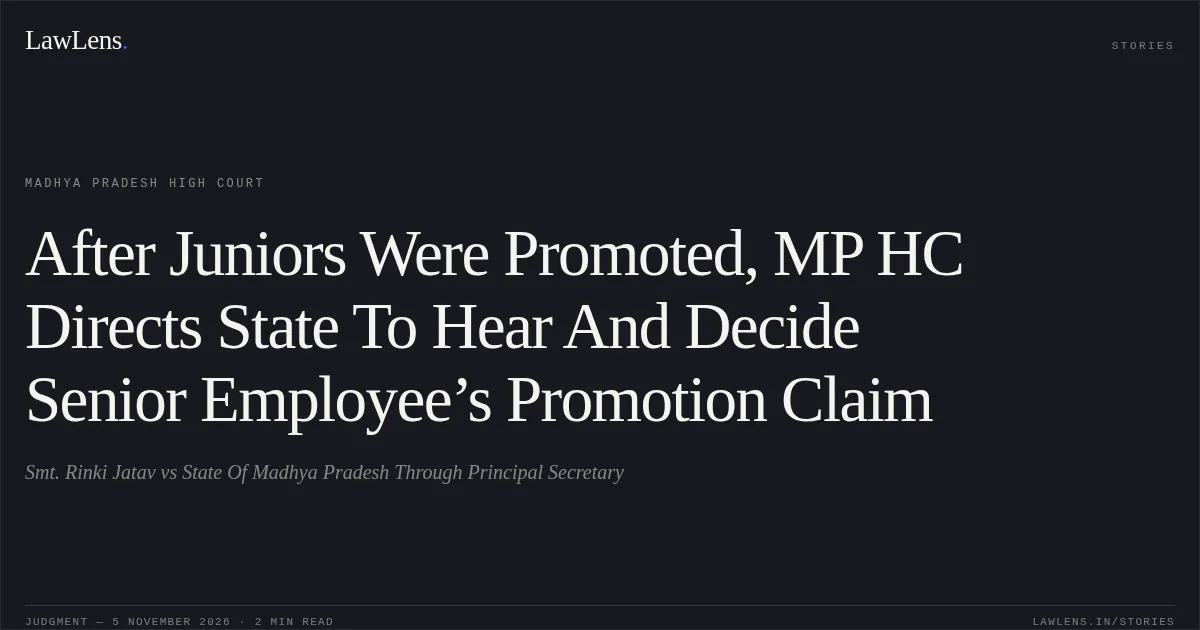
The petitioner claimed that she was senior to two employees promoted by order dated 21 September 2026, relying on the gradation list as of 1 April 2026, in which she was listed at Serial No. 58 and the two employees at Serial Nos. 59 and 66.
¶ 2–3She contended that her promotion had not been considered and asked the Court to direct the respondents to consider a fresh representation; the State did not oppose that limited request.
¶ 2–3The Court noted the petitioner’s reliance on principles concerning uncommunicated ACRs and promotion.
¶ 5–902Issues
i.Whether the petitioner’s claim for promotion, seniority and consequential benefits required consideration in light of her contention that juniors had been promoted without her case being considered.
¶ 2, 8–9ii.Whether the respondents should be directed to consider a fresh representation addressing the promotion criteria and the petitioner’s reliance on uncommunicated ACRs.
¶ 10–1103Law Applied
The Court relied on the principle that uncommunicated adverse ACR entries cannot be used to deny promotion, and that even other ACR gradings should be communicated so that an employee may seek an upgrade, drawing on Dev Dutt v. Union of India, (2008) 8 SCC 725; Abhijit Ghosh Dastidar v. Union of India, (2009) 16 SCC 146 and (2010) 1 SCC (L&S) 959; and Gurdial Singh Fijji v. State of Punjab, (1979) 2 SCC 368.
¶ 5–6, 9It also referred to Union of India v. K.V. Jankiraman, AIR 1991 SC 2010, and subsequent decisions for the proposition that “no work, no pay” may not apply where an employee was not at fault and the department prevented performance in the promotional post.
¶ 7The Court cited Mehfooz Ahmad v. High Court of Madhya Pradesh, 2024 (3) JLJ 17, for the rule that uncommunicated ACRs cannot be considered by a DPC.
¶ 804Reasoning
The Court considered the petitioner’s claim that she was senior to employees promoted in the relevant order and her reliance on authorities concerning uncommunicated ACRs.
¶ 2, 8–9Rather than determine whether she was entitled to promotion or the claimed consequential benefits, it directed the competent authority to examine her representation against the DPC criteria, consider the promotion of her juniors and the cited judgments, and provide a reasoned decision after giving her a personal hearing.
¶ 10–1105Holding
The petition was disposed of without granting promotion or seniority directly.
¶ 10–12The petitioner was directed to submit a fresh, detailed representation within two weeks; the competent authority must decide it by a reasoned and speaking order, after a personal hearing, within one month of receiving a certified copy of the order.
¶ 10–12Original Court PDF
Smt. Rinki JatavvsState Of Madhya Pradesh Through Principal Secretary
Click to open original judgment
Original judgment, available to read, download and summarize on LawLens.in