01Facts
The petitioner sought regular bail under Section 483 of the Bharatiya Nagarik Suraksha Sanhita, 2023, in an NDPS case.
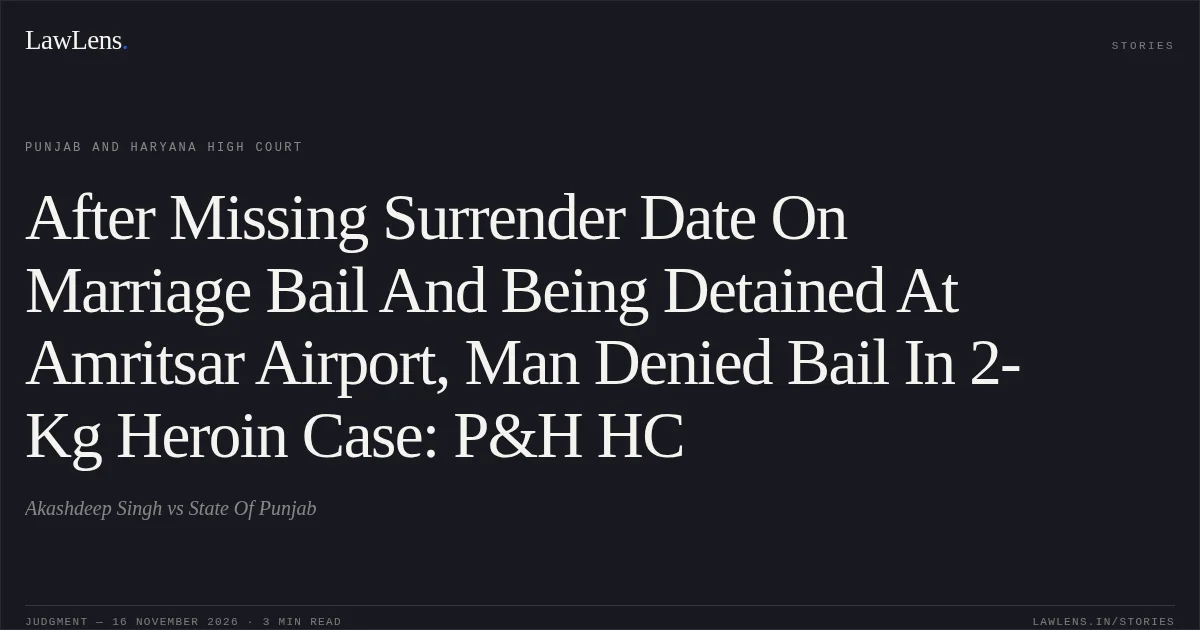
p. 2The prosecution alleged that, following a co-accused’s disclosure, the petitioner was arrested on 3 October 2025 and caused the recovery of 2 kg and 3 g of heroin; the FSL report confirmed the presence of heroin.
pp. 2–3The petitioner challenged the arrest for failure to communicate its grounds and disputed the recovery and investigation.
pp. 3–5He had earlier obtained interim bail to attend his marriage but did not surrender on the directed date and was later detained at Amritsar airport while attempting to travel abroad.
pp. 3, 15–16Charges had been framed and the case was at the prosecution-evidence stage.
p. 2, 1602Issues
i.Whether the petitioner’s arrest was vitiated by failure to effectively communicate the grounds of arrest, entitling him to release notwithstanding Section 37 of the NDPS Act.
¶ 11–24ii.Whether the petitioner satisfied the conditions for regular bail under Section 37 of the NDPS Act, having regard to the alleged commercial-quantity recovery, the evidence and his conduct after interim bail.
¶ 25–2803Law Applied
Article 22(1) of the Constitution, Section 52(1) of the NDPS Act and Section 47(1) of the BNSS require an arrested person to be informed of the grounds of arrest.
¶ 11Under Vihaan Kumar v. State of Haryana, the communication must effectively impart sufficient knowledge of the basic facts constituting the grounds, and the investigating agency bears the burden of proving compliance; an established constitutional violation warrants release notwithstanding statutory bail restrictions.
¶ 12The Court treated Mihir Rajesh Shah v. State of Maharashtra’s written-communication requirement as prospective and assessed this 3 October 2025 arrest under Vihaan Kumar.
¶ 15–20It distinguished failure to communicate grounds from inadequacy in the grounds communicated, applying a prejudice inquiry to the latter.
¶ 20, 23Under Section 37 of the NDPS Act, bail for a commercial-quantity offence requires reasonable grounds to believe that the accused is not guilty and that he is not likely to commit an offence while on bail; “reasonable grounds” require more than a prima facie assessment.
¶ 25Provisions in the judgment · 11 · Linked ones open on LawLens
Bharatiya Nagarik Suraksha Sanhita, 2023 Section 483Section 47Section 41Section 42Section 43Section 44
Narcotic Drugs and Psychotropic Substances Act, 1985 Section 21Section 29Section 52Section 37
Code of Criminal Procedure, 1973 Section 50
04Reasoning
Although the arrest memo recorded the FIR number and statutory provisions without setting out the underlying facts, the Court considered the record cumulatively: the petitioner’s father was informed of the arrest, the remand proceedings identified the alleged recovery and links to the co-accused, the petitioner was represented at remand, and he had himself previously stated that he was implicated on the co-accused’s disclosure.
¶ 21–23The Court therefore found that sufficient knowledge of the basic grounds had been imparted; any deficiency in the memo’s contents had not caused demonstrated prejudice.
¶ 21–23On the merits, the alleged 2 kg and 3 g recovery exceeded commercial quantity, was supported by the FSL report, and the petitioner’s challenges to the recovery raised matters for trial; the Court could not find reasonable grounds to believe he was not guilty.
¶ 26His failure to surrender after interim bail, subsequent detention at the airport, and omission of that episode from the bail petition further weighed against relief and indicated a risk of flight.
¶ 2705Holding
The Court held that no breach of Article 22(1) warranting release was established and that the petitioner did not satisfy Section 37 of the NDPS Act.
¶ 28It dismissed the regular-bail petition, clarifying that its observations were not an expression of opinion on the merits of the case.
¶ 28Original Court PDF
Akashdeep SinghvsState Of Punjab
Click to open original judgment
Original judgment, available to read, download and summarize on LawLens.in