Facts
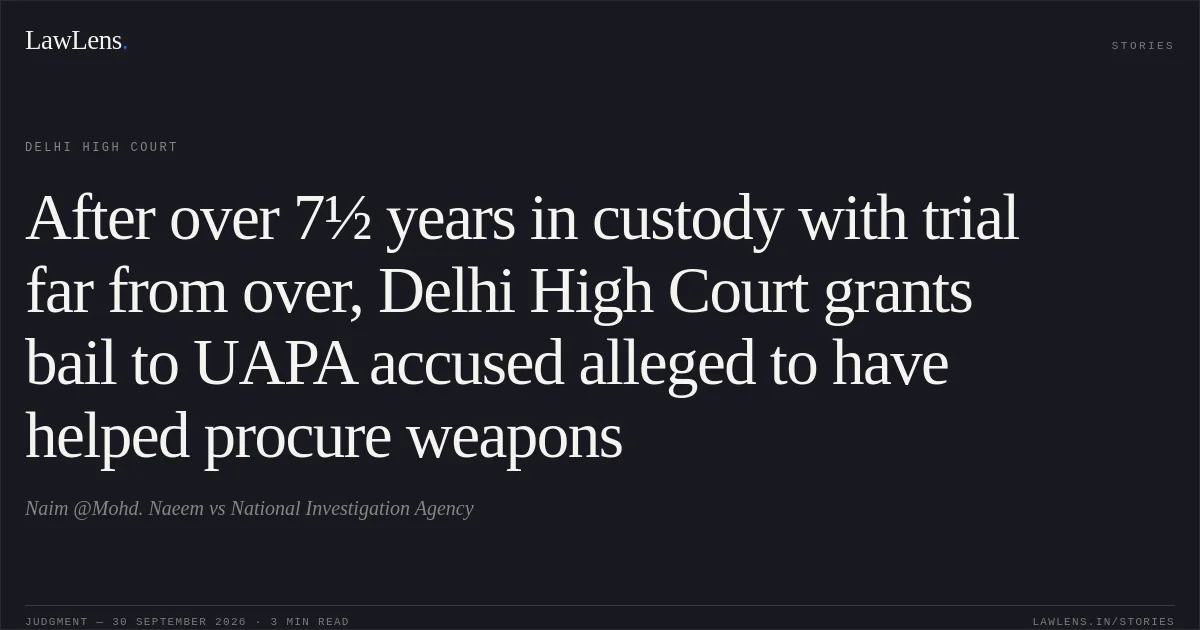
The appellant challenged the Trial Court’s order rejecting bail in a prosecution under Sections 120B, 121, 121A and 122 IPC; Sections 17, 18, 18B, 20, 38 and 39 of the UAPA; and Sections 4 and 5 of the Explosive Substances Act.
Source reference: p.1He had been in custody since 3 January 2019.
Source reference: p.1The prosecution alleged that he facilitated the procurement of firearms and ammunition for co-accused, including by connecting them with local arms suppliers in Meerut.
Source reference: pp.7–13At the time of the appeal, 42 of 112 witnesses had been examined, and the High Court found no likelihood of the trial concluding soon.
Source reference: pp.2, 26Issues
Whether the appellant should be released on bail, notwithstanding the restrictions under Section 43D(5) of the UAPA, in light of his prolonged pre-trial detention and the likely duration of the trial.
Source reference: pp.15–26Whether the prosecution material and the role attributed to the appellant justified continued detention at the bail stage.
Source reference: pp.13–15, 26Law Applied
Section 21(4) of the NIA Act provides the appellate route for challenging a bail order in a scheduled-offence case.
Source reference: p.1Section 43D(5) of the UAPA restricts bail where the Court finds the accusation prima facie true, but does not exclude constitutional courts’ power to grant bail where continued detention raises concerns under Article 21.
Source reference: pp.15–17, 22–23Relying on Union of India v. K.A. Najeeb, the judgment states that prolonged incarceration and the unlikelihood of trial within a reasonable time may justify bail despite statutory restrictions.
Source reference: pp.15–17, 22–23The judgment also refers to Gulfisha Fatima v. State (NCT of Delhi) for a contextual, accused-specific assessment of delay, role, the stage and likely course of trial, and risks on release; the bail-stage inquiry is not a determination of guilt or a mini-trial.
Source reference: pp.18–21It notes that the relevant constitutional and statutory principles must be applied as the law stands, notwithstanding a reference of questions to a larger Bench.
Source reference: pp.24–26Reasoning
The three village witnesses had already testified; without assessing their evidence in a manner that could affect the trial, the Court found their statements insufficient to persuade it to deny bail, and noted that their examination reduced the risk of influence.
Source reference: p.14The effect of the call-detail records was left to the Trial Court, while the prosecution’s claim that the alleged supply of arms established knowledge of terrorist use was also left for trial.
Source reference: pp.14–15Against that material, the appellant had spent more than seven and a half years in custody, while only 42 of 112 witnesses had been examined and the trial was unlikely to conclude soon.
Source reference: p.26Taking the nature of the evidence and the delay together, the Court held that continued detention was not justified.
Source reference: p.26Holding
The High Court allowed the appeal, set aside the order rejecting bail, and directed the appellant’s release on a personal bond of ₹50,000 with two sureties of the like amount, subject to conditions.
These included surrendering his passport, restrictions on travel and residence, regular reporting to the NIA, attendance at trial, and prohibitions on contacting witnesses, tampering with evidence, or otherwise prejudicing the proceedings.
Source reference: pp.26–28The Court clarified that its observations were confined to the bail application and did not express an opinion on the merits of the case.
Source reference: p.29Acts & Sections Cited
13 provisions across 6 statutes referred to in this judgment. Each provision opens on LawLens.
National Investigation Agency Act, 20081
Indian Penal Code, 18602
Unlawful Activities (Prevention) Act, 19676
Code of Criminal Procedure, 19731
Narcotic Drugs and Psychotropic Substances Act, 19851
Original Court PDF
Naim @Mohd. NaeemvsNational Investigation Agency
Click to open original judgment
Original judgment, available to read, download and summarize on LawLens.in