Facts
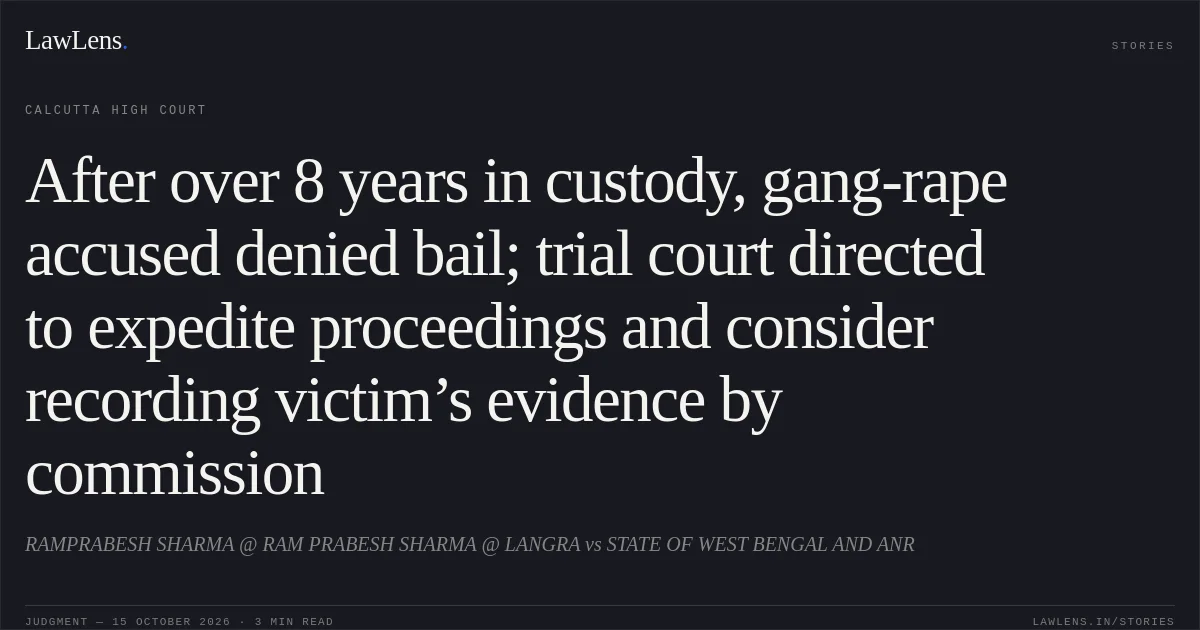
The appellant sought bail while challenging the rejection of his bail prayer in a prosecution arising from Kushmandi Police Case No. 20 of 2018.
Source reference: paras. 1, 3–5He had been charged under provisions including Sections 376D, 376(2)(m), 326 and 307 of the IPC and the SC/ST (Prevention of Atrocities) Act.
Source reference: paras. 1, 3–5The prosecution alleged that the victim, a Scheduled Tribe woman, was gang-raped and left for dead, suffering severe physical and mental injuries.
Source reference: paras. 1, 3–5The appellant had been in custody for more than eight years. He argued that the trial had been unduly delayed; the parties gave differing accounts of the number of witnesses examined—15 of 37 according to the appellant and 17 of 37 according to the State—and the victim and some medical witnesses had not yet testified. A prior bail application had been rejected, and the trial court had also refused bail.
Source reference: paras. 2–4, 7, 9–10Issues
Whether prolonged pre-trial custody and delay in completing the trial, considered in light of Article 21, justified granting bail to the appellant
Source reference: paras. 2, 7–11Whether the gravity of the alleged offence, the material against the appellant and the fact that the victim and important medical witnesses remained unexamined outweighed the delay-based ground for bail
Source reference: paras. 8–11Law Applied
The Court considered the appellant’s claim to personal liberty and a speedy trial under Article 21 of the Constitution alongside the gravity of the alleged offences and the material in the case diary.
Source reference: para. 1The application arose under Section 14A(2) of the SC/ST (Prevention of Atrocities) Act, read with the relevant criminal procedure provisions identified in the judgment.
Source reference: para. 1The parties cited Union of India v. K.A. Najeeb, Sagar Tatyaram Gorkhe v. State of Maharashtra, Aminuddin v. State of U.P. and Bhagwan Singh v. Dilip Kumar in support of their respective positions.
Source reference: paras. 2–4The Court’s stated approach was that delay and custody must be assessed in the context of the particular case; here, delay alone did not warrant bail given the alleged offence, the incriminating material and the outstanding testimony.
Source reference: paras. 8–11Reasoning
The Court acknowledged that the appellant had spent more than eight years in custody and that the trial remained incomplete.
Source reference: paras. 9–10However, it found no indication that the State or the victim was responsible for the delay, and noted that the victim’s severe physical and mental condition made it difficult for her to testify.
Source reference: paras. 9–10Having regard to the grave allegations, the material in the case diary and the fact that the victim and important medical experts had yet to be examined, the Court concluded that the appellant’s Article 21 and delay-based submissions did not justify release on bail.
Source reference: paras. 6, 10–11It nevertheless treated the prolonged trial as requiring urgent remedial action.
Source reference: no citationHolding
The Court rejected the bail application.
In view of the appellant’s lengthy custody and the delay in trial, it requested the trial court to treat the matter as a special case and proceed with day-to-day hearings or, at minimum, take evidence two days each week.
Source reference: para. 13If the victim could not be examined in court, the trial court was directed to consider examining her on commission and/or obtaining assistance from medical experts or psychiatrists.
Source reference: para. 13The application was disposed of with those observations and directions.
Source reference: para. 14Acts & Sections Cited
8 provisions across 4 statutes referred to in this judgment. Each provision opens on LawLens.
Code of Criminal Procedure, 19732
Bharatiya Nagarik Suraksha Sanhita, 20231
Scheduled Castes and the Scheduled Tribes (Prevention of Atrocities) Act, 19891
Indian Penal Code, 18604
Original Court PDF
RAMPRABESH SHARMA @ RAM PRABESH SHARMA @ LANGRAvsSTATE OF WEST BENGAL AND ANR
Click to open original judgment
Original judgment, available to read, download and summarize on LawLens.in
![Recovery of excess payments from a retired employee is impermissible absent fraud or misrepresentation.. KAMAL AFSAR vs NORTH CENTRAL RAILWAY. CAT - ['Allahabad']. LawLens](/stories/thumbnails/recovery-of-excess-payments-from-a-retired-employee-is-impermissible-absent-fraud-or-misre-4855cd93e9854b14922eda694d0bc8e1.webp)