Facts
The petitioners, students of Classes IX and XI at Jawahar Navodaya Vidyalaya, Karmalihata, Siwan, challenged orders directing recovery of assessed property damage and issuance of transfer certificates.
Source reference: paras. 2–6, pp. 2–5The orders followed a February 2026 incident involving alleged violence against the Principal and damage to school property; an FIR was registered against 41 students, and the school apportioned the assessed loss of ₹15,13,109 among them.
Source reference: paras. 2–6, pp. 2–5The petitioners disputed their involvement and argued that they had not received a fair hearing. The school relied on an enquiry, CCTV and video material, and opportunities said to have been given to the students and their parents.
Source reference: paras. 7–19, pp. 5–12; para. 34, p. 20; para. 43, p. 23Issues
1. Whether the decision to issue transfer certificates to the petitioners was unlawful or otherwise warranted interference under Article 226.
Source reference: paras. 26–27, pp. 16–17; paras. 38, 44–45, pp. 21, 24–252. Whether the school could recover the apportioned share of the assessed property damage from the students or their parents without a legally sustainable determination of individual liability.
Source reference: paras. 46–48, pp. 25–26Law Applied
The Court applied the principles of natural justice and fairness to student-discipline decisions: students must be informed of the allegations and given a reasonable opportunity to respond, with procedural safeguards proportionate to the allegations and proposed consequences.
Source reference: paras. 26, 30, pp. 16, 18It recognised judicial restraint in the internal disciplinary administration of educational institutions, subject to review for arbitrariness, procedural unfairness, mala fides or other legal infirmity.
Source reference: para. 27, p. 16Discipline must serve correction, prevention and the preservation of a learning environment, while taking account of students’ age and circumstances; serious misconduct may warrant removal where lawful and fair.
Source reference: paras. 23, 32–33, pp. 14, 19–20The Court referred to Maharashtra State Board of Secondary and Higher Secondary Education v. K.S. Gandhi, (1991) 2 SCC 716, on education’s role in intellectual and personal development.
Source reference: para. 24, p. 15The Court referred to Headmaster, Polikav High School v. Murali A., 1994 SCC OnLine Ker 73, on institutional discipline subject to fair procedure.
Source reference: para. 28, p. 17The Court referred to Javid Ahmed Shah v. Principal, Dr. B.R. Ambedkar Medical College, 1996 SCC OnLine Kar 87, on review of arbitrary or disproportionate disciplinary action.
Source reference: para. 29, p. 17The Court referred to P. Senthil v. Principal, SIVET College, 2003 SCC OnLine Mad 106, on protecting the academic environment through lawful institutional discipline.
Source reference: para. 31, p. 18Separately, recovery of institutional loss required a valid legal basis and a fair determination of individual responsibility and liability.
Source reference: paras. 46–47, pp. 25–26Reasoning
The Court considered the alleged assault, vandalism and resulting disruption grave, and noted that the school relied on an enquiry and documentary material, including CCTV and video recordings, to identify the students.
Source reference: paras. 34–37, pp. 20–21It also found that the record indicated that students and parents had opportunities to explain their position; in light of the seriousness of the allegations and the procedure stated to have been followed, it found no sufficient basis to hold that the transfer-certificate decision breached natural justice.
Source reference: para. 43, p. 23The Court therefore declined to interfere with the certificates, while emphasising that the apportioned recovery could not be sustained merely by dividing the total assessed loss among 41 students without establishing each student’s legal liability.
Source reference: paras. 44–47, pp. 24–26Holding
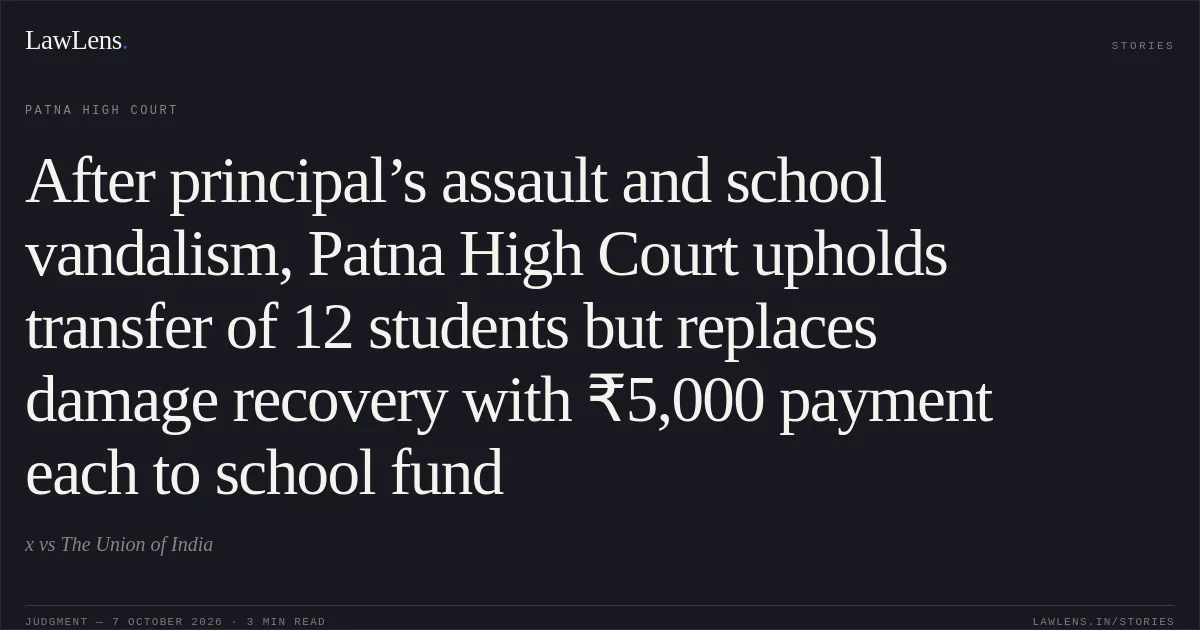
The Court upheld the issuance of transfer certificates and declined to interfere with that aspect of the orders.
It modified the recovery direction: the apportioned recovery of the assessed damage was not sustained, but, as an equitable measure, each petitioner’s parents were directed to deposit ₹5,000 in the school welfare fund when accepting the transfer certificate; this was expressly not an affirmation of the original assessment or apportionment.
Source reference: paras. 47–48, p. 26The District Magistrate was directed to examine whether the petitioners could be accommodated at a nearby Jawahar Navodaya Vidyalaya, subject to applicable rules and seat availability, and to take lawful steps to minimise disruption to their education.
Source reference: para. 49, pp. 26–27The petition was disposed of with that modification and without an order as to costs.
Source reference: paras. 50–52, p. 27Original Court PDF
xvsThe Union of India
Click to open original judgment
Original judgment, available to read, download and summarize on LawLens.in