Facts
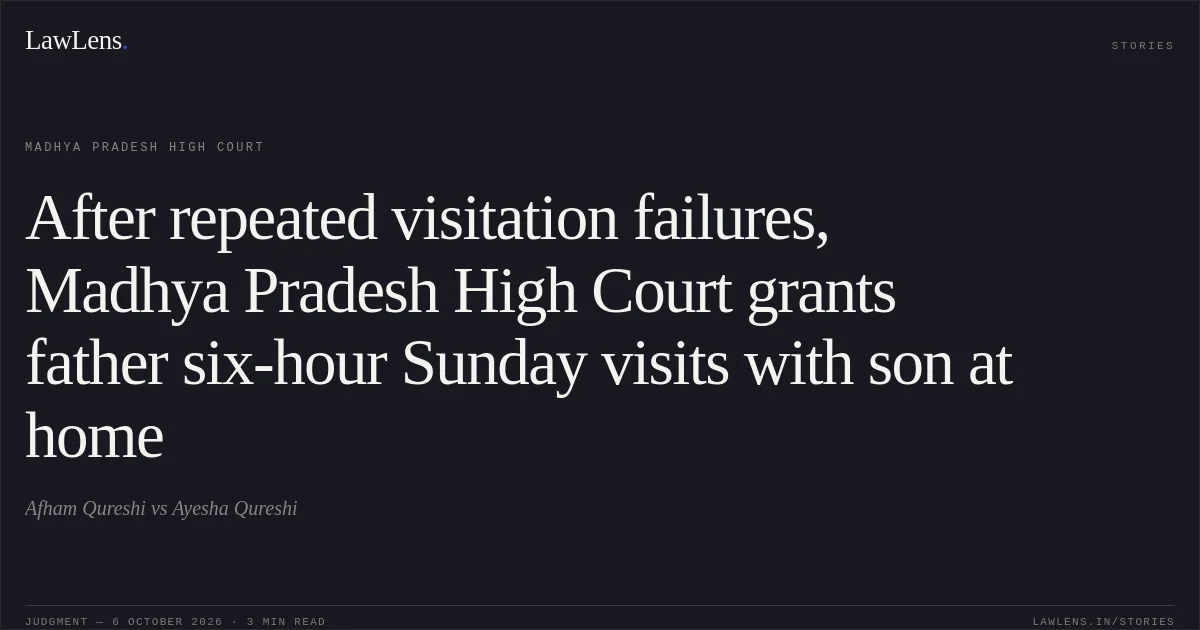
The applicant-father sought visitation with his minor son, Azlan, under a series of orders made by the Family Court and the High Court.
Source reference: para. 2–6Although the Family Court’s order of 19 August 2025 provided for regular visitation, the father alleged that the respondent-mother repeatedly failed to produce the child or facilitate the ordered interaction; the Family Court recorded non-compliance and imposed a fine of ₹500.
Source reference: para. 2–6, 17–18, 29The visitation arrangements were subsequently modified, including directions for meetings at the High Court premises.
Source reference: para. 19–24A Principal Registrar’s report, based on register entries and CCTV footage, stated that the mother frequently left before the allotted time and that the child often remained in her lap, limiting the father’s interaction.
Source reference: para. 19–24The mother opposed the petition, relying on safety concerns and arguing that the earlier order had been superseded by subsequent visitation directions.
Source reference: para. 14–15Issues
1. Whether the respondent’s conduct amounted to non-compliance or disobedience of the visitation orders.
Source reference: para. 172. Whether the existing visitation arrangement ensured meaningful interaction between the father and child, and, if not, what arrangement would best serve the child’s welfare.
Source reference: para. 37, 43Law Applied
Section 10 of the Contempt of Courts Act, 1971 confers on a High Court jurisdiction over contempt of subordinate courts, while Section 12 prescribes the available punishment.
Source reference: para. 48The Court applied the principle that a child’s welfare is paramount in custody and visitation matters, and that meaningful contact with both parents should ordinarily be preserved; visitation must be structured to support a genuine parent-child relationship rather than amount to a merely formal meeting.
Source reference: para. 26, 33–41It relied on Ashish Ranjan v. Anupam Tandon for the primacy of child welfare, Yashita Sahu v. State of Rajasthan and Amyra Dwivedi (Minor) v. Abhinav Dwivedi for meaningful visitation and a child-friendly setting, and Geeta Vohra v. Nitin Chopra for the principle that a party should not disregard a court order as inconvenient instead of seeking its modification.
Source reference: para. 31–33, 39–40The Court also referred to Debarati Bhunia in rejecting the tender-years doctrine as an automatic basis for preferring maternal care.
Source reference: para. 34–35Reasoning
The Court considered the repeated difficulties in implementing visitation, the Family Court’s record of non-compliance, and the Principal Registrar’s report that the father’s interaction was curtailed despite the child being brought to the venue.
Source reference: para. 27–29, 36It concluded that compliance required more than formally producing the child: the mother had to facilitate meaningful, uninterrupted contact.
Source reference: para. 37, 53At the same time, because the child’s welfare—not punishment of either parent—was paramount, the Court found that contempt punishment would serve no useful purpose at that stage.
Source reference: para. 49, 57It instead replaced the ineffective arrangement with structured, safeguarded visitation in a natural setting, while preserving the mother’s custody and leaving the final custody question to the Family Court.
Source reference: para. 50–52, 58Holding
The petition was disposed of without substantive punishment for contempt; the respondent was cautioned that future deliberate obstruction may invite action.
The father was granted Sunday visitation from 11:00 a.m. to 5:00 p.m. at his residence, with a lady Advocate appointed as Commissioner to collect and return the child; travel time was excluded, and the order provided for extension where pickup was delayed.
Source reference: para. 51(i)The Court also directed arrangements for missed visits, transport, child-friendly activities, daily telephone or video calls, and non-interference by the mother, while requiring the father to maintain appropriate conduct and return the child on time.
Source reference: para. 51(ii)–(xvii)The arrangement was expressly made subject to later orders of the Family Court and was not a final determination of custody.
Source reference: para. 52, 58Acts & Sections Cited
5 provisions across 3 statutes referred to in this judgment. Each provision opens on LawLens.
Contempt of Courts Act, 19712
Code of Civil Procedure, 19081
Original Court PDF
Afham QureshivsAyesha Qureshi
Click to open original judgment
Original judgment, available to read, download and summarize on LawLens.in