01Facts
The applicant sought to quash the charge-sheet dated 31 August 2025, the cognizance and summoning order dated 19 November 2025, and the proceedings in Criminal Case No. 765 of 2025, arising from an FIR alleging offences under Sections 85, 115(2), 351(2), 352 and 123 of the Bharatiya Nyaya Sanhita, 2023, and Sections 3/4 of the Dowry Prohibition Act, 1961.
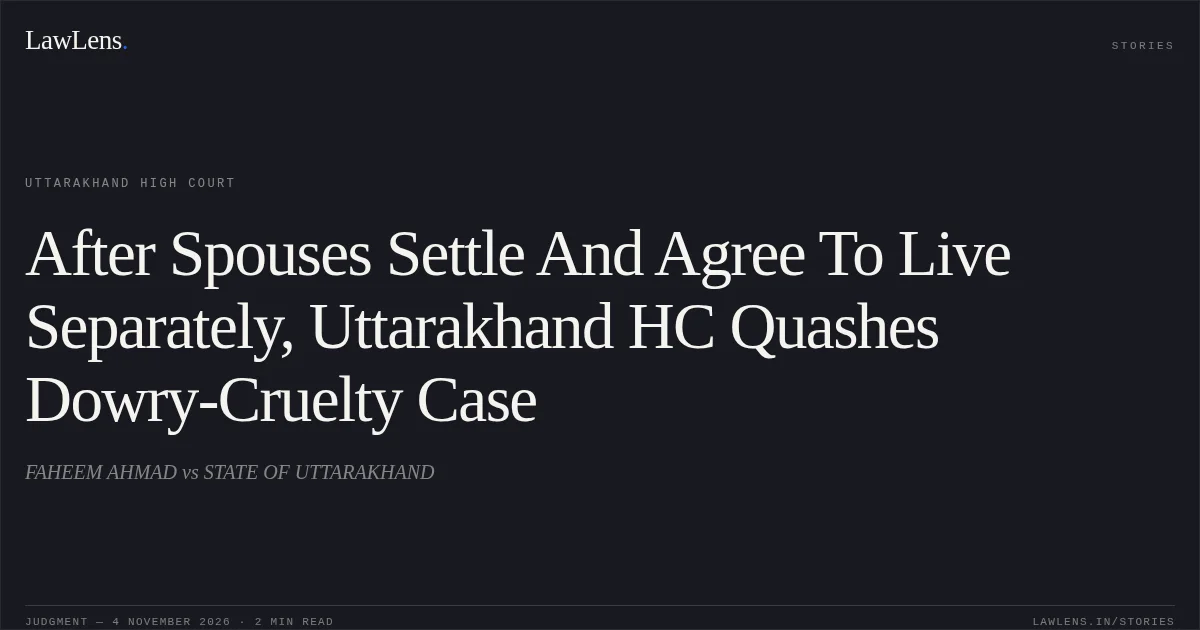
¶ 2The applicant and respondents 2 and 3 filed a compounding application supported by affidavits, stating that they had amicably settled their dispute and did not wish to continue the criminal proceedings.
¶ 3After interacting with the parties, the Court recorded that they had voluntarily agreed to live separately and initiate proceedings for dissolution of their marriage by mutual consent under the Uniform Civil Code.
¶ 5, 8The State opposed the compounding application.
¶ 602Issues
i.Whether the Court should exercise its inherent jurisdiction under Section 528 of the BNSS to quash the criminal proceedings in light of the parties’ settlement.
¶ 9–11ii.Whether the settlement was voluntary and whether continuation of the proceedings would serve a useful purpose or advance the ends of justice.
¶ 8–1103Law Applied
Section 528 of the Bharatiya Nagarik Suraksha Sanhita, 2023, empowers the High Court to exercise inherent jurisdiction to secure the ends of justice.
¶ 10Under Gian Singh v. State of Punjab, (2012) 10 SCC 303; Narinder Singh v. State of Punjab, (2014) 6 SCC 466; and State of Madhya Pradesh v. Laxmi Narayan, (2019) 5 SCC 688, a settlement does not by itself justify quashing criminal proceedings. The Court must independently consider the nature and gravity of the offences, the circumstances giving rise to the dispute, and whether quashing would secure the ends of justice.
¶ 10Provisions in the judgment · 8 · Linked ones open on LawLens
Bharatiya Nagarik Suraksha Sanhita, 2023 Section 528
Bharatiya Nyaya Sanhita, 2023 Section 85Section 115Section 351Section 352Section 123
04Reasoning
The Court confirmed through its interaction with the parties that the settlement was voluntary and free from coercion, pressure or undue influence, and that respondents 2 and 3 unequivocally no longer wished to pursue the case.
¶ 7–8Applying the principles in the cited authorities, the Court considered the nature and circumstances of the dispute, the allegations, and the settlement, and concluded that continuing the proceedings would serve no fruitful purpose or advance the ends of justice.
¶ 9–11Although the State opposed the application, the Court found that quashing was warranted under Section 528.
¶ 6, 1105Holding
The Court allowed the compounding application and, exercising its inherent jurisdiction under Section 528 of the BNSS, quashed the charge-sheet, the cognizance and summoning order, and the entire proceedings in Criminal Case No. 765 of 2025 arising from FIR No. 205 of 2025.
¶ 12The criminal miscellaneous application and any pending applications were disposed of accordingly.
¶ 13–14Original Court PDF
FAHEEM AHMADvsSTATE OF UTTARAKHAND
Click to open original judgment
Original judgment, available to read, download and summarize on LawLens.in