Facts
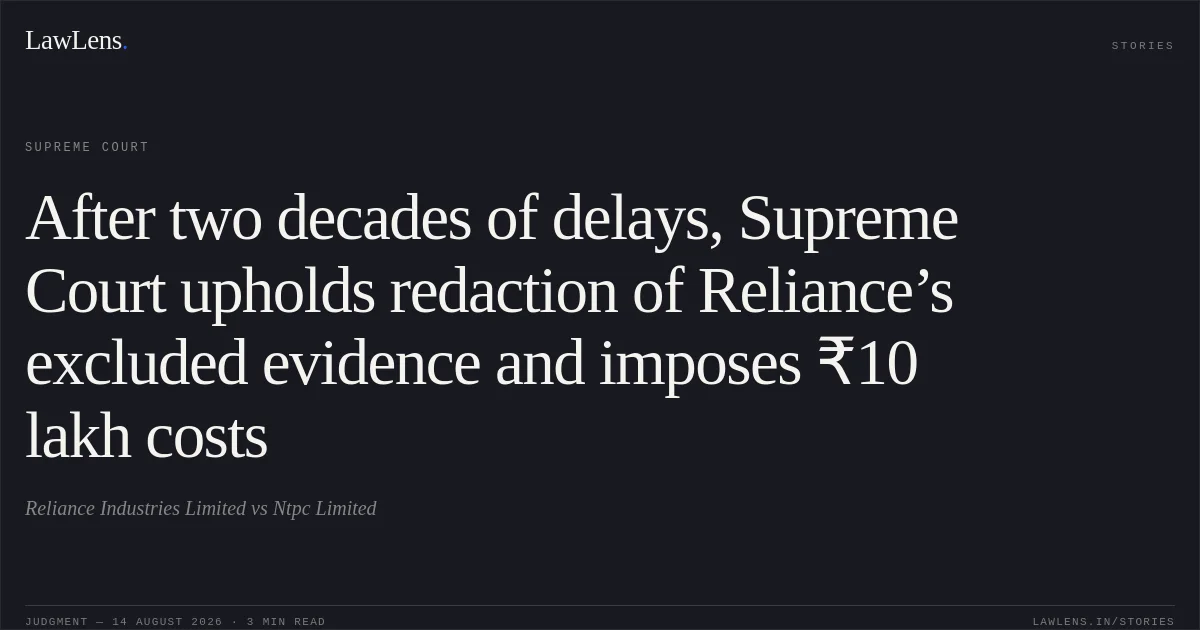
NTPC invited bids for the supply of natural gas, pursuant to which it issued a Letter of Intent (“LOI”) to Reliance Industries Limited (“RIL”), subject to negotiation and finalisation of a Gas Sale and Purchase Agreement. NTPC subsequently instituted a suit seeking a declaration that the LOI constituted a binding contract and for specific performance of the proposed supply arrangement.
Source reference: paras. 3–4During the prolonged trial, RIL unsuccessfully sought discovery and inspection of NTPC’s internal documents; the courts held such documents irrelevant to determining whether a concluded contract existed.
Source reference: paras. 6–7RIL later sought to introduce its own internal documents through its witness’s examination-in-chief affidavits, but the High Court refused their production, and the challenge to that order was withdrawn.
Source reference: paras. 8–10After RIL filed a second evidence affidavit, the High Court redacted portions of both affidavits that referred to the contents of internal emails, correspondence, and meetings previously held inadmissible, while retaining testimony concerning the witness’s personal perception, state of mind, and facts independently observed by him.
Source reference: paras. 11, 16–18In 2019, the Supreme Court held that oral evidence could not be used indirectly to introduce the contents of documents already excluded from evidence, although evidence that a meeting occurred or that discussions took place was not necessarily barred.
Source reference: paras. 13–15RIL challenged the High Court’s subsequent redaction order dated 22 August 2024 in the present appeal.
Source reference: paras. 16–20Issues
1. Whether the High Court correctly applied the Supreme Court’s earlier judgment by redacting portions of RIL’s examination-in-chief affidavits that sought to introduce, directly or indirectly, the contents of internal documents and correspondence already held inadmissible
Source reference: paras. 13–202. Whether RIL could reopen the question of admissibility by relying on Section 60 of the Indian Evidence Act, 1872, and asserting that its witness had personal knowledge of the internal meetings and communications
Source reference: para. 203. Whether the appeal warranted interference in view of the prolonged delay in the underlying commercial suit and the binding effect of the prior orders
Source reference: paras. 14, 21–23Law Applied
The Court applied the principle of finality and binding effect of judicial orders: once the earlier orders holding the internal documents irrelevant and refusing their production had attained finality, the trial court and parties could not circumvent them during the evidence stage.
Source reference: paras. 13–15It further applied the rule that a party cannot introduce, through oral testimony, the contents of documents that have been excluded from evidence; doing so would amount to an impermissible indirect reopening of the earlier decision.
Source reference: paras. 13–15Section 60 of the Indian Evidence Act, 1872, which generally requires oral evidence to be direct, could not be invoked to override the binding prior orders or to admit testimony concerning the contents of excluded documents.
Source reference: para. 20However, testimony based on the witness’s own perception, state of mind, or independently observed facts—such as the fact that discussions occurred or that a meeting was held—could remain admissible, provided it did not reproduce the substance of the excluded documents or communications.
Source reference: paras. 13–18Reasoning
The Supreme Court found that the High Court had undertaken a paragraph-by-paragraph examination rather than mechanically redacting the affidavits.
Source reference: para. 16It properly removed references to internal emails, internal correspondence, and summaries of meetings where those portions attempted to place the contents or substance of excluded documents before the court by oral evidence.
Source reference: para. 16At the same time, the High Court retained portions recording the witness’s perception of external correspondence, his state of mind, and facts personally observed by him, consistently with the limited qualification recognised in the Supreme Court’s 2019 judgment.
Source reference: paras. 16–18RIL’s reliance on Section 60 was therefore insufficient, as it sought to revisit an issue already conclusively determined between the parties.
Source reference: para. 20The Court also considered the litigation history, noting that repeated interlocutory challenges had delayed a suit pending since 2005/2006 and that permitting further reopening would frustrate the binding directions previously issued.
Source reference: paras. 21–22Holding
The appeal was dismissed.
The Court upheld the High Court’s redaction order, holding that the High Court had correctly implemented the Supreme Court’s earlier mandate and had neither exceeded its jurisdiction nor misapplied the law.
Source reference: paras. 19–20The High Court was directed to take up and dispose of the underlying commercial suit as expeditiously as possible.
Source reference: para. 22Costs of ₹10 lakh were imposed on RIL, payable to the Supreme Court Advocates-on-Record Association within five weeks.
Source reference: para. 23Acts & Sections Cited
1 provisions across 1 statute referred to in this judgment. Linked provisions open on LawLens.
Indian Evidence Act, 18721
Original Court PDF
Reliance Industries LimitedvsNtpc Limited
Click to open original judgment
Original judgment, available to read, download and summarize on LawLens.in