Facts
The appellant, Kuldeep Singh Sengar, was convicted by the Trial Court for offences involving a minor victim under the POCSO Act.
Source reference: p. 2During the pendency of his appeal, the victim filed an application (CRL.M.A. 21475/2025) seeking to lead additional evidence regarding her date of birth
Source reference: p. 2Specifically, she requested the court to summon a birth certificate from A.B.S. Public School and re-examine school officials to conclusively establish her age as a minor at the time of the offence
Source reference: p. 3The CBI contended that all relevant school records, including the admission register (Ex.PW3/2) stating her DOB as 17.08.2001, had already been proved during the trial
Source reference: p. 4-5The Trial Court had previously relied on these records and the testimony of the Principal (PW-3) and Assistant Teacher (PW-4) to conclude the victim was a minor
Source reference: para 13-14Issues
1. Whether the victim/survivor should be permitted to lead additional evidence at the appellate stage to produce a birth certificate from the school when the admission register was already exhibited during trial.
Source reference: p. 3 / para 4-62. Whether a fresh inquiry into the victim's age is warranted under Section 94 of the Juvenile Justice (Care and Protection of Children) Act, 2015, given the existing evidence.
Source reference: p. 13-14 / para 18-21Law Applied
The court applied Section 94 of the Juvenile Justice (Care and Protection of Children) Act, 2015, which mandates a statutory hierarchy for age determination: first, the school date of birth certificate or matriculation certificate; second, the municipal/panchayat birth certificate; and third, only in the absence of the former, a medical ossification test
Source reference: p. 13-14Jarnail Singh v. State of Haryana, which held that the JJ Act procedure applies to determine the age of victims of crime
Source reference: p. 15State of Uttar Pradesh v. Anurudh, which clarified that age determination is a matter of evidence and appreciation best suited for the Trial Court, and that a victim cannot claim "juvenility" at any stage in the same manner as an offender
Source reference: p. 19-20Reasoning
The Court observed that the Principal of the school (PW-3) had already provided a handwritten letter (Ex.PW3/4) during the trial, stating that no birth certificate was ever submitted at the time of the victim's admission as it was not the practice then
Source reference: p. 10-12The Trial Court had conducted an extensive analysis of the school’s admission register (D-16), corroborated by the handwriting of PW-4, and concluded the victim was a minor
Source reference: para 12-13The High Court reasoned that since the document sought (the birth certificate) is evidently non-existent or unavailable with the school, calling for it would result in a "roving inquiry"
Source reference: p. 20Furthermore, per Anurudh, while an offender can claim juvenility at any stage, the age of a victim is central to the trial's foundation and should be set at rest during the trial stage to avoid vitiating the correct legal framework
Source reference: p. 18-19Holding
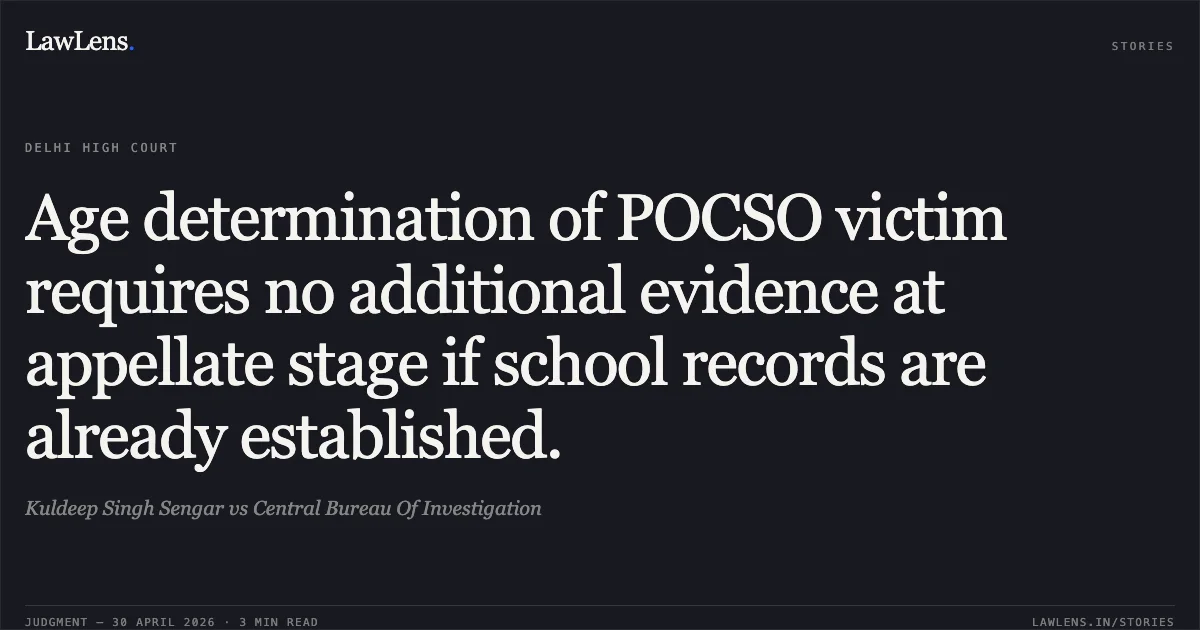
The High Court dismissed the application (CRL.M.A. 21475/2025), holding that no useful purpose would be served by calling for non-existent documents when the Trial Court had already reached a conclusion based on valid evidence
The Court held that the appeal would be heard based on the existing trial record
Source reference: para 24The matter was listed for final hearing on May 25, 2026, considering the appellant's prolonged custody
Source reference: para 27Acts & Sections Cited
6 provisions across 3 statutes referred to in this judgment. Each provision opens on LawLens.
Protection of Children from Sexual Offences Act, 20121
Juvenile Justice (Care and Protection of Children) Act, 2015.4
Indian Penal Code, 18601
Original Court PDF
Kuldeep Singh SengarvsCentral Bureau Of Investigation
Click to open original judgment
Original judgment, available to read, download and summarize on LawLens.in


