Facts
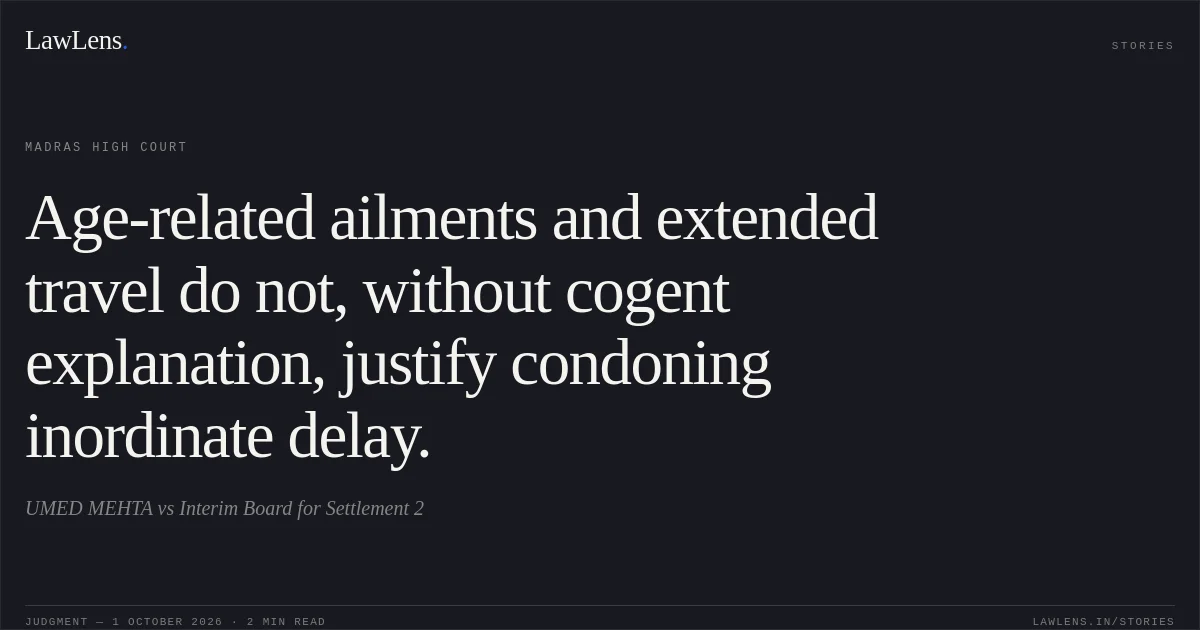
Umed Mehta sought condonation of a 739-day delay in filing a writ appeal against the Single Judge’s order dated 20 March 2024 in W.P. No. 7212 of 2024.
Source reference: p. 2, para. 1He attributed the delay to age-related ailments, including sciatica and osteoarthritis, and stated that he went abroad in June 2024, returned in December 2025, and thereafter contacted an advocate before filing the appeal in April 2026.
Source reference: p. 2, para. 2The Court considered the condonation application under Section 5 of the Limitation Act.
Source reference: p. 2, para. 1Issues
Whether the appellant established sufficient cause under Section 5 of the Limitation Act to condone the 739-day delay in filing the writ appeal.
Source reference: pp. 2, 6, paras. 1, 4–5Law Applied
Section 5 of the Limitation Act permits condonation only where sufficient cause for the delay is established.
Source reference: no citationThe Court relied on Karnataka Power Corporation Ltd. v. K. Thangappan, (2006) 4 SCC 322, for the principle that delay and laches are relevant and that discretion must be exercised judicially and reasonably.
Source reference: p. 3, para. 3(i)It also applied Shivamma v. Karnataka Housing Board, 2025 INSC 1104, and Thirunagalingam v. Lingeswaran, 2025 INSC 672: the length of delay matters; the court must first assess the bona fides and sufficiency of the explanation, and delay should not be condoned merely to advance substantial justice or as an act of generosity.
Source reference: pp. 4–5, paras. 3(ii)–(iii)Reasoning
The Court assessed the explanation for the entire 739-day delay against the requirement of bona fide and sufficient cause.
Source reference: pp. 2, 6, paras. 2, 4It held that the assertions concerning the appellant’s ailments, age, and travel abroad did not provide valid and cogent reasons sufficient to explain the delay.
Source reference: pp. 2, 6, paras. 2, 4Applying the cited authorities, the Court declined to treat the delay as automatically condonable in the interests of substantial justice.
Source reference: pp. 4–6, paras. 3–4Holding
The Court answered the issue in the negative, holding that sufficient cause had not been shown to condone the 739-day delay.
It dismissed the application for condonation and consequently rejected the writ appeal at the registry stage; there was no order as to costs.
Source reference: p. 6, para. 5Acts & Sections Cited
1 provisions across 1 statute referred to in this judgment. Each provision opens on LawLens.
Limitation Act, 19631
Original Court PDF
UMED MEHTAvsInterim Board for Settlement 2
Click to open original judgment
Original judgment, available to read, download and summarize on LawLens.in