Facts
The petitioner, a rice mill, challenged a notice dated 10 December 2013 issued by the District Certificate Officer, Bettiah, under Section 7 of the Bihar and Orissa Public Demands Recovery Act, 1914 (“PDR Act”), seeking recovery of ₹24,61,057, and a subsequent Form No. 17 notice dated 5 January 2016.
Source reference: para. 1The petitioner alleged defects in the certificate proceedings, including deficiencies in Form No. 1, non-compliance with the prescribed procedure, absence of proper enquiry, and that the amount was not recoverable as a public demand.
Source reference: para. 8While the writ petition was pending, the parties informed the Court that the Supreme Court was considering similar issues in SLP No. 16909 of 2016.
Source reference: para. 2After disposal of that matter, the respondents relied upon the Supreme Court’s decision in Pawapuri Rice Mills v. Bihar State Food and Civil Supplies Corporation Ltd. & Ors., 2024 SCC OnLine SC 3777, and sought disposal of the writ petition in accordance with that judgment.
Source reference: para. 3The petitioner submitted that the certificate case was still pending before the Certificate Officer.
Source reference: para. 4Issues
Whether the High Court should examine, in writ jurisdiction, the petitioner’s objections concerning procedural irregularities and the validity of the certificate proceedings under the PDR Act when statutory remedies are available?
Source reference: paras. 7–9Whether the petitioner should be permitted to raise objections before the Certificate Officer under Section 9 of the PDR Act, notwithstanding the pendency of the writ petition and any limitation objection?
Source reference: paras. 6, 11–12Whether coercive action should be taken against the petitioner during the period granted for availing the statutory remedy?
Source reference: para. 13Law Applied
The Court applied the PDR Act, 1914, particularly Section 9, which enables the certificate-debtor to file objections before the Certificate Officer.
Source reference: para. 11It relied on the Supreme Court’s decision in Pawapuri Rice Mills v. Bihar State Food and Civil Supplies Corporation Ltd. & Ors., 2024 SCC OnLine SC 3777, which held that the PDR Act is a comprehensive statutory framework providing safeguards and remedies in certificate proceedings, including remedies under Sections 43 and 44 before the civil court and appellate, revisional, and review remedies under Sections 60, 62 and 63.
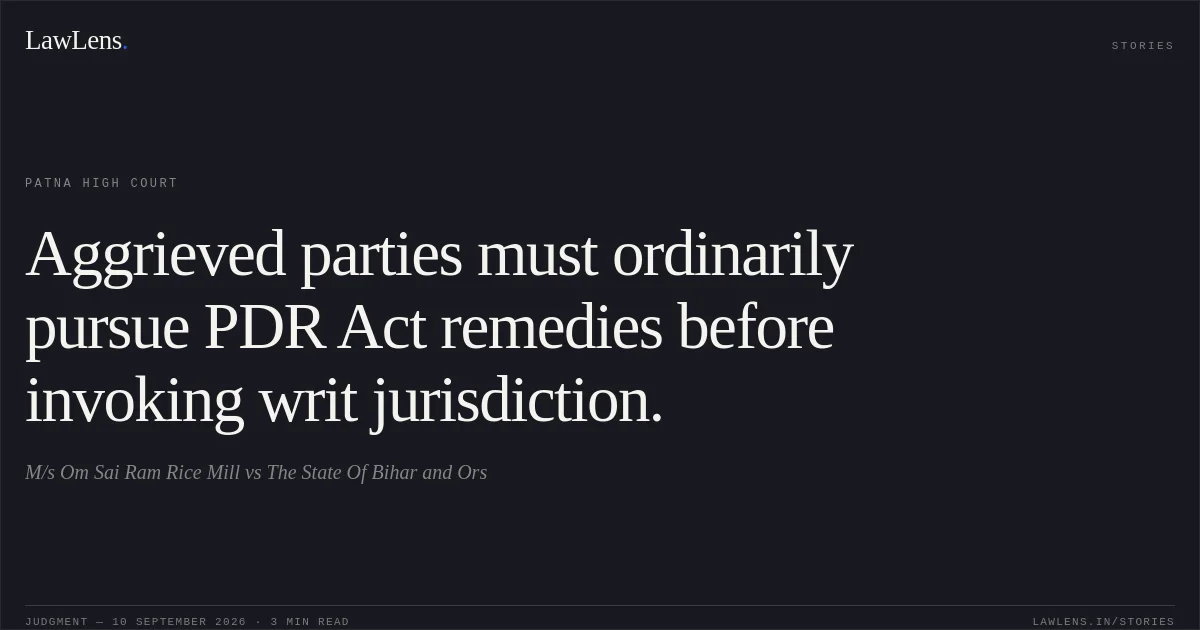
Source reference: para. 6The governing principle is that where an efficacious statutory remedy exists, a party should ordinarily pursue that remedy rather than invoke the extraordinary writ jurisdiction, particularly where the challenge involves disputed facts or alleged procedural irregularities.
Source reference: para. 7The Supreme Court had further permitted similarly situated rice millers to avail statutory remedies within thirty days and directed that such remedies be entertained without reference to limitation.
Source reference: para. 6Reasoning
The petitioner’s grounds concerned alleged procedural defects in the certificate proceedings and the disputed question whether the claimed amount constituted a public demand.
Source reference: para. 8Applying Pawapuri Rice Mills, the High Court held that such issues should ordinarily be examined by the statutory authorities under the PDR Act and not in the first instance through writ jurisdiction.
Source reference: para. 9Since the certificate case remained pending before the Certificate Officer, the petitioner could effectively raise all relevant objections under Section 9.
Source reference: para. 10Accordingly, the Court declined to express any opinion on the merits and granted the petitioner a fresh opportunity to pursue the statutory remedy.
Source reference: paras. 10–12To preserve the efficacy of that remedy, the Court directed that the objections be entertained without an objection based on delay, considered after hearing the parties, and decided by a reasoned and speaking order.
Source reference: paras. 10–12Holding
The writ petition was disposed of without adjudicating the merits of the petitioner’s challenge.
The petitioner was granted liberty to file objections under Section 9 of the PDR Act, along with supporting documents, before the concerned Certificate Officer within one month from receipt or communication of the order.
Source reference: para. 11If filed within that period, the objections were to be entertained and decided in accordance with law by a reasoned order after granting the parties an opportunity of hearing.
Source reference: para. 12No coercive steps were to be taken in the certificate proceeding during that period, subject to the petitioner availing the statutory remedy within the prescribed one-month period.
Source reference: para. 13Any pending interlocutory application was also disposed of.
Source reference: para. 15Acts & Sections Cited
7 provisions across 1 statute referred to in this judgment. Linked provisions open on LawLens.
Bihar and Orissa Public Demands Recovery Act, 19147
Original Court PDF
M/s Om Sai Ram Rice MillvsThe State Of Bihar and Ors
Click to open original judgment
Original judgment, available to read, download and summarize on LawLens.in